
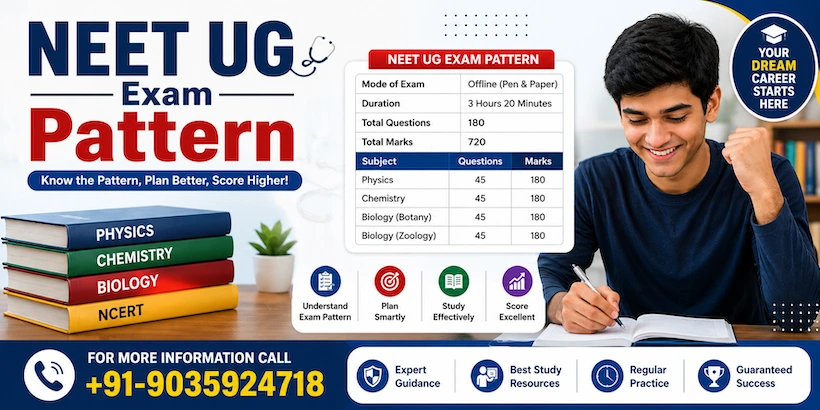
| In this article, we explore the complete NEET UG 2026 Exam Pattern, including exam mode, duration, language options, question types, marking scheme, and paper structure. Understanding the latest NEET 2026 exam format will help candidates prepare effectively, improve time management, and boost their chances of securing admission to top MBBS and BDS colleges in India. |
The NEET 2026 exam pattern will be released by NTA through the official information bulletin. The exam will be conducted in offline (pen-and-paper) mode with a duration of 3 hours 20 minutes. Understanding the latest NEET UG exam pattern, marking scheme, question distribution, and section-wise format is essential for effective preparation for MBBS and BDS admission through NEET 2026.. Good luck with your preparation.
NEET UG Exam Pattern 2026 Quick Overview
Check the latest NEET UG 2026 Exam Pattern, including exam mode, paper format, duration, language options, question types, and marking scheme to plan your preparation effectively.
| Particulars | Details |
|---|---|
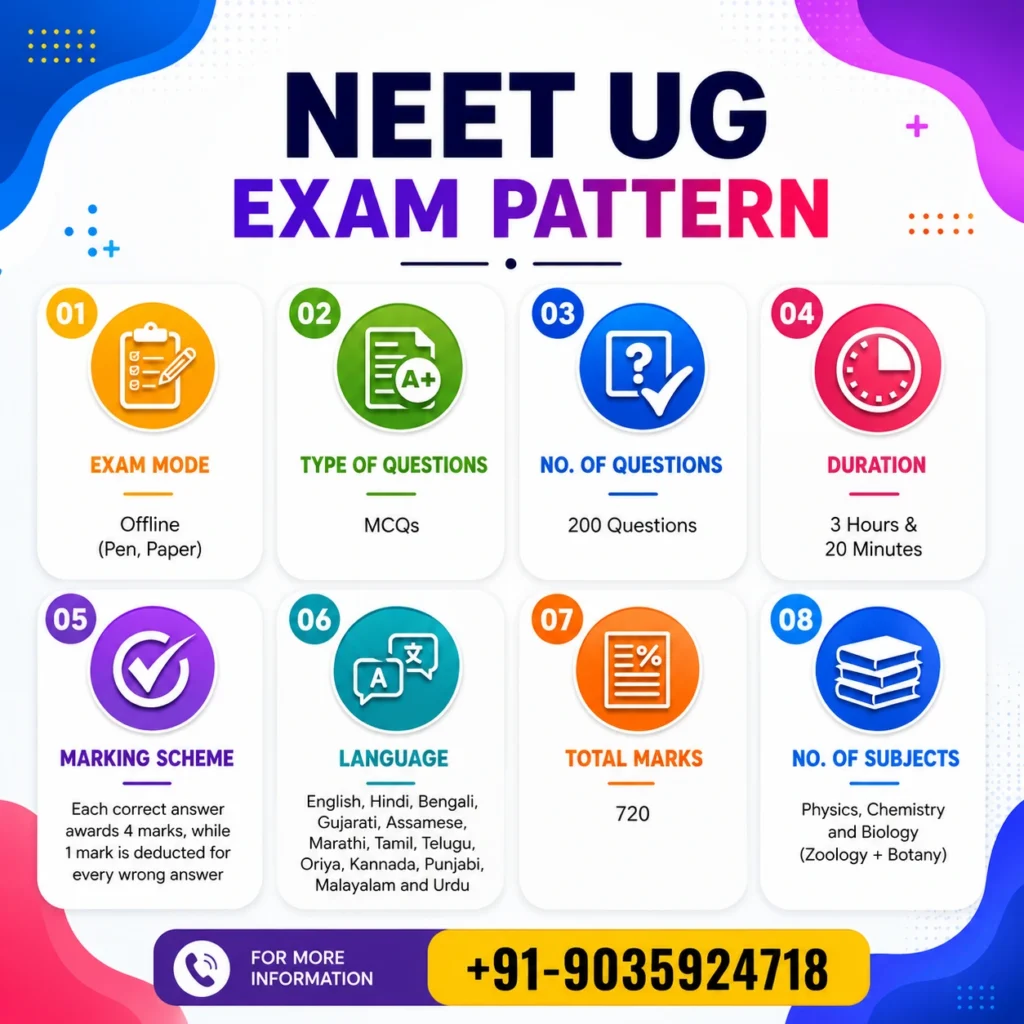
| Mode of the Examination | Offline (Pen-and-Paper Based) |
| Duration of the Examination | 3 hours (180 minutes) |
| Exam Timing | 2:00 PM to 5:00 PM (IST) |
| Type of Questions | Multiple Choice Questions (MCQs) |
| Total Number of Questions | 180 |
| Total Marks | 720 |
| Negative Marking | Yes |
| Marking Scheme | +4 for each correct answer -1 for each incorrect answer 0 for unattempted questions |
| Total Sections in the Question Paper | 4 (45 questions from each subject) |
| NEET Subjects | Physics, Chemistry, Biology (Botany + Zoology) |
| Medium of Question Paper | 13 Languages – English, Hindi, Urdu, Bengali, Assamese, Odia, Punjabi, Marathi, Gujarati, Kannada, Tamil, Telugu, Malayalam |
NEET UG Question Paper Pattern 2026
The NEET UG Exam Pattern consists of Section A and Section B for each subject. Section A includes 35 compulsory questions, while Section B contains 15 questions, out of which candidates must answer any 10. Understanding the latest NEET 2026 question paper pattern, marking scheme, and section-wise format is essential for students preparing for MBBS, BDS, and other medical courses through NEET UG.
| Subject | Section | No. of Questions | Section-wise Marks |
|---|---|---|---|
| Physics | Section A | 35 | 140 |
| Physics | Section B | 15 | 40 |
| Chemistry | Section A | 35 | 140 |
| Chemistry | Section B | 15 | 40 |
| Botany | Section A | 35 | 140 |
| Botany | Section B | 15 | 40 |
| Zoology | Section A | 35 | 140 |
| Zoology | Section B | 15 | 40 |
| Total | 180 | 720 |
NEET UG Marking Scheme 2026
The important points to note:
- ✅ Correct Answer – Each correct answer earns +4 marks.
- ❌ Incorrect Answer – For every wrong answer, 1 mark is deducted (–1).
- 🔄 Multiple Correct Options (After Key Challenge) – If more than one option is found correct, any of the correct options marked will be awarded +4 marks.
- 🗑️ Dropped Question – If a question is cancelled/ignored, all candidates receive +4 marks, regardless of whether they attempted it.
- ❓ Unanswered / Unattempted – No marks (0) for questions left blank.
- 🎯 Choosing the Best Option – Candidates must select the single best/correct answer for each question.
Check out the marking scheme given below for a better idea of NEET Marks distribution.
| Particulars | Marks Allotted |
|---|---|
| Correct Answer | +4 |
| Incorrect answer | -1 |
| No answer / Multiple answers | 0 |
Guidelines for Choosing the Language
NEET UG 2026 offers candidates the option to choose from 13 language mediums, making the exam more accessible across India. However, the availability of regional languages depends on the selected NEET exam centre location. Understanding the NEET 2026 language options and exam centre-wise language availability helps candidates choose the most comfortable medium for better performance in the medical entrance exam.
- Candidates must carefully select the question paper language while filling out the NEET UG application form, as the chosen medium cannot be changed later.
- Students opting for English will receive the question paper only in the English language.
- Candidates choosing Hindi will be provided with a bilingual question paper in both Hindi and English.
- Those selecting any regional language will receive a bilingual test booklet in their chosen regional language along with English.
- If there is any discrepancy or confusion in the translated version of a question, the English version will be considered final.
- The decision of the National Testing Agency (NTA) regarding language interpretation and translation-related issues will be final and binding on all candidates.
Regional Languages available for NEET UG 2026
Candidates who qualify NEET UG 2026 can participate in All India Quota (AIQ), State Quota, and institutional counselling, regardless of the language medium chosen for the exam, provided they meet the prescribed eligibility criteria.
| S.No | Medium of Question Paper | Examination Centres |
|---|---|---|
| 1 | English | All Examination Centres |
| 2 | English and Hindi | All Examination Centres in India |
| 3 | English and Assamese | Examination Centres in Assam |
| 4 | English and Bengali | Examination Centres in West Bengal, Tripura and Andaman & Nicobar Islands |
| 5 | English and Gujarati | Examination Centres in Gujarat, Daman and Diu, Dadra and Nagar Haveli |
| 6 | English and Kannada | Examination Centres in Karnataka |
| 7 | English and Malayalam | Examination Centres in Kerala and Lakshadweep |
| 8 | English and Marathi | Examination Centres in Maharashtra |
| 9 | English and Odia | Examination Centres in Odisha |
| 10 | English and Punjabi | Examination Centres in Punjab, Chandigarh and Delhi |
| 11 | English and Tamil | Examination Centres in Tamil Nadu, Puducherry and Andaman & Nicobar Islands |
| 12 | English and Telugu | Examination Centres in Andhra Pradesh and Telangana |
| 13 | English and Urdu | All Examination Centres in India |
How to calculate the NEET UG score after the exam?
Using the NEET UG Answer Key 2026, candidates can estimate their probable score before the result is declared. By applying the official NEET marking scheme, students can calculate their expected marks, predict their rank, and assess their chances of securing admission to top MBBS, BDS, and medical colleges through NEET UG counselling.
Formula to calculate NEET score:
NEET Score = (Correct answers X 4) – (Incorrect answers X 1)
The NEET UG exam pattern shared here is based on the latest available exam structure. Any official changes announced by NTA regarding the NEET 2026 paper pattern, marking scheme, or question format will be updated promptly to help candidates stay informed and prepare effectively.
NEET Paper Analysis for Physics
- The most important topic which carries maximum weightage.
- Second, you can give importance to Electrodynamics, expecting almost 9-10 questions.
- Physics is the most difficult section of the NEET exam.
- Most of the questions involve calculations, so practice for quick solving and time-saving.
Important Topics for Physics
- Electrodynamics
- Wave Optics
- Semi-Conductors
- Modern Physics
- Rigid Body Dynamics
- KTG & Thermodynamics
NEET Paper Analysis for Chemistry
- Chemistry is viewed as a moderately difficult section of the paper.
- After years of analysis from our experts, application-based questions have increased in number.
- In NEET 2026, it seems that more questions were asked from the class XII syllabus.
- Organic Chemistry has gradually gained more prominence than Inorganic Chemistry; expect 16-17 questions from Organic Chemistry in the paper.
Important Topics for Chemistry
- Chemical Bonding
- Coordination Compounds
- Carbonyl Compounds
- Organic Chemistry- I
NEET Paper Analysis for Biology
- Biology is comparatively easier than chemistry and physics.
- The paper includes 45 questions, each from both Botany and Zoology.
- In NEET 2026, it seems that more questions were asked from the class XII syllabus, almost 46 out of 90.
- Major questions were asked from NCERT, so students should study and focus more time on that instead of reference books.
Important Topics for Biology
- Plant Anatomy
- Pollination
- DNA Replication
- Photosynthesis
- PAGE Theory
- Endocrine System
- Excretory and Nervous System
- Digestive System
NEET UG Exam Pattern 2026 FAQs:
Q. What is the latest NEET UG exam pattern 2026?
A. NEET UG 2026 will be conducted in offline (pen-and-paper) mode. The exam includes Physics, Chemistry, and Biology questions with a prescribed marking scheme and time duration set by NTA.
Q. How many total questions are there in NEET UG 2026?
A. The NEET UG 2026 question paper is expected to contain a total of 200 questions, out of which candidates need to attempt the specified number as per the official exam pattern.
Q. What is the marking scheme for NEET UG 2026?
A. For every correct answer, candidates are awarded 4 marks, while 1 mark is deducted for each incorrect response. No marks are given for unanswered questions.
Q. In which languages is NEET UG 2026 available?
A. NEET UG 2026 is expected to be conducted in 13 languages, including English, Hindi, Tamil, Telugu, Bengali, Marathi, Gujarati, Kannada, Malayalam, Punjabi, Assamese, Odia, and Urdu.
Q. What type of questions are asked in NEET UG 2026?
A. NEET UG 2026 consists of objective-type multiple-choice questions (MCQs) from Physics, Chemistry, Botany, and Zoology based on the prescribed syllabus.
Q. What is the duration of the NEET UG 2026 examination?
A. The NEET UG 2026 exam duration is expected to be 3 hours and 20 minutes, allowing candidates sufficient time to complete the paper.
Q. Is there any negative marking in NEET UG 2026?
A. Yes, NEET UG 2026 follows a negative marking system. One mark is deducted for every incorrect answer, while correct answers receive four marks.
| Disclaimer: The information shared here is collected from multiple reliable sources for educational and informational purposes. While we strive to provide accurate and updated details, some information may change over time. If you notice any incorrect data or discrepancies, please contact us at mbbsenquiry1[@]gmail.com so our team can review and update the information accordingly. Read More |