
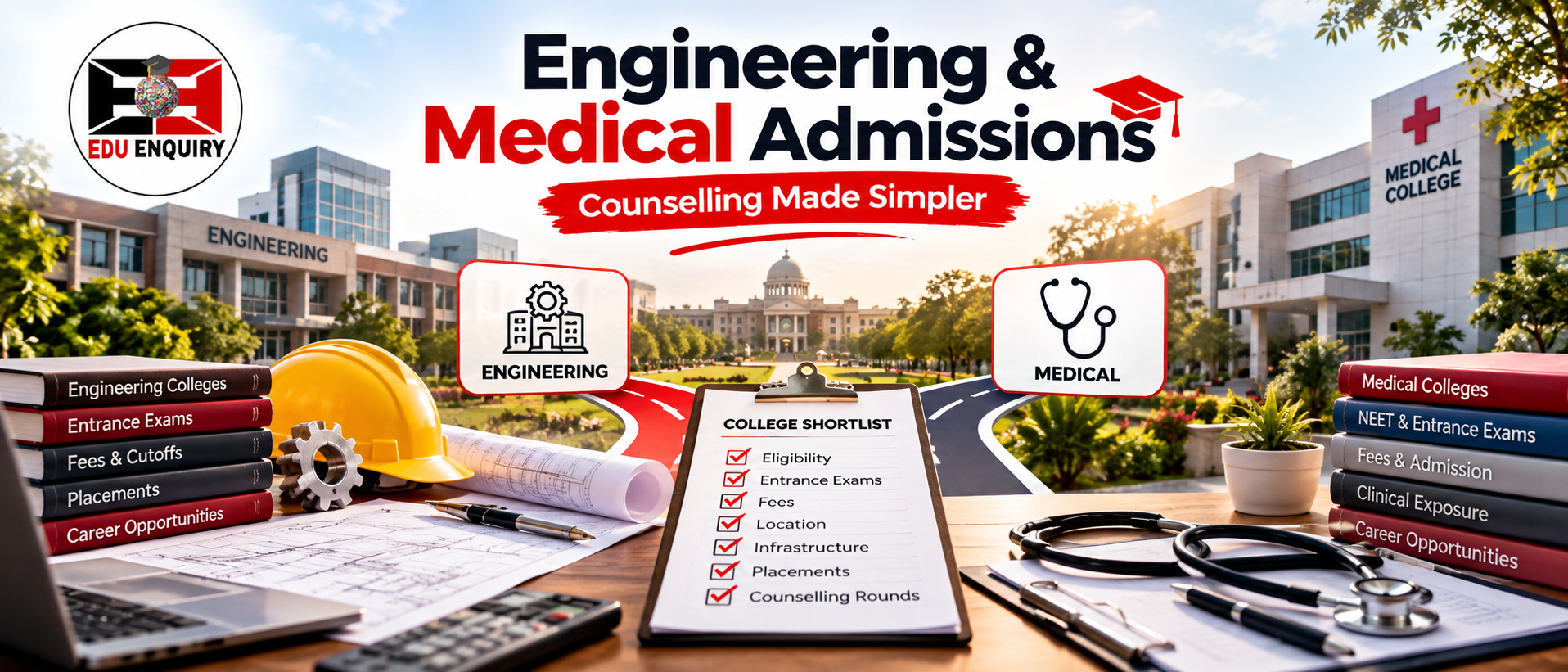
Choosing a college after an entrance exam can feel confusing. Students often have many colleges, courses, quotas, fees, and admission rules to compare. This is where engineering and medical admissions counselling can simplify the process. Counselling helps students understand their options and complete key admission steps in the right order.
After receiving an entrance exam result, students need to make several decisions. They may need to select colleges, arrange preferences, check eligibility, submit documents, and participate in seat allotment. Missing an important deadline or entering choices without proper research can affect the admission process. Counselling provides a structured way to approach these decisions. It can help students compare courses, understand seat categories, review college options, and make informed choices based on their rank and eligibility.
However, students should still research each college carefully before making a final decision. In this blog, we’ll cover how counselling can simplify college selection, choice filling, seat allotment, admission deadlines, and other key steps in engineering and medical admissions.

What Is Counselling in Engineering and Medical Admissions?
Counselling is the process through which eligible students apply for available seats in colleges and courses after an entrance examination or qualifying process. Depending on the admission system, counselling may be conducted at national, state, or institutional levels.
During counselling, students may need to:
- Register on the official counselling portal
- Verify their eligibility
- Submit required documents
- Select preferred colleges and courses
- Arrange choices in a specific order
- Participate in seat allotment
- Accept, upgrade, or reject an allotted seat
- Complete fee payment and admission formalities
The exact process can vary between engineering and medical courses. Therefore, students should always check the applicable admission rules and official notifications.
Why Is Counselling Important for College Selection?
The college search can become complicated when students have dozens of possible options. Counselling brings the process into a more organised structure. Instead of looking at colleges randomly, students can create a list based on their entrance rank, eligibility, preferred course, location, fees, and other priorities.
Counselling can also help students understand how seat allotment works. A student may not receive the first preference but could receive another option from the submitted list. Understanding this process can help students prepare realistic choices rather than relying only on assumptions.
How Can Counselling Simplify Your College Search?
1. Helps You Understand Your Available Options
After an entrance exam, students may be unsure about which colleges they can realistically consider. Counselling information can help students identify institutions and courses available according to their eligibility, rank, category, and admission route. This makes the initial college search more focused.
2. Makes College Comparison Easier
Students should compare colleges before filling in their preferences.
Important factors may include:
- Course availability
- College location
- Tuition fees
- Hostel facilities
- Infrastructure
- Faculty
- Clinical or practical exposure
- Placement opportunities
- Accreditation and recognition
- Previous admission trends
A structured comparison can help students understand the differences between their options.
3. Helps With Choice Filling
Choice filling is an important part of many counselling processes. Students usually need to arrange colleges and courses according to their preferences. This requires careful planning.
A useful approach is to divide choices into different groups:
- Highly preferred options
- Realistic options
- Safer options
Students should not select a college simply because it has a popular name. The course, fees, location, facilities, and personal career goals should also be considered.
4. Provides Information About Seat Allotment
Seat allotment can be difficult to understand for students experiencing the process for the first time. Counselling systems generally use factors such as rank, eligibility, preferences, seat availability, and applicable reservation rules to determine allotment.
Students should understand what happens after a seat is allotted. Depending on the counselling system, they may have options relating to acceptance, reporting, or participating in subsequent rounds. Reading the official counselling instructions carefully is therefore essential.
5. Helps Students Track Important Deadlines
Engineering and medical admissions involve several deadlines.
These may include:
- Registration deadlines
- Choice-filling dates
- Document verification
- Seat allotment results
- Fee payment
- Reporting dates
- Upgradation rounds
Missing a deadline can create unnecessary problems. Students should maintain a simple admission calendar and check official notifications regularly.
What Makes a Good Counselling Choice?
There is no single college that is suitable for every student. A sensible counselling choice generally combines several factors:
Suitable course + realistic admission chances + affordable fees + recognised college + preferred location + good facilities + suitable career prospects
Students should consider these factors together rather than choosing a college based only on its name or previous cut-off.
For example, a college with a lower previous cut-off may still be unsuitable if its fees are beyond the student’s budget or the course does not match their career plans. Similarly, a highly preferred college may not be a realistic option based on the student’s rank.
The goal of counselling is therefore not simply to find a college. It is to find a suitable combination of course, college, affordability, eligibility, and career objectives.
What Should You Consider Before Filling Counselling Choices?
Students should avoid filling in choices without proper research.
Before selecting a college, consider the following:
Course and Career Goals
First, understand whether the course matches your long-term interests and career plans.
Fees and Expenses
Look beyond tuition fees. Consider hostel costs, transportation, examination fees, equipment, books, and other expenses.
Location
The location can affect living costs, travel, accessibility, and overall student experience.
College Facilities
For MBBS in Maharashtra, students may consider hospital facilities, clinical exposure, laboratories, and practical training. For engineering courses, laboratories, technical facilities, industry exposure, and placement-related information may be relevant.
Recognition and Accreditation
Students should verify that the institution and course meet the applicable regulatory and recognition requirements.
Admission Trends
Previous cut-offs and seat-allotment trends can provide useful context. However, they should not be treated as guarantees for future admission.

Common Mistakes to Avoid During Counselling
Counselling becomes easier when students avoid common errors.
Some mistakes include:
- Filling choices without researching colleges
- Ignoring the fee structure
- Choosing only highly competitive colleges
- Missing registration deadlines
- Entering preferences randomly
- Failing to check eligibility
- Uploading incorrect documents
- Ignoring official counselling instructions
- Assuming previous-year cut-offs will remain unchanged
- Waiting until the final day to complete important steps
Students should carefully review every detail before submitting their choices.
How Can Students Prepare for Counselling?
Good preparation can make the process more manageable. Start by collecting important documents and checking their validity. Then, create a list of suitable colleges and compare them using consistent criteria.
Students can also create a preference sheet containing:
- College name
- Course
- Location
- Fees
- Previous cut-off information
- Seat category
- Hostel availability
- Personal preference
This simple system can make the choice-filling process more organised. Furthermore, students should monitor official counselling websites for updates. Admission schedules can change, so relying on old information may confuse.
Engineering and Medical Counselling: What Is the Difference?
Engineering and medical counselling follow different admission systems and rules. Engineering admissions may involve entrance examinations such as JEE and state-level examinations, depending on the course and institution. Medical admissions commonly involve NEET-based admission routes for relevant undergraduate medical and allied courses.
The counselling authority, eligibility requirements, seat categories, participating institutions, and procedures can differ. Therefore, students should not assume that the counselling process for engineering and medical admissions is identical.
How Can Counselling Help Parents and Students?
The admission process can be stressful for both students and parents. A structured counselling process provides a clear sequence of tasks. It helps families focus on realistic options instead of comparing every college available.
Understand Rank → Check Eligibility → Compare Colleges → Review Fees → Discuss Preferences → Fill Choices → Track Allotment → Complete Admission
This simple process can make college selection more organised. Students can understand their options, compare suitable colleges, review the fee structure, and arrange their preferences before submitting choices.
However, counselling should support research rather than replace it. Students and parents should check official information, compare costs, understand admission conditions, and discuss preferences before making important decisions.
Furthermore, keeping documents ready and tracking counselling deadlines can help avoid last-minute confusion. A clear plan can make the journey from entrance results to final admission easier to manage.
Final Note
Engineering and medical admissions counselling can make the college search more organised by bringing important decisions into a structured process. It helps students understand available options, compare colleges, arrange preferences, follow seat allotment, and track important admission deadlines.
However, counselling should always be supported by independent research. Students should consider course suitability, fees, location, facilities, recognition, and long-term career plans before finalising their choices.
For students looking for admission updates, counselling information, college details, and guidance related to engineering and MBBS admissions, they can rely on us at MDMSenquiry. To learn more about us, visit our website today.
Frequently Asked Questions
Counselling is an important part of many entrance-based admission systems. The exact requirement depends on the course, examination, institution, and admission authority. Students should check the relevant official admission guidelines.
Compare colleges based on your rank, eligibility, preferred course, fees, location, facilities, recognition, career objectives, and other personal priorities. Arrange your choices according to your genuine preferences.
This depends on the counselling authority and the particular counselling round. Some systems provide a period for modifying or locking choices, while others may restrict changes after submission. Always check the official schedule.
Requirements vary by course and counselling authority. Common documents may include entrance exam details, academic certificates, identity proof, photographs, category certificates where applicable, and other admission documents.
Read the instructions issued by the counselling authority carefully. You may need to pay the required fee, confirm your acceptance, complete reporting formalities, or participate in another round if permitted. Do not miss the stated deadline.