
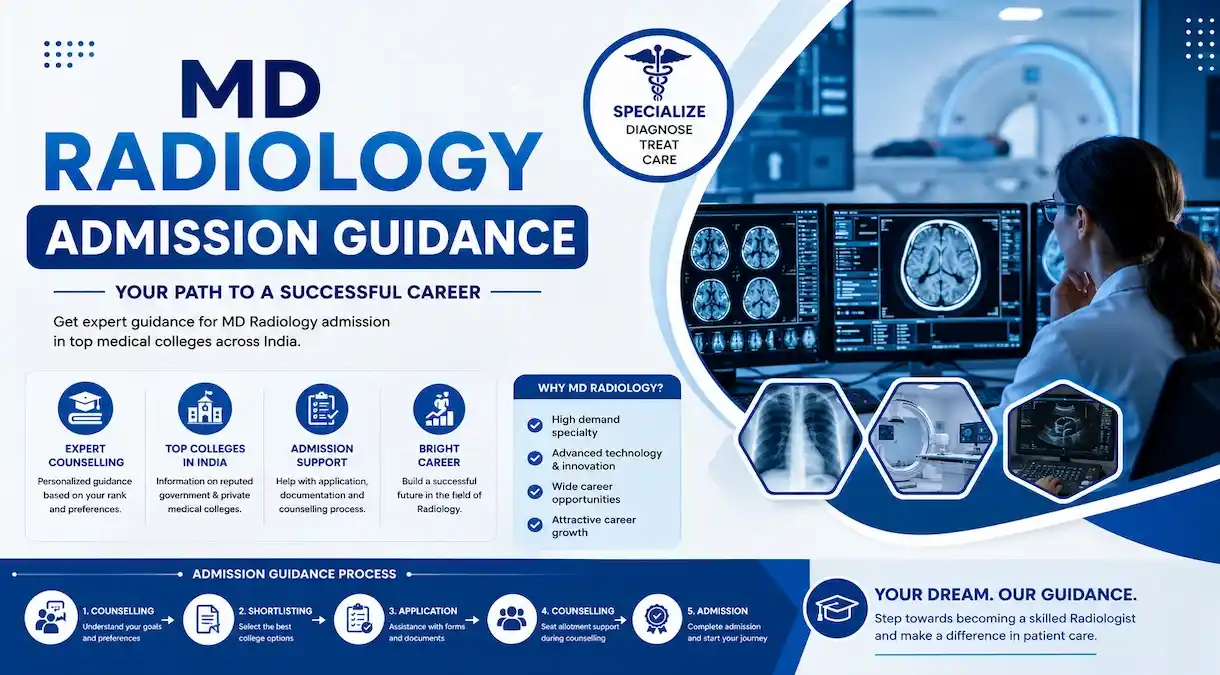
| In this article, you will find MD Radiology Admission Guidance and course Information Details – State-wise Seats matrix in Government/ Private institutions, Colleges Ranking, Radiology Tuition Fees 2026, NEET PG closing score cutoff. |
MD Radiology is a three-year postgraduate medical program focused on diagnosing and treating diseases through medical imaging techniques like X-rays, MRI, CT scans, and ultrasounds. Radiologists play a critical role in modern healthcare by interpreting imaging results and assisting in accurate diagnosis, helping guide treatment plans.
For MD Radiology admission, candidates must hold an MBBS degree with at least 50% marks from an MCI-recognized university and qualify for the relevant entrance exam. Leading medical institutions like AIIMS Delhi, PGIMER Chandigarh, JIPMER Puducherry, CMC Vellore, KMC Manipal are currently accepting applications for this program. If you aspire to pursue a career in Radiology, now is the time to apply.
To get admission, applicants must clear the NEET PG exam conducted by the National Board of Educations (NBE) or the Autonomous INI CET Exam, conducted by the All India Institute of Medical Sciences, Delhi. The MD Radiology course is a three-year postgraduate program offered in both public and private medical colleges. MD radiology programs are offered by 126 government and 209 private medical colleges in India. There are 2,777 seats available in 335 government/private medical colleges and hospitals. The Best MD Radiology Medical Colleges in India are AIIMS Delhi, PGIMER Chandigarh, JIPMER Puducherry, CMC Vellore, BHU Varanasi, KMC Manipal, DY Patil Vidyapeeth Pune, Madras Medical College etc.
Radiologists are in high demand due to advancements in medical imaging, increasing diagnostic needs, and the rise in chronic diseases. With expanding healthcare services, they play a crucial role, leading to strong job prospects and competitive salaries. This article provides information about admission, eligibility criteria, and career opportunities. Interested candidates can inquire or seek admission guidance through our website.
MD Radiology Course 2026 Quick Summary
Before we go on to complete the course overview, let us have a look at the major details of MD Radiology course.
| Course Name | Doctor of Medicine in Radiology |
|---|---|
| Generally Known as | MD Radiology |
| Course Level | MD Clinical (Postgraduate) |
| Duration | 3 years (Regular) |
| Stream | Medicine |
| Examination Type | Semester/Yearly System |
| Eligibility | MBBS degree recognized by the National Medical Commission (NMC) |
| Admission Process | Based on the results of the entrance examination (NEET) or personal interview in some cases |
| MD Radiology Colleges | Govt Colleges – 126 Pvt Colleges – 209 |
| MD Radiology Seats | Govt Seats – 1059 Pvt Seats – 1718 |
| Entrance Exam | NEET PG INI CET (AIIMS PG, PGIMER, JIPMER PG) |
| Average Course Tuition Fee | GOVT. Quota Fees: ₹1150/Year – ₹10325200/Year MNGT Quota Fees: ₹181910/Year – ₹12825200/Year NRI Quota Fees: $26317/Year – ₹16015000/Year |
| Average Starting Salary | INR 2 to 12 Lakhs |
| Top Recruiting Companies | Healthcare environments, including hospitals, physician practices, integrative healthcare clinics, public health clinics, college health centers, natural apothecaries, and settings that care for military veterans. |
What is MD in Radiology?
MD Radiology is a postgraduate medical degree that specializes in medical imaging and diagnostic procedures. Below are the key points:
- Course Focus: Specializes in diagnostic imaging techniques such as X-rays, MRI, CT scans, ultrasounds, and nuclear medicine.
- Duration: The program typically lasts for 3 years.
- Eligibility: Requires an MBBS degree from an MCI-recognized university and a qualifying score in the NEET PG exam.
- Core Subjects: Includes diagnostic radiology, interventional radiology, radiation safety, and advanced imaging technologies.
- Skills Developed: Interpretation of medical images, performing minimally invasive procedures, and ensuring radiation safety.
- Career Opportunities: Radiologists work in hospitals, diagnostic centers, research institutes, or academic settings.
- Role in Medicine: Plays a critical role in diagnosing diseases, guiding treatment plans, and monitoring patient progress.
MD Radiology Course Objectives
MD Radiology Course Objectives include the following key points:
- Mastery of Diagnostic Imaging: Gain proficiency in using various imaging technologies such as X-ray, CT, MRI, ultrasound, and nuclear medicine to diagnose diseases.
- Interpretation of Medical Images: Develop the ability to accurately interpret and analyze medical images for diagnosing a wide range of health conditions.
- Radiological Procedures: Learn to perform and guide interventional radiological procedures like biopsies, angiograms, and other minimally invasive treatments.
- Management of Radiological Equipment: Acquire the skills to operate and maintain complex radiological equipment, ensuring patient safety and optimal results.
- Radiation Safety: Understand and apply radiation protection measures to minimize exposure risks to patients, medical staff, and self.
- Collaborative Care: Work closely with other healthcare professionals to provide comprehensive patient care, using imaging techniques for treatment planning and monitoring.
- Research and Innovation: Engage in research to contribute to advancements in radiological science and stay updated with evolving technologies.
- Patient Communication: Develop the ability to effectively communicate findings with patients and medical teams, ensuring informed clinical decisions.
MD Radiology Course Duration
MD Radiology Course Duration typically follows these key points:
- Total Duration: The MD Radiology course spans 3 years.
- Academic Structure: The 3-year duration is divided into 6 semesters, each lasting approximately 6 months.
- Clinical Training: Throughout the course, students undergo rigorous clinical training, which includes hands-on practice in diagnostic and interventional radiology.
- Examinations: Periodic theoretical and practical exams are conducted after each semester to assess the progress of the candidates.
- Internship/Residency: Some programs may incorporate clinical residency rotations in various specialties of radiology to provide comprehensive exposure.
- Research Component: During the course, students are often required to complete a dissertation or research project in a specific area of radiology.
- Final Examination: At the end of the 3 years, candidates must clear a final examination, which includes both theoretical and practical assessments, to qualify for the MD degree.
The duration of the course is 2 years for those who have completed a recognized postgraduate diploma in the same specialty.
MD Radiology Admission Eligibility Criteria
MD Radiology Admission Eligibility Criteria typically include the following key points:
- MBBS Degree: Candidates must possess an MBBS degree from a medical college recognized by the Medical Council of India (MCI) or the National Medical Commission (NMC).
- Minimum Marks: Applicants are usually required to have secured at least 50% aggregate marks in their MBBS degree (subject to variations based on institution).
- Internship Completion: Candidates must have completed a 1-year compulsory rotating internship by the time of admission.
- NEET-PG Qualification: Candidates must qualify for the National Eligibility cum Entrance Test for Postgraduate (NEET-PG) with the required cutoff marks.
- Medical Registration: It is mandatory to be registered with the Medical Council of India (MCI) or a state medical council to be eligible for admission.
- Category-Based Relaxation: Relaxation in the qualifying criteria, such as minimum marks and NEET-PG cutoff, may be available for reserved category candidates (SC/ST/OBC/EWS), depending on the institution.
- Additional Requirements: Some institutions may conduct their own interviews or counseling sessions based on the NEET-PG score as part of the admission process.
MD Radiology Admission Process
MD Radiology Admission Process typically involves the following steps:
| Stage | What Candidates Need to Do |
|---|---|
| NEET PG | Qualify for NEET PG for MD Radiology admission |
| Counselling Registration | Register with MCC or the concerned state authority. |
| Fee Payment | Pay the applicable counselling fee and security deposit. |
| Choice Filling | Select preferred MD Radiology colleges and courses. |
| Choice Locking | Review and lock choices before the deadline. |
| Seat Allotment | Seat allotted based on rank, choices and availability. |
| Document Verification | Verify NEET PG, academic and internship documents. |
| Fee Payment | Pay college fees to confirm the allotted seat |
| College Reporting | Report to the allotted college within the given timeline. |
| Upgradation | Apply for a better preferred seat in subsequent rounds. |
| Final Admission | Complete joining formalities and start MD Radiology |
This process ensures that candidates are allotted seats based on merit and their preferred colleges and courses.
State-wise MD Radiology Seat Distribution
MD Radiology/ Radiodiagnosis seats are available across 30+ states and union territories. Here are the top states by seat availability:
| State | Total Colleges | Total Seats |
|---|---|---|
| Karnataka | 56 | 471 |
| Maharashtra | 51 | 401 |
| Uttar Pradesh | 44 | 303 |
| Tamil Nadu | 44 | 291 |
| Andhra Pradesh | 29 | 237 |
| Telangana | 31 | 230 |
| Rajasthan | 16 | 191 |
| Gujarat | 23 | 186 |
| Madhya Pradesh | 17 | 159 |
| Delhi | 9 | 117 |
| Kerala | 26 | 101 |
| West Bengal | 16 | 84 |
| Bihar | 14 | 72 |
| Odisha | 8 | 60 |
| Haryana | 9 | 59 |
Quota Wise MD Radiology 2025 Closing Score Cut off
Different counselling authorities conduct admissions through various quotas. Here are the MD Radiology opening and closing scores from NEET PG 2025:
| Quota | Counselling Authority | Opening Score | Closing Score |
|---|---|---|---|
| AIQ | All India Counselling | 201 | 695 |
| SQ | State Counselling | 9 | 785 |
| MNQ | Deemed Universities | 232 | 587 |
| MQ | Management Counselling | 66 | 632 |
| NRI | NRI Counselling | 29 | 545 |
| DUQ | Delhi University | 586 | 643 |
| IPQ | Indraprastha University | 360 | 650 |
| OPMQ | Open Management | 49 | 638 |
| BHQ | Banaras Hindu University | 590 | 615 |
| AMU | Aligarh Muslim University | 603 | 616 |
| OPQ | Central Universities | 333 | 398 |
All India Quota Category-wise MD Radiology Cut-offs 2025
MD Radiology NEET PG 2025 Round-1 MCC Counselling closing scores for different reservation categories:
| Category | 2025 Cut-off Score | Seats Allotted |
|---|---|---|
| GN (General) | 678 | 191 |
| EWS | 675 | 38 |
| OBC | 673 | 122 |
| ST | 644 | 31 |
| SC | 639 | 74 |
| GN-PH | 535 | 13 |
| OBC-PH | 470 | 7 |
| EWS-PH | 447 | 4 |
| SC-PH | 455 | 3 |
| ST-PH | 315 | 2 |
MD Radiology Category wise AIQ Round 1 Cutoff 2025 (Closing Rank & Marks)
| State | OPEN (R1 Closing Rank/Marks) | EWS (R1 Closing Rank/Marks) | OBC (R1 Closing Rank/Marks) | SC (R1 Closing Rank/Marks) | ST (R1 Closing Rank/Marks) |
|---|---|---|---|---|---|
| Andhra Pradesh | 2020 / 611 | 1770 / 614 | 2145 / 610 | 7727 / 567 | 14433 / 536 |
| Assam | 2920 / 601 | – | 3775 / 593 | 7731 / 567 | 6126 / 576 |
| Bihar | 1743 / 615 | 1961 / 612 | 2167 / 609 | – | 17238 / 525 |
| Chandigarh | 39 / 675 | 197 / 655 | 207 / 654 | 3356 / 597 | – |
| Chhattisgarh | – | – | 3195 / 598 | 7470 / 569 | – |
| Delhi | 187 / 655 | 163 / 657 | 283 / 650 | 1385 / 620 | 411 / 644 |
| Goa | – | 1364 / 620 | 1140 / 624 | – | 11976 / 546 |
| Gujarat | 899 / 629 | 661 / 635 | 1999 / 611 | 6023 / 577 | 5521 / 580 |
| Haryana | 402 / 645 | – | – | 5345 / 581 | 10603 / 552 |
| Himachal Pradesh | 1153 / 624 | 2524 / 605 | 2409 / 606 | 9580 / 558 | 16531 / 528 |
| Jammu & Kashmir | 1149 / 624 | 1523 / 618 | 3063 / 600 | 9941 / 556 | 9906 / 556 |
| Jharkhand | 939 / 628 | – | 1926 / 612 | – | – |
| Karnataka | 912 / 629 | 930 / 628 | 1363 / 620 | 7293 / 570 | 11250 / 550 |
| Kerala | 377 / 646 | 127 / 661 | 218 / 653 | 5048 / 583 | 13172 / 541 |
| Madhya Pradesh | 1144 / 624 | 1084 / 625 | 1731 / 615 | 7046 / 571 | 13812 / 539 |
| Maharashtra | 1262 / 622 | 2318 / 607 | 1631 / 616 | 6058 / 577 | 14953 / 534 |
| Manipur | 1126 / 625 | – | 2354 / 607 | 4009 / 591 | – |
| Meghalaya | 297 / 650 | – | – | – | – |
| Odisha | – | – | 2185 / 609 | 7572 / 568 | – |
| Punjab | 747 / 632 | – | 1583 / 616 | 7363 / 570 | 13917 / 538 |
| Rajasthan | 289 / 650 | 1471 / 619 | 1383 / 620 | 6932 / 572 | 11496 / 548 |
| Tamil Nadu | 834 / 631 | 3120 / 599 | 850 / 630 | 5955 / 577 | 8803 / 562 |
| Telangana | 1104 / 625 | 463 / 642 | 1767 / 614 | 5145 / 582 | 10392 / 553 |
| Tripura | 1797 / 614 | 3138 / 599 | – | – | – |
| Uttar Pradesh | 673 / 635 | 1121 / 625 | 1895 / 612 | 4917 / 584 | 9448 / 558 |
| West Bengal | 1260 / 622 | 4586 / 587 | 3936 / 592 | 3432 / 596 | 12858 / 542 |
Top 15 Preferred Colleges for MD Radiology 2025 AIQ
Below is a list of medical colleges in India for MD Radiology ranked based on candidate preferences during NEET PG 2025 AIQ counselling:
| Rank | College | State | District | Type |
|---|---|---|---|---|
| 1 | VMMC & Safdarjung Hospital | Delhi | South Delhi | Govt-State |
| 2 | Seth GS Medical College | Maharashtra | Mumbai City | Govt-State |
| 3 | Maulana Azad Medical College | Delhi | New Delhi | Govt-State |
| 4 | SGPGIMS | Uttar Pradesh | Lucknow | Govt-State |
| 5 | Lady Hardinge Medical College | Delhi | New Delhi | Govt-State |
| 6 | Govt Medical College Thiruvananthapuram | Kerala | Thiruvananthapuram | Govt-State |
| 7 | Govt Medical College Kozhikkode | Kerala | Kozhikode | Govt-State |
| 8 | Madras Govt Medical College | Tamil Nadu | Chennai | Govt-State |
| 9 | PGIMER Delhi | Delhi | New Delhi | Govt-State |
| 10 | Govt Medical College Kottayam | Kerala | Kottayam | Govt-State |
| 11 | University College of Medical Sciences | Delhi | North East Delhi | Govt-State |
| 12 | Patna Medical College | Bihar | Patna | Govt-State |
| 13 | IMS BHU | Uttar Pradesh | Varanasi | Govt-Deemed |
| 14 | Govt Medical College Chandigarh | Chandigarh | Chandigarh | Govt-State |
| 15 | Lokmanya Tilak Medical College Mumbai | Maharashtra | Mumbai City | Govt-State |
Documents Required for MD Radiology Admission in India
- NEET PG Scorecard
- MBBS degree certificate and mark sheets
- Internship completion certificate
- MCI or State Medical Council registration certificate
- Identity proof (Aadhaar card, passport, etc.)
- Caste or category certificate (if applicable)
- Passport-sized photographs
MD Radiology Course Syllabus
Key Subjects Covered:
- Cardiovascular imaging
- Gastrointestinal radiology
- Radiation oncology
- Pediatric Radiology
- Neuroradiology
- Breast imaging
Syllabus of Radiology as prescribed by various Universities and Colleges.
| Semester I | Semester III |
| Medical Radiation Physics as applied to Radio–Diagnosis | Musculoskeletal System |
| Production of X- rays: | Respiratory System |
| Interaction of radiation with matter | Cardiovascular System |
| Radiography | Gastrointestinal System |
| Semester III | Semester IV |
| Fluoroscopy | Urogenital tract |
| Special Radiography | CNS Including Spine |
| Interaction of radiation with matter | Imaging of Obstetrics & Gynaecology |
| Nuclear Medicine | Radiopharmaceuticals |
| Semester V | Semester VI |
| Radiation Biology | Radiation protection |
| Guidelines for safe work practice | Ultrasonogram |
| MRI | Endocrine System |
MD Radiology Career Opportunities
MD Radiology opens up a wide range of career opportunities in both clinical and non-clinical areas. Radiologists are in demand in hospitals, private clinics, research, and the radiologists industry. Here are the key career opportunities available after completing MD Radiology:
- Diagnostic Radiologist: Specialize in interpreting medical images like X-rays, MRIs, and CT scans to diagnose conditions.
- Interventional Radiologist: Perform minimally invasive treatments using image guidance, such as angioplasty, stenting, and biopsies.
- Oncological Radiologist: Focus on cancer imaging for diagnosis, staging, and monitoring treatment, often working in collaboration with oncologists.
- Paediatric Radiologist: Specialize in diagnosing and treating conditions in children, where imaging techniques need special consideration.
- Neuroradiologist: Focus on imaging and diagnosis of brain, spinal cord, and nervous system disorders such as stroke or tumors.
- Musculoskeletal Radiologist: Specialize in imaging related to bones, joints, and soft tissue, often dealing with trauma or sports injuries.
- Academic Radiologist: Work in teaching hospitals or universities, contributing to research and educating future radiologists.
- Hospital Radiologist: Employed by hospitals to provide diagnostic imaging services in departments like emergency, trauma, and oncology.
- Private Practice Radiologist: Works independently or in private diagnostic centers, providing imaging services to outpatient clients.
- Tele-Radiologist: Works remotely by interpreting images sent electronically, a growing field with the expansion of telemedicine.
- Consultant Radiologist: Offers expert advice in radiology, often collaborating with other specialists to provide integrated patient care.
- Government and Military Services: Radiologists are employed in public healthcare systems, military services, and organizations like the Indian Armed Forces.
Radiologists often receive competitive salaries, and there is high demand for qualified professionals globally, especially with the growth of advanced imaging technologies.
Super-Specialization course after MD in Radiology:
After completing an MD Radiology, several super-specialization courses (also known as fellowships or DM/MCh programs) are available to further specialize in specific areas of radiology. These courses provide advanced training in niche fields. Some of the popular super-specialization options include:
| S.No. | Specialty / Fellowship | Focus Area & Description |
|---|---|---|
| 1 | DM Neuroradiology | Advanced imaging of brain, spine, and nervous system using MRI, CT, and angiography for diagnosing neurological conditions. |
| 2 | DM Interventional Radiology | Minimally invasive procedures like stenting, angioplasty, embolization, and biopsies using imaging guidance. |
| 3 | Fellowship in Oncological Imaging | Cancer imaging for diagnosis, staging, and treatment monitoring using PET-CT, MRI, and nuclear medicine. |
| 4 | Fellowship in Pediatric Radiology | Imaging for infants and children, including congenital abnormalities and developmental disorders. |
| 5 | Fellowship in Musculoskeletal Radiology | Imaging of bones, joints, muscles, and soft tissues for sports injuries and degenerative conditions. |
| 6 | Fellowship in Vascular and Interventional Radiology | Vascular interventions including catheter-based and image-guided vascular procedures. |
| 7 | Fellowship in Breast Imaging | Breast cancer detection and diagnosis via mammography, ultrasound, MRI, and biopsy techniques. |
| 8 | Fellowship in Cardiac Imaging | Imaging of heart and vascular structures using echocardiography, cardiac MRI, and CT angiography. |
| 9 | Fellowship in Abdominal Imaging | Imaging of GI tract, liver, pancreas, and abdominal organs using CT, MRI, and ultrasound. |
| 10 | Fellowship in Nuclear Medicine | Use of radioactive substances for diagnostic imaging and treatment in oncology, cardiology, and neurology. |
These super-specializations allow radiologists to gain expertise in specific areas, enhancing career prospects in academic, clinical, and research settings.
Job Prospects and Salary
MD Radiology Job Prospects:
After completing an MD in Radiology, professionals have a wide range of career opportunities in both clinical and non-clinical roles. The job prospects are diverse, and radiologists are in high demand across various healthcare settings. Some key roles include:
- Diagnostic Radiologist: Work in hospitals or diagnostic centers, interpreting medical images like X-rays, CT scans, MRIs, and ultrasounds.
- Interventional Radiologist: Specialize in minimally invasive procedures using image guidance, such as angioplasty or tumor ablation.
- Academic/Teaching Positions: Teach and conduct research in medical colleges or universities.
- Consultant Radiologist: Offer expert diagnostic services in hospitals or clinics, often in a freelance or part-time capacity.
- Tele-Radiologist: Work remotely by interpreting radiological images sent digitally from various locations.
- Researcher: Engage in research for medical advancements in imaging techniques and technologies.
- Private Practice: Own or manage diagnostic imaging centers.
MD Radiology Salary:
The salary of a radiologist depends on experience, specialization, and location. Below are general estimates:
| Experience Level | India (Per Annum) | Abroad (Per Annum) |
|---|---|---|
| Junior Radiologist / Resident | ₹8 – 12 Lakhs | $150,000 – 200,000 (USD) |
| Experienced Radiologist | ₹15 – 25 Lakhs | $250,000 – 400,000 (USD) |
| Consultant Radiologist / Private Practice | Varies (Higher based on cases, affiliations & practice volume) | Varies (Higher based on cases, affiliations & practice volume) |
Read Also: Top AIIMS Medical Colleges
Conclusion
In conclusion, pursuing an MD in Radiology offers a promising career with growing demand in the healthcare sector. Admission to the course requires candidates to hold an MBBS degree and qualify in entrance exams like NEET PG. The comprehensive training in diagnostic imaging equips graduates with essential skills, opening up diverse career opportunities in hospitals, diagnostic centers, and academic institutions. With advancements in medical technology, MD Radiology professionals are well-positioned for a dynamic and rewarding career.
Read More Articles
| MD TB & Chest | MS Orthopaedics | MS Ophthalmology |
| MD Anaesthesiology | MD Psychiatry | MD Dermatology |
| MD General Medicine | MD/MS Obstetrics and Gynaecology | MD Pediatrics |
| MS ENT | MS General Surgery |
FAQs
Q. Is MD Radiology the most competitive branch in NEET PG?
A. Yes. MD Radiology consistently ranks as the most competitive PG branch due to high demand, excellent earning potential, and limited seats across India.
Q. What is the eligibility criteria for MD Radiology admission?
A. Candidates must hold an MBBS degree with compulsory internship completion and NMC registration. Qualifying NEET PG is mandatory for all quotas, including Management and NRI.
Q. What NEET PG score is usually required for MD Radiology?
A. Government colleges require very high percentiles (often 650+), while private/management quota seats may be accessible at lower scores depending on the state and college.
Q. Can I get MD Radiology through management or NRI quota?
A. Yes. Many private and deemed universities offer MD Radiology under Management and NRI quota. These seats have different fee structures and comparatively lower cutoffs.
Q. What is the expected fee range for MD Radiology in India?
A. Fees vary widely:
- NRI quota: USD 60,000 – 1,50,000 for the full course
- Government colleges: ₹60,000 – ₹1.5 lakh per year
- Private colleges: ₹30 – ₹1.25 crore per year (depending on state)
Q. What are the career prospects after MD Radiology?
A. Radiologists get high-paying roles in diagnostic centres, hospitals, tele-radiology companies, and corporate chains. Starting salaries range between ₹18–35 LPA, increasing significantly with experience.
Is NEET-PG mandatory for MD Radiology admission?
Yes, qualifying for NEET-PG is mandatory for securing MD radiology seats in India. It serves as the primary entrance exam for both government and private medical colleges. Without a valid NEET-PG score, candidates cannot participate in counselling or seat allocation processes, regardless of their academic background or internship completion.
What are the eligibility criteria for MD Radiology?
To apply amongst the total radiology seats in India, candidates must have an MBBS degree from a recognised institution, complete a one-year compulsory rotating internship, and be registered with the National Medical Commission or a State Medical Council. Additionally, qualifying for NEET-PG is essential to become eligible for counselling and admission.
What is the duration and structure of the MD Radiology course?
An MD radiology degree is a three-year postgraduate program focused on diagnostic imaging techniques such as X-rays, CT scans, MRIs, and ultrasounds. The course includes theoretical learning, practical training, and clinical exposure, helping students develop expertise in interpreting medical images and diagnosing various health conditions accurately.
How does the admission process for MD Radiology work?
The MD radiology admission process begins with appearing for NEET-PG, followed by qualifying for the cutoff. Candidates then participate in centralised counselling, either through All India Quota or state-level counselling. Based on rank, preferences, and availability, seats are allotted, after which candidates complete document verification and admission formalities.
Are there different quota options available for admission?
Yes, radiology seats in India are offered under various quotas, including All India Quota, State Quota, Management Quota, and NRI Quota. Each category has different eligibility criteria, fee structures, and competition levels. Candidates should carefully review these options during counselling to choose the most suitable pathway for admission.