
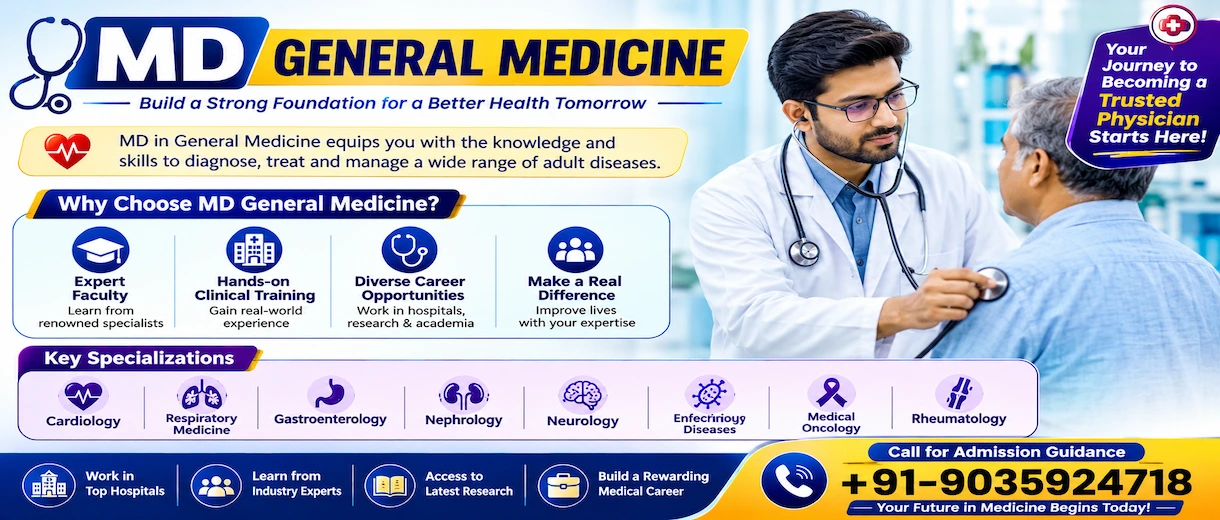
| In this article, you will find MD General Medicine Admission Guidance and Course Information Details – State wise Seats matrix in Government/ Private institutions, Colleges Ranking, Tuition Fees 2026, NEET PG closing score cut off. |
About MD General Medicine Course
MD General Medicine is a three-year postgraduate program. It trains doctors to diagnose and treat adults. The course focuses on internal medicine, clinical skills, and handling complex medical conditions. To apply for MD General Medicine, candidates must hold an MBBS degree with at least 50% marks. The MBBS must be from an MCI-recognized university, and candidates should clear the entrance exam. Top institutes like AIIMS New Delhi, PGIMER Chandigarh, CMC Vellore, and JIPMER Puducherry offer seats. Other reputed colleges include SGPGIMS Lucknow, BHU Varanasi, KMC Manipal, and MMC Chennai.
MD General Medicine Admission is mainly through NEET PG conducted by NBE, or INI CET conducted by AIIMS Delhi. The program is available in both public and private medical colleges across different states in India. The MD General Medicine course duration is three years, combining theory, practice, and patient care. It builds strong expertise in managing diseases, chronic conditions, and critical health complications. Demand for general medicine specialists is high in India and also growing across global healthcare. Graduates can work as consultants, physicians, academicians, or pursue super-specialty courses. This article provides complete details about admission, eligibility, and future career opportunities. Interested students can seek admission guidance or inquiries directly through our official website.
MD General Medicine Course 2026 Quick Summary
| Name of the course | MD General Medicine |
|---|---|
| Course Level | Postgraduate (MD CLINICAL) |
| Duration | 3 years, full-time |
| Stream | Medicine |
| Examination Type | Semester/Yearly System |
| Eligibility | MBBS degree recognized by the National Medical Commission (NMC) |
| Admission Process | Based on the results of the entrance examination (NEET PG/INI CET) |
| Entrance Exam | NEET PG, INI CET |
| Number of General Medicine Colleges | 511 (Govt – 229, Private – 282) |
| Number of General Medicine Seats | 6146 (Govt – 3020, Private – 3126) |
| Average Course Tuition Fee | GOVT. Quota Fees – ₹ 1150/Year – ₹ 7825200/Year MNGT Quota Fees – ₹ 181910/Year – ₹ 9700200/Year NRI Quota Fees – $ 26317/Year – ₹ 20000000/Year |
| Average Starting Salary | INR 2.5 to 20 Lakhs |
| Top Recruiting Companies | Fortis Healthcare, MAX Healthcare, Care Hospitals, Indian Council of Medical Research, Apollo Hospitals, Kailash Hospital, Adecco India Private Limited, Jaypee Healthcare Limited, Meditrina Hospitals Private Limited, etc. |
What is MD General Medicine?
MD in General Medicine is a postgraduate degree that focuses on diagnosing and treating a wide range of adult diseases. Here’s a point-wise overview:
- Definition: MD in General Medicine is a specialization that deals with the prevention, diagnosis, and treatment of adult diseases, focusing on non-surgical care.
- Duration: The course typically lasts for 3 years.
- Eligibility: Candidates must hold an MBBS degree from a recognized institution and qualify for the NEET PG entrance exam.
- Key Learning Areas: Internal medicine, cardiology, neurology, endocrinology, gastroenterology, pulmonology, infectious diseases, and rheumatology.
- Skills Acquired: Proficiency in diagnosing complex medical conditions, managing chronic illnesses, prescribing medication, and delivering preventive care.
- Role: A General Medicine specialist provides comprehensive healthcare to adults, manages acute and chronic conditions, and coordinates care with other specialists.
- Career Opportunities: Physician, Consultant in hospitals, Clinics, Healthcare administrators, or Academician.
- Job Sectors: Hospitals, private practices, clinics, healthcare organizations, academic institutions, and research centers.
MD in General Medicine offers a broad foundation in adult healthcare, making it one of the most versatile and in-demand specializations in the medical field.
Top 10 General Medicine Medical Colleges in India
The updated list of Best General Medicine Colleges in India is officially recognised by the National Medical Commission (NMC). To know detailed info about fee structure, Courses offered, Admission Procedure, Placement Stats, Cut-off, Facilities available and complete college review.
| S.No. | College Name | Estd | Affiliated with | MD General Medicine Seats Intake |
| 1. | Christian Medical College, Vellore | 1900 | Tamil Nadu Dr M.G.R. Medical University | 16 |
| 2. | ARMED Forces Medical College | 1948 | Maharashtra University of Health Sciences | 22 |
| 3. | Institute of Medical Sciences, Varanasi, Uttar Pradesh | 1960 | Banaras Hindu University (BHU) | 19 |
| 4. | Jawaharlal Institute of Postgraduate Medical Education And Research | 1823 | Statutory Autonomous, Puducherry | 20 |
| 5. | Madras Medical College, Chennai | 1835 | Tamil Nadu Dr MGR Medical University | 35 |
| 6. | King George’s Medical University, Lucknow | 1911 | UGC | 28 |
| 7. | Sri Ramachandra Institute of Higher Education and Research | 1985 | Sri Ramachandra University (Deemed) Chennai | 30 |
| 8. | Seth GS Medical College, Mumbai | 1926 | Maharashtra University of Health Sciences | 23 |
| 9. | Maulana Azad Medical College, Delhi | 1958 | University Of Delhi | 22 |
| 10. | Kasturba Medical College, Manipal | 1955 | Manipal Academy of Higher Education | 24 |
MD General Medicine Course Objectives
MD General Medicine Course Objectives include the following key points:
- Comprehensive Knowledge: Equip students with in-depth knowledge of internal medicine, including the pathophysiology, diagnosis, and treatment of diseases affecting adults.
- Diagnostic Skills: Develop the ability to accurately diagnose a wide range of medical conditions using clinical judgment and modern diagnostic tools.
- Clinical Expertise: Foster proficiency in managing both acute and chronic medical conditions across various organ systems.
- Patient-Centered Care: Encourage a holistic approach to patient care, focusing on prevention, treatment, and rehabilitation, with attention to patient comfort and needs.
- Emergency Management: Train in managing medical emergencies effectively and promptly, including critical care in intensive care units (ICU).
- Research and Innovation: Promote the development of research skills and the ability to interpret medical literature, contributing to advancements in medicine.
- Ethical Practice: Instill strong ethical standards in medical practice, including patient confidentiality, informed consent, and professional behavior.
- Interdisciplinary Collaboration: Prepare students to work effectively with other healthcare professionals to provide comprehensive, team-based care.
- Continual Learning: Encourage lifelong learning and staying updated with medical advancements and evolving treatment protocols.
- Teaching and Mentoring: Equip students to teach and mentor future medical professionals, ensuring the transmission of knowledge and skills.
These objectives ensure that MD in General Medicine graduates are well-rounded, capable of handling diverse medical challenges, and prepared to contribute meaningfully to healthcare.
MD General Medicine Course Duration
MD General Medicine Course Duration typically follows these key points:
- Total Duration: The MD General Medicine course spans 3 years.
- Academic Structure: The 3-year duration is divided into 6 semesters, each lasting approximately 6 months.
- Clinical Training: Throughout the course, students undergo rigorous clinical training, which includes hands-on practice in diagnostic and interventional general medicine.
- Examinations: Periodic theoretical and practical exams are conducted after each semester to assess the progress of the candidates.
- Internship/Residency: Some programs may incorporate clinical residency rotations in various specialties of general medicine to provide comprehensive exposure.
- Research Component: During the course, students are often required to complete a dissertation or research project in a specific area of general medicine.
- Final Examination: At the end of the 3 years, candidates must clear a final examination, which includes both theoretical and practical assessments, to qualify for the MD degree.
The duration of the course is 2 years for those who have completed a recognized postgraduate diploma in the same specialty.
MD General Medicine Admission Eligibility Criteria
MD General Medicine Admission Eligibility Criteria typically includes the following key points:
- MBBS Degree: Candidates must possess an MBBS degree from a medical college recognized by the Medical Council of India (MCI) or the National Medical Commission (NMC).
- Minimum Marks: Applicants are usually required to have secured at least 50% aggregate marks in their MBBS degree (subject to variations based on institution).
- Internship Completion: Candidates must have completed a 1-year compulsory rotating internship by the time of admission.
- NEET-PG Qualification: Candidates must qualify the National Eligibility cum Entrance Test for Postgraduate (NEET-PG) with the required cutoff marks.
- Medical Registration: It is mandatory to be registered with the Medical Council of India (MCI) or a state medical council to be eligible for admission.
- Category-Based Relaxation: Relaxation in the qualifying criteria, such as minimum marks and NEET-PG cutoff, may be available for reserved category candidates (SC/ST/OBC/EWS), depending on the institution.
- Additional Requirements: Some institutions may conduct their own interviews or counseling sessions based on the NEET-PG score as part of the admission process.
MD General Medicine Admission Process
MD General Medicine Admission Process typically involves the following steps:
| Stage | What Candidates Need to Do |
|---|---|
| NEET PG | Qualify for NEET PG for MD General Medicine admission |
| Counselling Registration | Register with MCC or the concerned state authority. |
| Fee Payment | Pay the applicable counselling fee and security deposit. |
| Choice Filling | Select preferred MD General Medicine colleges and courses. |
| Choice Locking | Review and lock choices before the deadline. |
| Seat Allotment | Seat allotted based on rank, choices and availability. |
| Document Verification | Verify NEET PG, academic and internship documents. |
| Fee Payment | Pay college fees to confirm the allotted seat |
| College Reporting | Report to the allotted college within the given timeline. |
| Upgradation | Apply for a better preferred seat in subsequent rounds. |
| Final Admission | Complete joining formalities and start MD General Medicine |
This process ensures that candidates are allotted seats based on merit and their preferred colleges and courses.
Documents Required for MD General Medicine Admission
- MBBS Degree Certificate: Proof of completion of MBBS from a recognized institution.
- Internship Completion Certificate: Certificate indicating the successful completion of a 1-year compulsory internship.
- Mark Sheets: All mark sheets of the MBBS course, including professional examinations.
- NEET PG Scorecard: Copy of the NEET PG (National Eligibility cum Entrance Test for Postgraduate) scorecard.
- Registration Certificate: Valid registration certificate from the Medical Council of India (MCI) or State Medical Council.
- Identity Proof: Government-issued photo ID (Aadhaar card, passport, voter ID, etc.).
- Passport-sized Photographs: Recent passport-sized photographs (usually around 5-10).
- Caste Certificate (if applicable): For candidates belonging to reserved categories (SC/ST/OBC), a caste certificate may be required.
- Transfer Certificate: Transfer certificate from the previous institution.
- Character Certificate: A character certificate from the last attended institution.
- No Objection Certificate (if applicable): For candidates who are currently employed or pursuing other courses.
- Medical Fitness Certificate: Certificate from a registered medical practitioner confirming medical fitness.
MD General Medicine Course Syllabus
Syllabus of General Medicine as prescribed by various Universities and Colleges.
| MD General Medicine Theory Subjects | MD General Medicine Clinical Training Subjects |
| Basic Medical Sciences | Perform a thorough physical examination of all the systems |
| Medicine and Allied specialties, including pediatrics, dermatology & psychiatry | Test dose administration |
| Tropical Medicine and Infectious Diseases | Respiratory Management |
| Recent Advances in Medicine | Critically Ill Person |
| Neurology-interpet | |
| Laboratory- Diagnostic Abilities | |
| Observation of Procedure | |
| MD General Medicine Skill Development Subjects | MD General Medicine Course Structure |
| Interpretation Under Supervision | VI Semesters |
| Interpretation Skills | Core subjects |
| Communication Skills | Laboratory Practical |
| Professionalism | Seminars |
| Ethical Behaviour | Conferences |
| Therapeutic Decision Making | Projects |
| Self-Directed Learning | Thesis |
| MD General Medicine Teaching Methodology and Techniques | MD General Medicine Projects |
| Procedural abilities OPD & ward work | Epidemics versus Pandemics |
| Intermediate degree of cognitive abilities | Adult health care |
| Specialised procedural skills | Medical humanitarian missions in the developing world |
| Emergency | Homoeopathic medicines – the placebo effect |
| Special skill | Virus infections – causes and treatment |
| Intensive critical care | Vaccination – dangers versus benefits |
| Artificial tissues and organs | |
| Rare genetic diseases | |
| Brain injuries |
MD General Medicine Career Opportunities
Here are the career opportunities available after completing an MD in General Medicine:
- Consultant Physician: Work as a general physician in hospitals, clinics, or private practice, diagnosing and treating a wide range of medical conditions.
- Hospitalist: Manage the care of hospitalized patients, often coordinating with specialists and other healthcare professionals.
- Medical Officer: Serve in government or private healthcare settings, overseeing patient care and implementing health programs.
- Academic Positions: Teach in medical colleges as a faculty member, contributing to medical education and training future doctors.
- Researcher: Engage in clinical or translational research, contributing to medical knowledge and innovations in treatment.
- Specialization: Pursue further specialization through fellowships in fields such as cardiology, endocrinology, gastroenterology, or infectious diseases.
- Public Health Official: Work with governmental or non-governmental organizations to develop and implement public health initiatives.
- Telemedicine Practitioner: Provide remote consultation and medical advice through telemedicine platforms, reaching patients in underserved areas.
- Healthcare Administration: Take on administrative roles in hospitals or healthcare organizations, focusing on management and policy-making.
- Consultancy: Work as a medical consultant for healthcare companies, insurance firms, or legal entities, providing expertise on medical issues.
- Private Practice: Establish a private clinic or practice, offering personalized healthcare services to patients.
- Pharmaceutical Industry: Engage in roles related to clinical trials, drug development, and medical affairs within pharmaceutical companies.
- Medical Writing: Contribute to medical publications, journals, or educational material, leveraging clinical knowledge for informative writing.
- International Organizations: Work with organizations like WHO, UNICEF, or Médecins Sans Frontières (Doctors Without Borders) in global health initiatives.
These opportunities highlight the diverse career paths available to MD General Medicine graduates, allowing them to pursue various interests in healthcare, research, education, and public health.
Super-Specialization after MD General Medicine Course:
After completing an MD in General Medicine, graduates have the opportunity to pursue super-specialization in various fields. Here’s an overview of some common super-specialization courses available for MD General Medicine graduates:
- DM Cardiology: Focuses on the diagnosis and treatment of heart-related diseases.
- DM Nephrology: Specializes in kidney disorders, including dialysis and transplantation.
- DM Endocrinology: Concentrates on hormonal disorders, diabetes management, and metabolic conditions.
- DM Gastroenterology: Deals with digestive system diseases, liver disorders, and gastrointestinal tract issues.
- DM Pulmonary Medicine: Focuses on respiratory diseases, critical care, and sleep medicine.
- DM Infectious Diseases: Specializes in the treatment of complex infections and emerging infectious diseases.
- DM Rheumatology: Concentrates on autoimmune diseases and musculoskeletal disorders.
- DM Medical Oncology: Focuses on the diagnosis and treatment of cancer and tumor-related conditions.
- DM Hematology: Specializes in blood disorders, including anemia, leukemias, and coagulation issues.
- DM Critical Care Medicine: Trains in the management of critically ill patients, requiring intensive monitoring and treatment.
Job Prospects and Salary
Here’s an overview of the job prospects and salary expectations for MD General Medicine graduates:
Job Prospects
- Consultant Physician: Work in hospitals, clinics, or private practice as a general physician, diagnosing and treating various medical conditions.
- Hospitalist: Manage the care of hospitalized patients, often working in acute care settings.
- Medical Officer: Employment in government hospitals, healthcare facilities, or NGOs, overseeing patient care and health programs.
- Academic Positions: Teaching roles in medical colleges as faculty, contributing to medical education.
- Researcher: Opportunities in clinical research, working on studies to advance medical knowledge and treatments.
- Super-Specialization: Pursue further specialization (e.g., cardiology, nephrology), increasing job prospects in niche areas.
- Public Health Official: Work with health departments or organizations to develop public health policies and programs.
- Telemedicine Practitioner: Provide remote healthcare services, especially in rural or underserved areas.
- Healthcare Administration: Administrative roles in hospitals or healthcare organizations, focusing on management and policy.
- Pharmaceutical Industry: Roles in clinical trials, medical affairs, or regulatory affairs in pharmaceutical companies.
Salary Expectations
- Entry-Level Salaries: Fresh MD General Medicine graduates can expect salaries ranging from ₹8 to ₹15 lakhs per annum, depending on the region and type of employment.
- Consultant Physicians: Experienced consultants can earn between ₹15 to ₹25 lakhs per annum or more, particularly in private practice or well-established hospitals.
- Hospitalists: Salaries may range from ₹10 to ₹20 lakhs per annum, depending on the hospital and location.
- Academia: Faculty positions may offer salaries between ₹8 to ₹15 lakhs per annum, depending on the institution and experience.
- Super-Specialization: Graduates pursuing super-specialization may command higher salaries, often starting from ₹20 lakhs per annum and increasing significantly with experience.
- Research Roles: Salaries in research positions can vary widely but typically start at around ₹10 to ₹15 lakhs per annum.
- Public Health and Administration: These roles may offer salaries ranging from ₹8 to ₹20 lakhs per annum, depending on the level of responsibility and organization.
Read Also: Top AIIMS Medical Colleges.
State wise MD General Medicine Seats
| State / UT | Medical Colleges | MD Dermatology Seats |
|---|---|---|
| Karnataka | 66 | 827 |
| Maharashtra | 59 | 697 |
| Tamil Nadu | 54 | 625 |
| Uttar Pradesh | 50 | 616 |
| Andhra Pradesh | 36 | 460 |
| Gujarat | 28 | 398 |
| Rajasthan | 19 | 385 |
| Telangana | 31 | 379 |
| Madhya Pradesh | 20 | 294 |
| Delhi | 9 | 202 |
| West Bengal | 20 | 199 |
| Kerala | 29 | 189 |
| Bihar | 16 | 151 |
| Odisha | 9 | 139 |
| Puducherry | 9 | 114 |
| Punjab | 7 | 95 |
| Assam | 6 | 92 |
| Haryana | 11 | 88 |
| Uttarakhand | 7 | 82 |
| Chhattisgarh | 10 | 77 |
| Jammu & Kashmir | 6 | 75 |
| Chandigarh | 2 | 65 |
| Himachal Pradesh | 5 | 41 |
| Manipur | 3 | 30 |
| Jharkhand | 3 | 27 |
| Tripura | 2 | 17 |
| Goa | 1 | 14 |
| Dadra & Nagar Haveli | 1 | 4 |
| Mizoram | 1 | 2 |
| Arunachal Pradesh | 1 | 2 |
| Sikkim | 1 | 2 |
| Meghalaya | 1 | 2 |
MD General Medicine Cutoff 2025: Government, Private & Deemed Medical Colleges
Compare the MD General Medicine cutoff for Government Medical Colleges (AIQ 50% vs State Quota 50%), Private Medical Colleges (Open State & Non-Domicile Quota), and Deemed Universities (Management Quota) to choose the best college based on your NEET PG rank and score.
| State | AIQ (Govt) | State Quota (Govt) | Closing Rank 2025 (Private College – Open State) |
|---|---|---|---|
| Andhra Pradesh | 4,521 | 3,425 | 40,033 |
| Assam | 8,259 | 12,668 | — |
| Bihar | 5,590 | 6,200 | 72,107 |
| Chhattisgarh | 6,969 | 10,128 | 18,252 |
| Gujarat | 2,403 | 2,691 | — |
| Haryana | 950 | 1,161 | 77,309 |
| Rajasthan | 4,040 | — | 2,12,463 |
| Himachal Pradesh | 4,000 | 3,854 | 49,354 |
| Karnataka | 5,201 | 4,058 | 23,260 |
| Kerala | 2,189 | 5,201 | — |
| Madhya Pradesh | 5,209 | 8,087 | — |
| Maharashtra | 4,212 | 15,686 | — |
| Odisha | 2,408 | 1,828 | — |
| Pondicherry | 3,479 | 10,731 | 94,537 |
| Punjab | 3,030 | 91,953 | 13,440 |
| Tamil Nadu | 4,747 | 8,055 | 63,202 |
| Telangana | 2,885 | 6,601 | 43,768 |
| Uttar Pradesh | 5,193 | 7,858 | 67,012 |
| Uttarakhand | 4,705 | 765 | 43,158 |
| West Bengal | 3,225 | 3,963 | 69,992 |
| Sikkim | — | — | 18,859 |
Deemed University MD General Medicine Cutoff Management Quota
| SL. No. | Institute | CR 2025 |
|---|---|---|
| 1 | Kasturba Medical College, Manipal | 8,613 |
| 2 | Kasturba Medical College, Mangalore | 12,900 |
| 3 | Kalinga Institute of Medical Sciences, Bhubaneswar | 15,311 |
| 4 | SRMC & RI, Chennai | 18,130 |
| 5 | Amrita School of Medicine, Faridabad | 18,701 |
| 6 | K.S. Hegde Medical College, Mangalore | 19,769 |
| 7 | JN Medical College, Belgaum | 21,430 |
| 8 | Hamdard Institute, Delhi | 21,619 |
| 9 | Symbiosis Medical College for Women, Pune | 21,619 |
| 10 | BVDU Sangli | 22,944 |
| 11 | JSS Medical College, Mysore | 23,126 |
| 12 | Amrita School of Medicine, Kochi | 24,955 |
| 13 | IMS & SUM, Bhubaneswar | 25,020 |
| 14 | MGM Medical College, Navi Mumbai | 26,648 |
| 15 | DY Patil Medical College, Kolhapur | 27,080 |
| 16 | Rural Medical College, LONI | 27,377 |
| 17 | MGM Medical College, Aurangabad | 27,887 |
| 18 | BVDU Pune | 29,142 |
| 19 | SBKS Medical College, Vadodara | 29,794 |
| 20 | Krishna Institute of Medical Sciences, Karad | 33,468 |
| 21 | SDU Medical College, Kolar | 33,831 |
| 22 | Shri BM Patil Medical College, Vijayapura | 35,167 |
| 23 | GITAM Institute of Medical Sciences, Vizag | 36,901 |
| 24 | DY Patil Medical College, Pimpri Pune | 41,782 |
| 25 | MM Institute of Medical Sciences, Mullana Ambala | 46,246 |
| 26 | SRM Medical College, Kancheepuram | 46,663 |
| 27 | DY Patil Medical College, Navi Mumbai | 48,577 |
| 28 | Yenepoya Medical College, Mangalore | 50,521 |
| 29 | Saveetha Medical College, Kanchipuram | 50,842 |
| 30 | Chettinad Hospital & Research Institute, Kanchipuram | 51,622 |
| 31 | Rajeshwari Medical College, Bangalore | 51,840 |
| 32 | Vinayaka Missions Medical College, Karaikal | 55,670 |
| 33 | MGMC & RI, Pondicherry | 58,575 |
| 34 | JN Medical College, Meghe Wardha | 62,613 |
| 35 | ACS Medical College, Chennai | 64,337 |
| 36 | Malla Reddy Institute of Medical Sciences, Hyderabad | 66,649 |
| 37 | Meenakshi Medical College, Enathur | 68,611 |
| 38 | Datta Meghe Medical College, Nagpur | 68,769 |
| 39 | Vinayaka Missions Medical College, Salem | 68,906 |
| 40 | Santosh Medical College, Ghaziabad | 71,217 |
| 41 | Malla Reddy Medical College (Women), Hyderabad | 71,237 |
| 42 | Sri Lalithambigai Medical College, Chennai | 73,544 |
| 43 | Aarupadai Veedu Medical College, Pondicherry | 79,140 |
| 44 | Shri Satya Sai Medical College, Kancheepuram | 81,062 |
| 45 | Sree Balaji Medical College, Chennai | 81,210 |
| 46 | Bhaarat Medical College, Chennai | 96,357 |
| 47 | Siddhartha Medical College, Tumkur | 96,479 |
| 48 | Sri Siddhartha Institute of Medical Sciences, T. Begur | 97,934 |
| 49 | SLIMS, Pondicherry | 1,12,471 |
| 50 | Vels Medical College, Tiruvallur | 1,17,507 |
Quota Wise MD General Medicine 2025 Closing Score Cut off
| Quota | Description | Opening NEET PG 2025 Score | Closing NEET PG 2025 Score |
|---|---|---|---|
| AIQ | All India Counselling | 58 | 687 |
| AMU | Aligarh Muslim University Counselling | 589 | 593 |
| BHQ | Banaras Hindu University PG Counselling | 509 | 605 |
| DUQ | Delhi University – Internal Counselling | 242 | 660 |
| IPQ | Indraprastha University Counselling | 309 | 637 |
| MNQ | Deemed Universities Counselling | 263 | 570 |
| MQ | Management Counselling | 28 | 640 |
| NRI | Non Resident Indian (NRI) Counselling | 40 | 541 |
| OPMQ | Open Management Counselling | 0 | 668 |
| OPQ | Central Universities Counselling | 272 | 447 |
| SQ | State Counselling | 21 | 671 |
All India Category Wise MD General Medicine Cut off
| Category | 2025 Cut off Score | Allotted Seats |
|---|---|---|
| OBC | 658 | 321 |
| GN | 686 | 479 |
| SC | 658 | 192 |
| ST-PH | 250 | 1 |
| EWS | 671 | 117 |
| EWS-PH | 316 | 3 |
| GN-PH | 568 | 26 |
| ST | 638 | 96 |
| OBC-PH | 478 | 14 |
Conclusion
In conclusion, an MD in General Medicine offers a fulfilling and versatile career with growth opportunities, both in terms of professional expertise and financial reward. It is a prestigious qualification that allows medical professionals to make significant contributions to patient care and the healthcare industry as a whole.
Read More Articles
| MD TB & Chest | MS Orthopaedics | MD Radiology |
| MD Anaesthesiology | MD Psychiatry | MD Dermatology |
| MS Ophthalmology | MD/MS Obstetrics and Gynaecology | MD Pediatrics |
| MS ENT | MS General Surgery |
MD General Medicine 2026 – FAQ’s
Q. What is the eligibility criteria for MD General Medicine in 2026?
A. Candidates must hold an MBBS degree from an NMC-recognized institution and qualify NEET-PG.
Q. What is the duration of the MD General Medicine course?
A. The program is a full-time 3-year postgraduate degree with both clinical and research training.
Q. How many MD General Medicine seats are available in India for 2026?
A. Seat availability varies by state and college; on average, 6000+ seats are offered nationwide.
Q. What is the expected NEET-PG cutoff for MD General Medicine in 2026?
A. Cutoffs differ by category and college; usually among the top 1000–5000 ranks for reputed colleges.
Q. What is the scope after completing MD General Medicine?
A. Graduates can work as physicians, hospital consultants, pursue DM super-specialties, or research roles.
Q. What is the average stipend for MD General Medicine students?
A. Stipends differ by state; generally ₹60,000–₹1,20,000 per month in government medical colleges.
Q. What is the average fee for MD General Medicine in India?
A. Government colleges charge ₹1–2 lakhs total, while private/deemed universities may charge ₹20–70 lakhs.
Q. What are the career prospects abroad after MD General Medicine?
A. Graduates can clear exams like USMLE, PLAB, or AMC for international practice and specialization.