
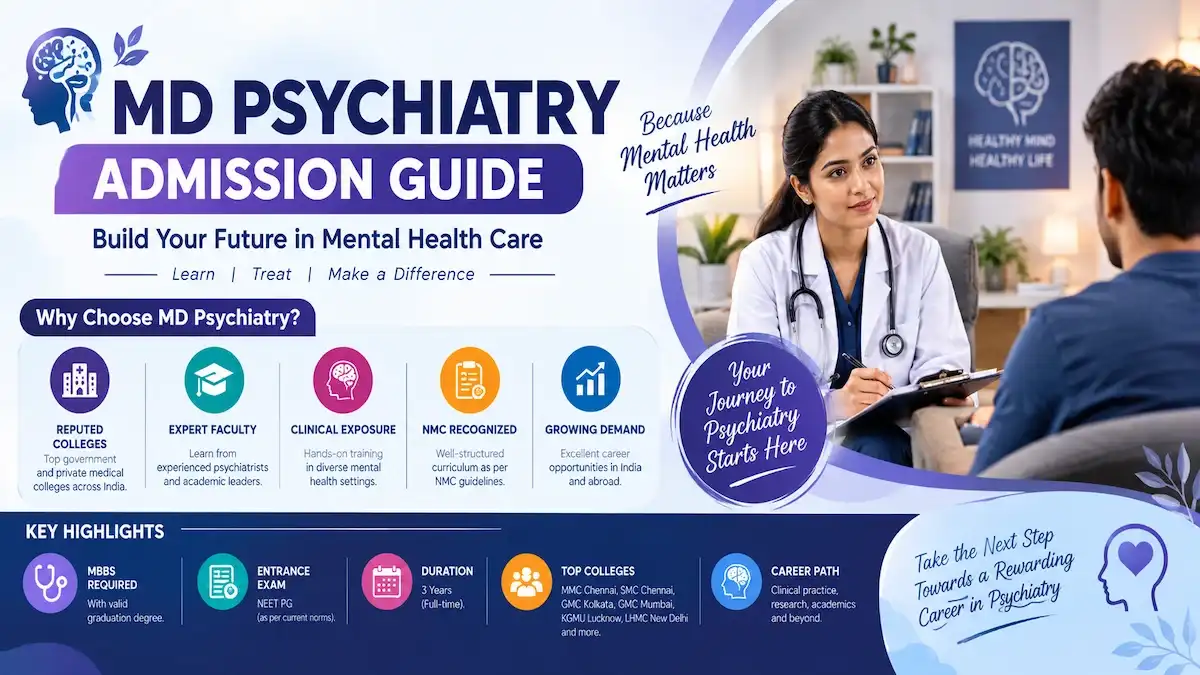
| In this article, you will find MD Psychiatry Admission Guidance and Course Information Details – State-wise Seats matrix in Government and Private institutions, Colleges Ranking, Tuition Fees, NEET PG closing score cut off. |
MD Psychiatry is a 3 years postgraduate medical degree focused on the study, diagnosis, treatment, and prevention of mental health disorders. This specialization deals with various mental health conditions such as depression, anxiety, schizophrenia, bipolar disorder, and addiction. Psychiatry is a critical branch of medicine that addresses the complex relationship between mental, emotional, and behavioural health.
For MD Psychiatry admission, candidates must have an MBBS degree from an NMC-recognized university and qualify NEET PG or INI CET, as applicable. MD Psychiatry is a 3-year postgraduate medical course offered by government and private medical colleges. Candidates seeking admission can explore reputed institutions offering quality training in mental health and psychiatric care.
Madras Medical College, Stanley Medical College, Government Medical College Kolkata, Grant Medical College, KGMU Lucknow and Lady Hardinge Medical College are among the well-known MD Psychiatry colleges in India. Other reputed options include RG Kar Medical College, Andhra Medical College, Mysore Medical College and Patna Medical College for postgraduate psychiatry education.
The demand for MD Psychiatry is rapidly increasing due to rising mental health awareness, stress-related disorders, and the growing need for mental health professionals. Psychiatrists are sought after in hospitals, clinics, and rehabilitation centers both in India and globally.
MD Psychiatry Admission 2026 Quick Summary
| Course Name | Doctor of Medicine in Psychiatry |
|---|---|
| Generally Known as | MD Psychiatry |
| Course Level | Postgraduate (MD Clinical) |
| Duration | 3 years, full-time |
| Stream | Medicine |
| Examination Type | Semester/Yearly System |
| Eligibility | MBBS degree recognized by the National Medical Commission (NMC) |
| Admission Process | Based on the results of the entrance examination (PG NEET) or personal interview in some cases |
| MD Psychiatry Colleges | 375 (Govt. Colleges – 153, Pvt. Colleges – 222) |
| MD Psychiatry Seats | 1602 (Govt. Seats – 748, Pvt. Seats – 854) |
| Entrance Exam | NEET PG, INI CET (AIIMS PG, PGIMER, JIPMER PG) |
| Average Tuition Fee | GOVT. Quota Fees – ₹ 1150/Year – ₹ 5125200/Year MNGT Quota Fees – ₹ 181910/Year – ₹ 7728000/Year NRI Quota Fees – $ 26317/Year – ₹ 9660000/Year |
| Average Starting Salary | INR 2 to 30 Lakhs/Year |
| Top Recruiting Companies | Healthcare environments, including hospitals, physician practices, integrative healthcare clinics, public health clinics, college health centers, natural apothecaries, and in settings that care for military veterans. |
| Top MD Psychiatry Colleges in India | Madras Medical College, Stanley Medical College, Government Medical College Kolkata, Grant Medical College, King Georges Medical University etc |
What is MD Psychiatry?
MD Psychiatry is a postgraduate medical degree focused on diagnosing, treating, and preventing mental, emotional, and behavioural disorders. Psychiatrists specialize in conditions such as depression, anxiety, schizophrenia, and addiction, using a combination of psychotherapy, medications, and other treatments to improve mental health.
Key Areas of Study in MD Psychiatry
- Clinical Psychiatry: Diagnosis and management of mood disorders, anxiety disorders, psychosis, and personality disorders.
- Psychopharmacology: Use of medications to treat mental health disorders.
- Psychotherapy: Learning therapeutic methods such as cognitive behavioral therapy (CBT), psychoanalysis, and counselling.
- Child and Adolescent Psychiatry: Focus on mental health issues affecting younger populations.
- Addiction Psychiatry: Management of substance use and related mental health disorders.
The course duration is typically three years and involves both theoretical learning and practical clinical training, including hands-on experience in hospitals and mental health facilities. Graduates can work as psychiatrists in hospitals, clinics, or academic settings, or pursue further specialization in fields like child psychiatry, forensic psychiatry, or addiction medicine.
MD Psychiatry Course Objectives
The objectives of the MD Psychiatry course are designed to develop the knowledge, skills, and professional attitude required for the diagnosis, treatment, and prevention of mental health disorders. Here are the key objectives:
- Comprehensive Knowledge of Mental Health: Gain an in-depth understanding of various psychiatric disorders, their etiology, symptoms, and classification, including mood disorders, anxiety, psychosis, and personality disorders.
- Clinical Diagnostic Skills: Develop proficiency in evaluating and diagnosing mental health conditions using clinical interviews, psychiatric assessments, and standardized diagnostic criteria like DSM or ICD.
- Therapeutic Expertise: Learn and apply psychotherapeutic techniques (e.g., cognitive-behavioral therapy, psychoanalysis, family therapy) and pharmacological treatments for managing psychiatric disorders.
- Patient Management: Master the management of acute and chronic psychiatric conditions in different settings, including inpatient and outpatient care, emergency psychiatry, and community mental health programs.
- Ethics and Professionalism: Cultivate a deep understanding of ethical issues in psychiatry, including patient confidentiality, informed consent, and the management of vulnerable populations.
- Research and Evidence-Based Practice: Develop skills in psychiatric research methodology, critical appraisal of scientific literature, and application of evidence-based practices to improve patient care.
- Interdisciplinary Collaboration: Work effectively with other healthcare professionals, including psychologists, social workers, and occupational therapists, to provide holistic care for patients.
- Communication and Counseling Skills: Enhance the ability to communicate effectively with patients and their families, providing support, counseling, and psychoeducation to help them understand and manage psychiatric conditions.
- Specialized Psychiatry Fields: Explore subspecialties like child and adolescent psychiatry, addiction psychiatry, forensic psychiatry, geriatric psychiatry, and liaison psychiatry for specialized career paths.
- Public Mental Health: Participate in community psychiatry programs to address public health issues, promote mental well-being, and reduce the stigma associated with mental illnesses.
These objectives prepare MD Psychiatry graduates to be competent psychiatrists who can deliver quality mental healthcare, engage in research, and contribute to public health initiatives.
MD Psychiatry Duration
The MD Psychiatry course typically spans 3 years, comprising both academic learning and extensive practical training. Here’s a breakdown of the duration:
- Total Duration: MD Psychiatry 3 years of full-time study.
- Course Structure: Divided into theoretical coursework, practical training, and clinical rotations.
- Clinical Training: Ongoing throughout the 3 years in various settings like hospitals, psychiatric wards, outpatient clinics, and community mental health services.
- Examinations: Regular internal assessments and final examinations conducted at the end of the course.
- Research Component: A dissertation or research project is usually a mandatory component of the course, to be completed within the 3-year timeframe.
This duration is designed to provide both academic knowledge and hands-on clinical experience, ensuring that students are well-prepared for a career in psychiatry.
The duration of the course is 2 years for those who have completed a recognized postgraduate diploma in the same specialty.
MD Psychiatry Admission Eligibility Criteria
MD Psychiatry Admission Eligibility Criteria typically includes the following key points:
- Educational Qualification: Must have completed an MBBS degree from a recognized medical institution.
- Recognition of Degree: The MBBS degree should be recognized by the Medical Council of India (MCI) or National Medical Commission (NMC).
- Internship Requirement: Must have completed a one-year rotatory internship by the time of application.
- Entrance Exam Requirement: Must qualify for the NEET-PG entrance exam (or other applicable exams like INI-CET for AIIMS exams).
- Minimum Marks/Percentile: Must secure the minimum required percentile (e.g., 50th percentile for general category) in the entrance exam.
- Medical Registration: Must be registered with the State Medical Council or Medical Council of India (MCI)/National Medical Commission (NMC) with a valid registration certificate.
- Age Limit: Some institutes may impose an upper age limit, though this varies by institution and state regulations.
- Category Reservation: Eligibility may vary slightly depending on reservation criteria (SC/ST/OBC/General).
MD Psychiatry Admission Process
- Qualifying Exam: Candidates must appear for NEET PG/ INI CET and score the required percentile to be eligible for counselling.
- Counselling: The counselling process for admission is conducted by the Medical Counselling Committee (MCC) for the All India Quota (AIQ) and by state authorities for state quota seats.
- Seats: Admissions are based on NEET PG rank, and the number of seats available in medical colleges under government, private, and deemed universities.
- Admission to MD Psychiatry is based on the candidate’s performance in the national level entrance examination National Eligibility Cum Entrance Test (NEET) PG which is a single-window entrance examination to MD/MS/PG diploma courses in Medicine.
Entrance Exams
- NEET-PG: The National Board of Examinations (NBE) conducts NEET-PG annually for admission to various MD/MS courses, including Psychiatry.
- Some autonomous institutes like AIIMS, JIPMER, and PGIMER may conduct separate entrance exams or counselling, though NEET-PG scores are often accepted by many colleges.
Counselling Process for NEET PG MD Psychiatry Admission
- All India Quota (AIQ): 50% of the seats in government medical colleges are reserved under the All India Quota, and the counselling for these seats is conducted by the Medical Counselling Committee (MCC).
- State Quota: The remaining 50% of seats in government medical colleges, as well as seats in private and deemed universities, are filled through state-level counselling.
- Management Quota: Private medical colleges may also offer seats under the management quota, where admissions are based on NEET PG scores but with a different fee structure.
The NEET PG Counselling Process is an organized procedure for postgraduate (PG) medical admissions in India. Here’s a step-by-step guide:
1. Qualifying NEET PG Exam
- Candidates must first qualify for the NEET PG exam conducted by the National Board of Examinations (NBE). The exam is mandatory for admission into MD/MS/PG Diploma courses.
2. Registration for Counselling
- Qualified candidates need to register online for the counselling process.
- The registration is done through the official websites of either the Medical Counselling Committee (MCC) for All India Quota (AIQ) seats or respective state counselling authorities for state quota seats.
3. Payment of Counselling Fee
- After registration, candidates must pay a non-refundable registration fee and a refundable security deposit, based on the seat category (AIQ, Deemed Universities, etc.).
4. Choice Filling and Locking
- Candidates must fill in their choices of courses and colleges.
- They can select multiple colleges and courses in order of preference.
- Once satisfied, the choices must be locked before the deadline. After locking, changes cannot be made.
5. Seat Allotment
- Based on the candidate’s NEET PG rank, category, and choices, the seat allotment process is conducted.
- The result of the allotment is announced online, and candidates can check which seat they’ve been allotted.
6. Reporting to the Allotted College
- Candidates who are allotted a seat must report to the respective college within the given time frame with the required documents.
- At this stage, candidates can choose to either accept the seat or opt for upgradation to a better-preferred seat in subsequent rounds.
7. Document Verification
- At the allotted college, candidates undergo document verification.
8. Free Exit / Upgradation
- After Round 1, candidates can either:
- Exit without penalty if they do not wish to continue with the allotted seat, or
- Upgrade by participating in Round 2 for better options.
9. Round 2 and Mop-Up Round
- If seats remain vacant after Round 1, Round 2 and Mop-Up rounds are conducted.
- In these rounds, candidates may upgrade or apply for leftover seats. The same process of choice filling, locking, and seat allotment is followed.
10. Final Admission
- Once satisfied with the allotted seat, candidates complete all formalities by paying the fees and joining the course.
This process ensures that candidates are allotted seats based on merit and their preferred colleges and courses.
Documents Required for MD Psychiatry Admission
Here are the documents required for MD Psychiatry admission:
- MBBS Degree Certificate: Proof of completing the MBBS course from a recognized institution.
- MBBS Mark Sheets: Mark sheets of all professional MBBS examinations.
- Internship Completion Certificate: Certificate confirming the completion of a one-year compulsory rotating internship.
- NEET-PG Scorecard: Proof of qualifying for the NEET-PG exam with the required cutoff.
- Medical Registration Certificate: Registration with the Medical Council of India (MCI) or State Medical Council (SMC).
- Transfer Certificate (TC): Issued by the previous institution after completion of MBBS.
- Migration Certificate: For students coming from other universities.
- Category Certificate (if applicable): SC/ST/OBC/EWS certificate if applying under a reserved category.
- Date of Birth Proof: Birth certificate or 10th-grade mark sheet for age verification.
- Passport-sized Photographs: Recent passport-sized photographs (usually 4-6 copies).
- Photo ID Proof: Aadhaar card, passport, or any government-issued ID.
- Domicile Certificate (if applicable): Proof of residence if required by the institution.
These documents are typically required during the admission and counselling process for MS Orthopaedics.
MD Psychiatry Course Syllabus
In this section, we have mentioned the major topics of the MD Psychiatry course curriculum taught by various colleges/universities.
Key Subjects Covered:
- Basic Sciences in Psychiatry
- General Psychiatry
- Child and Adolescent Psychiatry
- Geriatric Psychiatry
- Addiction Psychiatry
- Psychotherapy
Syllabus of Psychiatry as prescribed by various Universities and Colleges.
| 1st Sem Syllabus | 2nd Sem Syllabus |
| Learning Theories | Clinical Psychiatry |
| Basic and applied Electrophysiology | Course, Outcome, and Prognosis of Schizophrenia |
| Excitatory Amino Acids in Psychiatric Disorders | Biological Basis of Schizophrenia |
| Consciousness | Etiological Theories of Mood Disorders |
| Aggression: Psychology and Biology | Antisocial Personality Disorders |
| Information Processing: Brain Models of Mind | Subtypes of Depressive Disorders and their Clinical Relevance |
| Magnetic Resonance and Implications for Psychiatry | Organic Delusional, Mood, and Personality Disorders |
| 3rd Sem Syllabus | 4th Sem Syllabus |
| Reactions to severe stress | Psychological management of sexual dysfunctions |
| Recent advances in eating disorders | Models of psychotherapy: An overview |
| Anxiety disorders | Supportive psychotherapies |
| Biological Basis of Anxiety | Management of a Suicidal Patient |
| Nosological status and clinical features of Neurasthenia | Behavioural therapies |
| Non-organic sleep disorders | Scientific evaluation of the efficacy of psychotherapy: methodological problems |
| Somatization disorders: Diagnosis and clinical features | Drug treatment of generalized anxiety and panic disorders |
| — | Role of Lithium in Psychiatric Disorders |
| — | Electroconvulsive Therapy: current trends |
| 5th Sem Syllabus | 6th Sem Syllabus |
| Ethics in Psychiatry | Dementia: Differential Diagnosis and Management |
| Integration of Mental Health into Primary Care – Its Role and Future in India. | Psychological Aspects of Gastrointestinal Disorders |
| Learning Disorders of Childhood | Psychological Aspects of Breast Cancer |
| Neuro Psychological Assessment of Children | Stress and Psychological Disorders |
| Child Abuse and Neglect | Concept and Assessment of Disability |
| Neuro Psychological Assessment of Children | Stress and Psychological Disorders |
| — | Obesity |
| — | Consultation-Liaison Psychiatry |
MD Psychiatry Career Opportunities
In this section, we provided the career opportunities after MD Psychiatry course in India; let’s look.
- Clinical Psychiatrist: Diagnose and treat mental health disorders in hospitals, private clinics, or psychiatric institutions.
- Academic Roles: Teach psychiatry in medical colleges and universities; mentor medical students and psychiatry residents.
- Researcher: Conduct research in mental health, psychopharmacology, and behavioral sciences, contributing to advances in psychiatry.
- Child and Adolescent Psychiatrist: Specialize in diagnosing and treating psychiatric disorders in children and adolescents, working in pediatric hospitals, clinics, or schools.
- Addiction Psychiatrist: Focus on the treatment of substance use disorders and behavioural addictions; work in rehabilitation centers or addiction clinics.
- Forensic Psychiatrist: Work with the legal system, assessing the mental health of individuals involved in legal cases, and providing expert testimony in court.
- Geriatric Psychiatrist: Treat mental health conditions in elderly patients, such as dementia and depression, in nursing homes, hospitals, or specialized geriatric centers.
- Community Psychiatrist: Work in community mental health programs, focusing on public mental health, awareness, and reducing the stigma of mental illness.
- Consultant Psychiatrist: Provide specialized psychiatric consultation in hospitals, healthcare organizations, or corporate settings.
- Private Practice: Set up a private clinic offering mental health services, therapy, and treatment for various psychiatric conditions.
Additional Opportunities:
- Telepsychiatry: Offer online consultations and therapy.
- Policy Advisor: Work with governments or NGOs to shape mental health policies.
- NGO Work: Engage in mental health advocacy and public health programs.
These roles provide ample opportunities for psychiatrists to impact the mental health sector significantly.
Super-Specialization after MD Psychiatry
After completing MD Psychiatry, offers several super-specialisation options for those who want to further advance their expertise in specific areas of psychiatry. Here are some common super-specialization branches in psychiatry:
- DM – GERIATRIC MENTAL HEALTH
- DM – CHILD AND ADOLESCENT PSYCHIATRY
- DM/DrNB – MEDICAL GENETICS
- Child and Adolescent Psychiatry: Focuses on diagnosing and treating psychiatric disorders in children and adolescents, including developmental disorders, ADHD, and mood disorders.
- Geriatric Psychiatry: Specializes in mental health issues affecting the elderly, such as dementia, depression, and age-related cognitive decline.
- Addiction Psychiatry: Deals with the prevention, diagnosis, and treatment of substance use disorders and behavioral addictions (e.g., alcohol, drugs, gambling).
- Forensic Psychiatry: Involves the intersection of psychiatry and law, assessing and treating individuals involved in the legal system, providing expert testimony, and working in criminal justice settings.
- Consultation-Liaison Psychiatry (Psychosomatic Medicine): Focuses on the management of psychiatric conditions in patients with complex medical and surgical problems, bridging the gap between psychiatry and general medical care.
- Neuropsychiatry: Combines neurology and psychiatry, focusing on the treatment of patients with neurological disorders that affect behavior and cognition, such as epilepsy, traumatic brain injury, and neurodegenerative diseases.
- Community Psychiatry: Specializes in the public health aspect of psychiatry, working in community settings to address mental health on a larger scale, often focusing on underserved populations.
- Sleep Medicine: Focuses on diagnosing and treating sleep disorders that have psychiatric components, such as insomnia, sleep apnea, and narcolepsy.
- Emergency Psychiatry: Involves the management of acute psychiatric emergencies, including suicidal ideation, severe depression, psychosis, and substance-related crises.
These super-specialization branches allow psychiatrists to gain advanced skills and knowledge in specific fields, offering greater career opportunities and a focused approach to treating mental health issues.
MD Psychiatry Job Prospects and Salary
MD Psychiatry Job Prospects
- Hospital Psychiatry: Work as a consultant psychiatrist in general hospitals or specialized psychiatric hospitals, managing inpatient and outpatient services.
- Private Practice: Set up a private clinic offering diagnostic services, therapy, and treatment for mental health conditions, catering to individuals and families.
- Academic and Teaching Roles: Teach psychiatry in medical colleges and universities, guiding medical students and training future psychiatrists.
- Research Positions: Conduct psychiatric research in areas like psychopharmacology, behavioral health, and neuropsychiatry at research institutions or pharmaceutical companies.
- Consultant for Corporates: Provide mental health support and counseling in corporate settings, focusing on stress management, work-life balance, and employee well-being.
- Forensic Psychiatry: Work with the legal system to assess mental health conditions of individuals involved in legal cases and provide expert testimony.
- Government and NGO Roles: Work in public health initiatives, policy making, and mental health advocacy through government or non-governmental organizations.
- Telepsychiatry: Offer psychiatric consultations and therapy sessions online, providing mental health care to patients remotely.
- Community Mental Health: Participate in or lead mental health programs in community settings, especially in rural or underserved areas.
- Specialized Psychiatry Fields: Pursue careers in subspecialties like child psychiatry, addiction psychiatry, or geriatric psychiatry for focused care.
MD Psychiatry Salary
- Starting Salary: ₹8-12 lakhs per annum in India.
- With Experience (5-10 years): ₹15-25 lakhs per annum.
- In Private Practice: Earnings can vary widely, with experienced psychiatrists potentially earning ₹20-30 lakhs or more annually depending on clientele and location.
- International Salary: In countries like the USA or UK, psychiatrists can earn anywhere between $150,000 to $300,000 annually depending on experience and location.
Overall, MD Psychiatry offers excellent career prospects and competitive salaries, with opportunities for growth in both clinical practice and academic settings.
State-wise MD Psychiatry Seat Distribution
MD Psychiatry seats are available across 28+ states and union territories. Here are the top states by seat availability:
| State | Total Colleges | Total Seats |
|---|---|---|
| Karnataka | 54 | 240 |
| Maharashtra | 41 | 170 |
| Tamil Nadu | 36 | 166 |
| Uttar Pradesh | 38 | 164 |
| Andhra Pradesh | 29 | 116 |
| Rajasthan | 16 | 99 |
| Telangana | 23 | 89 |
| Gujarat | 21 | 80 |
| Madhya Pradesh | 17 | 76 |
| Kerala | 22 | 71 |
| Delhi | 7 | 69 |
| West Bengal | 16 | 54 |
| Assam | 6 | 38 |
| Uttarakhand | 3 | 38 |
| Jharkhand | 2 | 35 |
| Puducherry | 8 | 35 |
| Odisha | 6 | 34 |
| Haryana | 8 | 30 |
| Jammu & Kashmir | 4 | 24 |
| Chhattisgarh | 7 | 24 |
| Punjab | 6 | 20 |
| Chandigarh | 2 | 19 |
| Bihar | 7 | 17 |
| Himachal Pradesh | 4 | 10 |
| Goa | 1 | 8 |
| Manipur | 2 | 5 |
| Sikkim | 1 | 3 |
| Tripura | 1 | 3 |
| Grand Total | 388 | 1,818 |
Quota Wise MD Psychiatry 2025 Closing Score Cut off
Different counselling authorities conduct admissions through various quotas. Here are the MD Psychiatry opening and closing scores from NEET PG 2025:
| Quota | Counselling Authority | Opening NEET PG 2025 Score | Closing NEET PG 2025 Score |
|---|---|---|---|
| AIQ | All India Counselling | 26 | 636 |
| AMU | Aligarh Muslim University Counselling | 571 | 571 |
| BHQ | Banaras Hindu University PG Counselling | 324 | 485 |
| DUQ | Delhi University – Internal Counselling | 450 | 599 |
| IPQ | Indraprastha University Counselling | 385 | 610 |
| MNQ | Deemed Universities Counselling | 222 | 507 |
| MQ | Management Counselling | 75 | 554 |
| NRI | Non Resident Indian (NRI) Counselling | 101 | 426 |
| OPMQ | Open Management Counselling | 121 | 555 |
| OPQ | Central Universities Counselling | 223 | 346 |
| SQ | State Counselling | 24 | 633 |
All India Category Wise MD Psychiatry Cut off
The NEET PG 2025 closing cutoff scores for Round-1 MCC Counselling are provided below for all reservation categories. The final column indicates the total number of MD Psychiatry seats allotted during the 2025 AIQ counselling.
| Category | 2025 Cut off Score | Allotted Seats |
|---|---|---|
| ST | 519 | 23 |
| OBC | 597 | 94 |
| SC | 572 | 38 |
| GN-PH | 477 | 5 |
| OBC-PH | 294 | 1 |
| GN | 636 | 127 |
| EWS | 597 | 32 |
MD Psychiatry Category wise AIQ Round 1 Cutoff 2025 (Closing Rank & Marks)
| State | OPEN (R1 Closing Rank/Marks) | EWS (R1 Closing Rank/Marks) | OBC (R1 Closing Rank/Marks) | SC (R1 Closing Rank/Marks) | ST (R1 Closing Rank/Marks) |
|---|---|---|---|---|---|
| Andhra Pradesh | 16458 / 528 | 22842 / 506 | 17875 / 523 | 27313 / 491 | 46440 / 436 |
| Assam | 13874 / 539 | 25251 / 498 | 22415 / 508 | 36517 / 464 | 27498 / 491 |
| Bihar | – | – | 13602 / 540 | 34335 / 470 | 58570 / 404 |
| Chandigarh | 1534 / 617 | – | 8141 / 565 | – | 18944 / 519 |
| Chhattisgarh | 11448 / 549 | – | 20110 / 515 | – | – |
| Delhi | 1585 / 616 | 3361 / 597 | 10716 / 552 | 15774 / 531 | 33674 / 472 |
| Goa | 6881 / 572 | – | 14214 / 537 | 29454 / 485 | – |
| Gujarat | 5566 / 580 | 4229 / 590 | 14172 / 537 | – | 39936 / 454 |
| Haryana | 5721 / 579 | 7827 / 567 | 14727 / 535 | 15817 / 531 | – |
| Himachal Pradesh | 8399 / 564 | – | 20255 / 515 | 29806 / 484 | – |
| Jammu & Kashmir | 9245 / 559 | – | 17751 / 524 | 33939 / 471 | 37663 / 460 |
| Jharkhand | 5497 / 580 | 12318 / 545 | 13687 / 539 | 24311 / 501 | 35958 / 465 |
| Karnataka | 8111 / 565 | – | 19452 / 517 | 36032 / 465 | 70812 / 373 |
| Kerala | 7224 / 570 | 31680 / 478 | 12878 / 542 | 26443 / 494 | 67190 / 382 |
| Madhya Pradesh | 8363 / 564 | 12901 / 542 | 19566 / 517 | 33288 / 473 | – |
| Maharashtra | 10862 / 551 | 15995 / 530 | 18878 / 520 | 22960 / 506 | – |
| Manipur | 9318 / 559 | – | – | – | – |
| Odisha | 7717 / 567 | 19972 / 516 | 11879 / 547 | – | – |
| Punjab | 5702 / 579 | – | 16877 / 527 | – | 55066 / 413 |
| Rajasthan | 8366 / 564 | 10462 / 553 | 13868 / 539 | 21535 / 510 | 32377 / 476 |
| Tamil Nadu | 11644 / 548 | 31649 / 478 | 15696 / 531 | 34903 / 468 | 72084 / 370 |
| Telangana | 16162 / 530 | 16523 / 528 | 18332 / 521 | 37273 / 462 | 34193 / 470 |
| Tripura | – | – | 21855 / 510 | – | 52273 / 420 |
| Uttar Pradesh | 8643 / 562 | 14705 / 535 | 16028 / 530 | 17227 / 525 | 53275 / 418 |
| West Bengal | 13643 / 540 | – | 16227 / 529 | 20783 / 513 | – |
MD Psychiatry Category wise AIQ Round 3 Cutoff 2025 (Closing Rank & Marks)
MD Psychiatry – AIQ Round 3 Cutoff 2025 (Closing Rank / Marks by Category wise)
| State | OPEN (R3 Closing Rank/Marks) | EWS (R3 Closing Rank/Marks) | OBC (R3 Closing Rank/Marks) | SC (R3 Closing Rank/Marks) | ST (R3 Closing Rank/Marks) |
|---|---|---|---|---|---|
| Andhra Pradesh | 22042 / 509 | 37363 / 461 | 23386 / 505 | 38140 / 459 | 46440 / 436 |
| Assam | 22337 / 508 | 33279 / 473 | 29174 / 485 | 42169 / 448 | 63171 / 392 |
| Bihar | – | – | 17657 / 524 | 40441 / 452 | 71374 / 372 |
| Chandigarh | 2079 / 610 | – | 8141 / 565 | – | 37663 / 460 |
| Chhattisgarh | 15512 / 532 | – | 29083 / 486 | – | – |
| Delhi | 4083 / 591 | 6675 / 573 | 14458 / 536 | 17227 / 525 | 34193 / 470 |
| Goa | 10300 / 554 | – | 14686 / 535 | 29627 / 484 | – |
| Gujarat | 9309 / 559 | 4229 / 590 | 19145 / 518 | 33288 / 473 | 64414 / 389 |
| Haryana | 5732 / 579 | 12229 / 545 | 16939 / 527 | 22960 / 506 | – |
| Himachal Pradesh | 15628 / 531 | – | 23036 / 506 | 29806 / 484 | – |
| Jammu & Kashmir | 13501 / 540 | – | 30334 / 482 | 43836 / 443 | 68957 / 378 |
| Jharkhand | 7876 / 566 | 12353 / 545 | 17076 / 526 | 27313 / 491 | 61437 / 397 |
| Karnataka | 21229 / 511 | 32212 / 476 | 28985 / 486 | 44916 / 440 | 88492 / 331 |
| Kerala | 7883 / 566 | 41818 / 449 | 12878 / 542 | 35009 / 468 | 67442 / 381 |
| Madhya Pradesh | 13940 / 538 | 15342 / 532 | 25529 / 497 | 37452 / 461 | – |
| Maharashtra | 15003 / 534 | 27784 / 490 | 23241 / 505 | 25737 / 497 | 65749 / 386 |
| Manipur | 9318 / 559 | – | 12268 / 545 | – | – |
| Odisha | 7717 / 567 | 31452 / 479 | 21835 / 510 | – | – |
| Punjab | 5702 / 579 | – | 24747 / 500 | – | 69255 / 377 |
| Rajasthan | 13135 / 541 | 18987 / 519 | 14804 / 535 | 29307 / 485 | 38219 / 459 |
| Tamil Nadu | 16904 / 527 | 42326 / 447 | 22182 / 508 | 41790 / 449 | 76141 / 360 |
| Telangana | 21287 / 511 | 16523 / 528 | 25714 / 497 | 46993 / 435 | 61937 / 395 |
| Tripura | – | – | 31877 / 477 | – | 71515 / 371 |
| Uttar Pradesh | 14668 / 535 | 21485 / 511 | 21685 / 510 | 31844 / 477 | 66876 / 383 |
| West Bengal | 16912 / 527 | – | 21055 / 512 | 20783 / 513 | – |
MD Psychiatry Deemed University Round 3 Cutoff 2025 (Closing Rank)
Top 15 Most Preferred MD Psychiatry Colleges in India (NEET PG 2025 AIQ)
Here we provide a list of top medical colleges that offer MD Psychiatry courses. Check the list below.
| Rank | College | State | District | Type |
|---|---|---|---|---|
| 1 | PGIMER Delhi | Delhi | New Delhi | Govt-State |
| 2 | Govt Medical College Chandigarh | Chandigarh | Chandigarh | Govt-State |
| 3 | Seth GS Medical College | Maharashtra | Mumbai City | Govt-State |
| 4 | BJ Medical College Ahmedabad | Gujarat | Ahmedabad | Govt-State |
| 5 | Lady Hardinge Medical College | Delhi | New Delhi | Govt-State |
| 6 | Lokmanya Tilak Medical College Mumbai | Maharashtra | Mumbai City | Govt-State |
| 7 | Institute of Medical Sciences BHU | Uttar Pradesh | Varanasi | Govt-Deemed |
| 8 | Jawaharlal Nehru Medical College AMU | Uttar Pradesh | Aligarh | Govt-Deemed |
| 9 | Pt DDU Medical College | Gujarat | Rajkot | Govt-State |
| 10 | Govt Medical College Surat | Gujarat | Surat | Govt-State |
| 11 | VMMC And Safdarjung Hospital | Delhi | South Delhi | Govt-State |
| 12 | Grant Medical College Mumbai | Maharashtra | Mumbai City | Govt-State |
| 13 | Bangalore Govt Medical College | Karnataka | Bangalore Urban | Govt-State |
| 14 | MP Shah Govt Medical College Jamnagar | Gujarat | Jamnagar | Govt-State |
| 15 | BJ Govt Medical College Pune | Maharashtra | Pune | Govt-State |
Conclusion
In conclusion, MD Psychiatry is not only a rewarding profession in terms of salary but also offers the opportunity to make a significant impact on individual and public mental health. It is a fulfilling career path for those dedicated to understanding and improving the human mind and mental well-being.
FAQs
Q. Is NEET PG mandatory for MD Psychiatry admission?
A. Yes. NEET PG is compulsory for all seats—Government, Private, Management, and NRI quota. No college offers admission without a valid NEET PG score.
Q. What is the minimum NEET PG score required for MD Psychiatry?
A. Cutoffs vary yearly, but MD Psychiatry usually requires a moderate to high score due to rising demand. Private and management quota seats may have lower cutoffs.
Q. Can I get MD Psychiatry through the management or NRI quota?
A. Yes. Many private medical colleges offer MD Psychiatry seats under Management and NRI quota for eligible NEET PG–qualified candidates.
Q. What is the duration of MD Psychiatry and what training does it include?
A. It is a 3-year postgraduate course covering psychotherapy, psychopharmacology, child psychiatry, addiction psychiatry, emergency psychiatry, and community mental health.
Q. What are the career opportunities after MD Psychiatry?
A. Graduates can work as Psychiatrists in hospitals, mental health centres, rehabilitation clinics, academic institutions, corporate wellness programs, and private practice.
| Disclaimer: The information shared here is collected from multiple reliable sources for educational and informational purposes. While we strive to provide accurate and updated details, some information may change over time. If you notice any incorrect data or discrepancies, please contact us at mbbsenquiry1[@]gmail.com so our team can review and update the information accordingly. Read More |