
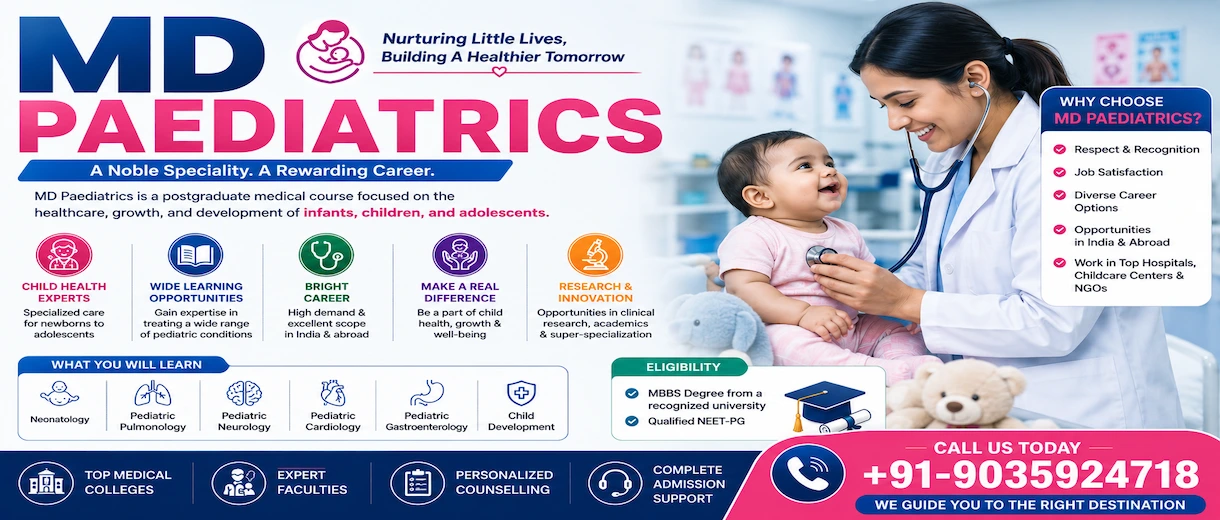
| In this article, you will find MD Pediatrics Admission Process and Course Information Details – State wise Seats Matrix in Government/ Private institutions, Colleges Ranking, Tuition Fees 2026, NEET PG closing score cut off. |
About MD Pediatrics Course
MD Pediatrics is a 3-year postgraduate degree focusing on medical conditions in infants, children, and youth. To pursue this program, candidates must hold an MBBS degree from an MCI-recognized university with 50% marks. This qualification serves as the first step of medical training to become a licensed physician and MD specialist.
For Pediatrics admission, applicants must qualify through NEET PG or INI CET, conducted by AIIMS Delhi and NBE authorities. Top institutes currently accepting applications include LHMC, PGIMER Delhi, LTMMC Mumbai, TDMC Alappuzha, ESIC MC Joka, IMS BHU, ESIC PGIMSR Bengaluru, IPGMER Kolkata. Students with aspirations in child healthcare should apply now, as MD Pediatrics offers excellent career pathways.
The course equips graduates with expertise in diagnosing and treating conditions affecting children of all age groups. It is available in both public and private medical colleges, making it widely accessible for aspiring pediatricians. The best colleges in India offering MD Pediatrics are LHMC, PGIMER Delhi, LTMMC Mumbai, TDMC Alappuzha, ESIC MC Joka, MAMC, ESI PGIMSR Delhi, RMLIMS Lucknow, SMC Chennai, Madurai GMC, MMCRI Mysuru, MKCG MCH Berhampur, IMS BHU, ESIC PGIMSR Bengaluru, IPGMER Kolkata, which also offer advanced training in Paediatrics specialization. These medical schools are known for excellence in academics, clinical exposure, and research opportunities in pediatrics.
Pediatrics is a rapidly growing field due to the increasing child population and focus on advanced neonatal healthcare. Government initiatives, rise in child health awareness, and better facilities have raised demand for pediatric experts. This degree ensures long-term opportunities both in India and abroad, making it a valuable postgraduate qualification.
This article outlines the admission process, eligibility criteria, and available career options in MD Pediatrics in India. Interested candidates can seek admission guidance and detailed counseling support directly through our official website.
Top 15 MD Pediatrics Medical Colleges in India
Here are the top 15 medical colleges in India for pursuing MD Paediatrics:
| S. No. | Institute | City / State | Type | MD Paediatrics Seats |
|---|---|---|---|---|
| 1 | Lady Hardinge Medical College | New Delhi | Govt-State | 25 |
| 2 | PGIMER Delhi | New Delhi | Govt-State | 38 |
| 3 | Lokmanya Tilak Medical College Mumbai | Mumbai | Govt-State | 12 |
| 4 | TD Govt Medical College | Alappuzha | Govt-State | 9 |
| 5 | ESIC Medical College Joka Kolkata | Kolkata | Govt-Aided | 2 |
| 6 | Maulana Azad Medical College | New Delhi | Govt-State | 15 |
| 7 | ESI PGIMSR Delhi | New Delhi | Govt-Aided | 8 |
| 8 | Dr Ram Manohar Lohia Institute of Medical Sciences | Lucknow | Govt-State | 7 |
| 9 | Stanley Medical College | Chennai | Govt-State | 16 |
| 10 | Madurai Govt Medical College | Madurai | Govt-State | 17 |
| 11 | Mysore Medical College | Mysore | Govt-State | 12 |
| 12 | Maharaja KC Gajapati Medical College | Ganjam | Govt-State | 11 |
| 13 | Institute of Medical Sciences BHU | Varanasi | Govt-Deemed | 12 |
| 14 | ESIC and PGIMSR Bangalore | Bangalore Urban | Govt-Aided | 6 |
| 15 | Institute of PG Medical Education and Research, Kolkata | Kolkata | Govt-State | 9 |
MD Pediatrics Course 2026 Quick Summary
| Name of the course | Doctor of Medicine in Paediatrics |
|---|---|
| Generally Known as | MD Paediatrics |
| Course Level | Post Graduate |
| Duration | 3 years, full-time |
| Stream | Medicine |
| Examination Type | Semester/Yearly System |
| Eligibility | MBBS degree recognized by the National Medical Commission (NMC) |
| Admission Process | Based on the results of the entrance examination (NEET) or personal interview in some cases |
| No of Colleges | Govt. – 233 Pvt – 274 |
| No of Seats | Govt. Seats – 2146 Pvt Seats – 2038 |
| Entrance Exam | NEET PG |
| Average Course Tuition Fee | GOVT. Quota Fees – ₹ 1150/Year – ₹ 5200000/Year MNGT Quota Fees – ₹ 181910/Year – ₹ 6500000/Year NRI Quota Fees – $ 45000/Year – ₹ 9015500/Year |
| Average Starting Salary | INR 1 to 12 Lakhs |
| Top Recruiting Companies | Apollo’s Children Hospital, AIIMS, Rainbow Hospital for Women & Children, Sir Ganga Ram Hospital, Indraprastha Apollo Hospital, Institute of Child Health, Columbia Asia Hospital, Kokilaben Dhirubhai Ambani Hospital, Christian Medical Hospital, P.D. Hinduja Hospital |
What is MD Pediatrics?
A paediatrician provides general medical care, monitors growth and development, and tracks and administers immunizations for infants, children, adolescents, and young adults. The paediatrician diagnoses and treats illnesses, medical conditions, and injuries, and eases the lives of children with chronic conditions. Below we have mentioned the roles of a paediatrician:
- Diagnosing and treating illnesses, medical conditions, and injuries.
- Ordering, performing, and interpreting diagnostic tests.
- Collecting, recording, and maintaining patients’ information and histories.
- Prescribing and administering treatments, therapies, medications, vaccinations, and other specialized medical care.
- Explaining procedures and discussing test results or prescribed treatments with patients and family members.
- Monitoring patients’ conditions and progress.
- Directing, coordinating, consulting with, and referring patients to nurses, students, assistants, specialists, therapists, and other medical staff.
- Advising patients, parents, and guardians on diets, activities, hygiene, and disease prevention.
- Conducting research and remaining up to date on current trends, discoveries, and developments in the field.
These objectives aim to develop well-rounded dermatologists who are clinically competent, empathetic, and capable of making a positive impact in public health.
MD Pediatrics Course Objectives
The MD Pediatrics course aims to equip students with the following key objectives:
- Develop Clinical Expertise: Gain comprehensive knowledge and skills to diagnose and manage common and complex pediatric diseases.
- Holistic Child Care: Provide preventive, curative, and rehabilitative care for children from infancy to adolescence.
- Growth & Development: Understand normal and abnormal physical, cognitive, and emotional growth and development in children.
- Neonatal Care: Develop expertise in managing newborns, especially critically ill or premature infants in neonatal units.
- Immunization and Disease Prevention: Master the principles of vaccination and preventive care in pediatrics.
- Emergency Pediatrics: Manage pediatric emergencies, including trauma, respiratory distress, seizures, and cardiac arrest.
- Multidisciplinary Approach: Collaborate with other specialties to provide comprehensive healthcare for children with chronic or complex diseases.
- Research and Evidence-Based Medicine: Conduct research in pediatric health and apply evidence-based approaches to improve patient outcomes.
- Ethical Pediatric Practice: Adhere to ethical principles, patient rights, and professional conduct in pediatric practice.
- Teaching and Training: Develop teaching skills for training medical students, interns, and junior doctors in pediatric care.
These objectives ensure that MD Pediatrics graduates are equipped with the knowledge, skills, and professionalism to excel in child healthcare.
MD Pediatrics Course Duration
MD Pediatrics Course Duration typically follows these key points:
- Total Duration: The MD Pediatrics course spans 3 years.
- Academic Structure: The 3-year duration is divided into 6 semesters, each lasting approximately 6 months.
- Clinical Training: Throughout the course, students undergo rigorous clinical training, which includes hands-on practice in diagnostic and interventional paediatrics.
- Examinations: Periodic theoretical and practical exams are conducted after each semester to assess the progress of the candidates.
- Internship/Residency: Some programs may incorporate clinical residency rotations in various specialties of radiology to provide comprehensive exposure.
- Research Component: During the course, students are often required to complete a dissertation or research project in a specific area of paediatrics.
- Final Examination: At the end of the 3 years, candidates must clear a final examination, which includes both theoretical and practical assessments, to qualify for the MD degree.
The duration of the course is 2 years for those who have completed a recognized postgraduate diploma in the same specialty.
MD Pediatrics Admission Eligibility Criteria
MD Pediatrics Admission Eligibility Criteria typically includes the following key points:
- MBBS Degree: Candidates must possess an MBBS degree from a medical college recognized by the Medical Council of India (MCI) or the National Medical Commission (NMC).
- Minimum Marks: Applicants are usually required to have secured at least 50% aggregate marks in their MBBS degree (subject to variations based on institution).
- Internship Completion: Candidates must have completed a 1-year compulsory rotating internship by the time of admission.
- NEET-PG Qualification: Candidates must qualify for the National Eligibility cum Entrance Test for Postgraduate (NEET-PG) with the required cutoff marks.
- Medical Registration: It is mandatory to be registered with the Medical Council of India (MCI) or a state medical council to be eligible for admission.
- Category-Based Relaxation: Relaxation in the qualifying criteria, such as minimum marks and NEET-PG cutoff, may be available for reserved category candidates (SC/ST/OBC/EWS), depending on the institution.
- Additional Requirements: Some institutions may conduct their own interviews or counseling sessions based on the NEET-PG score as part of the admission process.
MD Paediatrics Admission Process
- Qualifying Exam: Candidates must appear for NEET PG and score the required percentile to be eligible for counselling.
- Counselling: The counselling process for admission is conducted by the Medical Counselling Committee (MCC) for the All India Quota (AIQ) and by state authorities for state quota seats.
- Seats: Admissions are based on NEET PG rank, and the number of seats available in medical colleges under government, private, and deemed universities.
- Admission to MD in Paediatrics is based on the candidate’s performance in the national-level entrance examination, National Eligibility Cum Entrance Test (NEET) PG, which is a single-window entrance examination to MD/MS/PG diploma courses in Medicine.
Entrance Exams
- NEET-PG: The National Board of Examinations (NBE) conducts NEET-PG annually for admission to various MD/MS courses, including Paediatrics.
- Some autonomous institutes like AIIMS, JIPMER, and PGIMER may conduct separate entrance exams (INI CET) or counseling, though NEET-PG scores are often accepted for many colleges.
Counselling Process
- All India Quota (AIQ): 50% of the seats in government medical colleges are reserved under the All India Quota, and the counselling for these seats is conducted by the Medical Counselling Committee (MCC).
- State Quota: The remaining 50% of seats in government medical colleges, as well as seats in private and deemed universities, are filled through state-level counselling.
- Management Quota: Private medical colleges may also offer seats under the management quota, where admissions are based on NEET PG scores but with a different fee structure.
The NEET PG Counselling Process is an organized procedure for postgraduate medical admissions in India. Here’s a step-by-step guide:
1. Qualifying NEET PG Exam
- Candidates must first qualify for the NEET PG exam conducted by the National Board of Examinations (NBE). The exam is mandatory for admission into MD/MS/PG Diploma courses.
2. Registration for Counselling
- Qualified candidates need to register online for the counselling process.
- The registration is done through the official websites of either the Medical Counselling Committee (MCC) for All India Quota (AIQ) seats or respective state counselling authorities for state quota seats.
3. Payment of Counselling Fee
- After registration, candidates must pay a non-refundable registration fee and a refundable security deposit, based on the seat category (AIQ, Deemed Universities, etc.).
4. Choice Filling and Locking
- Candidates must fill in their choices of courses and colleges.
- They can select multiple colleges and courses in order of preference.
- Once satisfied, the choices must be locked before the deadline. After locking, changes cannot be made.
5. Seat Allotment
- Based on the candidate’s NEET PG rank, category, and choices, the seat allotment process is conducted.
- The result of the allotment is announced online, and candidates can check which seat they’ve been allotted.
6. Reporting to the Allotted College
- Candidates who are allotted a seat must report to the respective college within the given time frame with the required documents.
- At this stage, candidates can choose to either accept the seat or opt for upgradation to a better-preferred seat in subsequent rounds.
7. Document Verification
- At the allotted college, candidates undergo document verification.
8. Free Exit / Upgradation
- After Round 1, candidates can either:
- Exit without penalty if they do not wish to continue with the allotted seat, or
- Upgrade by participating in Round 2 for better options.
9. Round 2 and Mop-Up Round
- If seats remain vacant after Round 1, Round 2 and Mop-Up rounds are conducted.
- In these rounds, candidates may upgrade or apply for leftover seats. The same process of choice filling, locking, and seat allotment is followed.
10. Final Admission
- Once satisfied with the allotted seat, candidates complete all formalities by paying the fees and joining the course.
This process ensures that candidates are allotted seats based on merit and their preferred colleges and courses.
Documents Required for MD Pediatrics Admission
- NEET PG Scorecard 2025
- MBBS degree certificate and mark sheets
- Internship completion certificate
- MCI or State Medical Council registration certificate
- Identity proof (Aadhaar card, passport, etc.)
- Caste or category certificate (if applicable)
- Passport-sized photographs
MD Pediatrics Course Syllabus
Key Subjects Covered:
- Neonatology
- Growth and Development
- Pediatric Infectious Diseases
- Pediatric Cardiology
- Pediatric Neurology
- Immunization and Vaccines
- Pediatric Endocrinology
- Pediatric Gastroenterology
- Pediatric Hematology
- Pediatric Emergency Care
Syllabus of Paediatrics as prescribed by various Universities and Colleges.
| SEMESTER I | SEMESTER II |
| Growth and Development | Psychological disorder |
| Respiratory | Endocrinology |
| Neonatology | Infections |
| Behavioral Disorder | Skin diseases |
| SEMESTER III | SEMESTER IV |
| Social Paediatrics | Adolescent Health |
| Genetics | Central Nervous System |
| Nutrition | Fetus Newborn |
| Cardiovascular | Eye diseases |
| Neurological Disorders | Emergence and critical care |
| Infections | Digestive system |
| SEMESTER V | SEMESTER VI |
| Social Paediatrics II | Adolescent Health II |
| Research Project | Internship |
MD Paediatrics Career Opportunities
MD Paediatrics offers diverse career opportunities including roles as a General Pediatrician, Neonatologist, Pediatric Cardiologist, Pediatric Neurologist, or Pediatric Oncologist. Other options include Academic roles, Public Health Specialist, Researcher, and positions in Healthcare Administration or Global Health.
- General Pediatrician: Work in hospitals, clinics, or private practice, providing medical care for children.
- Neonatologist: Specialize in caring for newborns, particularly premature or critically ill infants in neonatal intensive care units (NICUs).
- Pediatric Emergency Specialist: Manage pediatric emergencies in hospitals, focusing on acute care for critically ill children.
- Pediatric Cardiologist: Specialize in diagnosing and treating heart-related disorders in children.
- Pediatric Neurologist: Focus on neurological disorders in children, such as epilepsy, cerebral palsy, and developmental delays.
- Pediatric Endocrinologist: Treat children with hormonal and growth disorders, including diabetes and thyroid issues.
- Pediatric Oncologist: Manage childhood cancers, including diagnosis, treatment, and long-term care.
- Academic and Teaching Roles: Become a faculty member in medical colleges, contributing to teaching and research in pediatrics.
- Public Health Specialist: Work in government or NGOs to improve child health through public health initiatives and programs.
- Researcher: Engage in clinical research to advance pediatric medicine, working in hospitals, research institutions, or pharmaceutical companies.
- Healthcare Administration: Administrative roles in hospitals or healthcare organizations, managing pediatric healthcare services.
- Global Health: Work with international organizations (e.g., UNICEF, WHO) on child health programs in developing countries.
MD Paediatrics offers a wide range of rewarding career paths with opportunities for specialization and significant societal impact.
Super-Specialization:
After completing MD Paediatrics, doctors can pursue super-specialization courses through a Doctorate of Medicine (DM) or Fellowship in various pediatric subfields. Some popular options include:
- DM Neonatology: Focuses on the care of newborns, particularly those with critical illnesses or premature birth.
- DM Pediatric Cardiology: Specializes in diagnosing and treating heart diseases in children, including congenital heart defects.
- DM Pediatric Neurology: Focuses on neurological disorders in children, such as epilepsy, developmental delays, and cerebral palsy.
- DM Pediatric Endocrinology: Specializes in hormonal and metabolic disorders in children, including diabetes and growth issues.
- DM Pediatric Oncology: Concentrates on diagnosing and treating cancers in children, such as leukemia, neuroblastoma, and brain tumors.
- DM Pediatric Gastroenterology: Focuses on diseases of the digestive system in children, including liver and gastrointestinal tract disorders.
- DM Pediatric Nephrology: Specializes in kidney diseases and urinary disorders in children, including renal failure and dialysis.
- Fellowship in Pediatric Critical Care: Specializes in managing critically ill children, often in Pediatric Intensive Care Units (PICUs).
- Fellowship in Pediatric Pulmonology: Focuses on respiratory disorders in children, such as asthma and cystic fibrosis.
- Fellowship in Pediatric Rheumatology: Specializes in autoimmune and musculoskeletal diseases in children, like juvenile arthritis.
These super-specialization courses further enhance a pediatrician’s expertise in specific areas of child healthcare, opening more advanced career opportunities.
MD Paediatrics Job Prospects and Salary
MD Paediatrics Job Prospects:
- General Pediatrician: Work in hospitals, clinics, or private practice, providing comprehensive care to infants, children, and adolescents.
- Neonatologist: Specialize in newborn care, particularly for premature or critically ill infants in NICUs.
- Pediatric Emergency Specialist: Manage acute medical emergencies in children.
- Pediatric Sub-Specialist: Super-specialize in fields like pediatric cardiology, neurology, or endocrinology.
- Academic Roles: Teaching and research positions in medical colleges and universities.
- Public Health Specialist: Work with government or NGOs on child health programs.
- Private Practice: Run independent pediatric clinics with a high earning potential.
- Hospital Administration: Take on leadership roles in managing pediatric departments or child healthcare services.
MD Paediatrics Salary:
- Entry-level Pediatrician: ₹8-12 lakhs per annum.
- Experienced Pediatrician: ₹12-20 lakhs per annum, especially in private hospitals or clinics.
- Super-Specialists: ₹20-30 lakhs or more, depending on experience and expertise in specific sub-specializations.
- Private Practice: Earnings can be much higher, depending on location and patient base.
With experience, specialization, and reputation, pediatricians can see a significant increase in both job opportunities and salary growth. A branch of medicine and surgery, with excellent career prospects in both the public and private sectors.
MD Paediatrics Cutoff 2025: Government, Private & Deemed Medical Colleges
Compare the MD Paediatrics cutoff for Government Medical Colleges (AIQ 50% vs State Quota 50%), Private Medical Colleges (Open State & Non-Domicile Quota), and Deemed Universities (Management Quota) to choose the best college based on your NEET PG rank and score.
| State | AIQ (Govt) | State Quota (Govt) | Closing Rank 2025 (Private College – Open State Non-Domicile) |
|---|---|---|---|
| Andhra Pradesh | 10,548 | 12,695 | 50,847 |
| Assam | 13,006 | 16,152 | — |
| Bihar | 7,926 | 15,557 | 1,41,007 |
| Chhattisgarh | 10,816 | 14,201 | — |
| Gujarat | 8,192 | 10,009 | — |
| Haryana | 6,568 | 5,097 | 86,113 |
| Himachal Pradesh | 6,816 | 8,635 | 69,375 |
| Karnataka | 10,732 | 10,865 | 30,044 |
| Kerala | 2,738 | 9,159 | — |
| Madhya Pradesh | 8,865 | 12,731 | — |
| Maharashtra | 10,806 | 25,976 | — |
| Odisha | 5,086 | 3,887 | — |
| Pondicherry | — | 11,209 | 99,747 |
| Punjab | 7,634 | 10,585 | 19,355 |
| Rajasthan | 7,468 | — | 1,96,186 |
| Tamil Nadu | 8,688 | 12,260 | 62,295 |
| Telangana | 9,693 | 13,354 | 56,014 |
| Uttar Pradesh | 10,176 | 11,774 | 1,01,677 |
| Uttarakhand | 8,527 | 10,436 | 69,375 |
| West Bengal | 9,976 | 11,357 | 98,562 |
| Sikkim | — | — | 32,570 |
Quota Wise MD Paediatrics 2025 Closing Score Cut off
| Quota | Description | Opening NEET PG 2025 Score | Closing NEET PG 2025 Score |
|---|---|---|---|
| AIQ | All India Counselling | 67 | 644 |
| AMU | Aligarh Muslim University Counselling | 537 | 575 |
| BHQ | Banaras Hindu University PG Counselling | 450 | 604 |
| DUQ | Delhi University – Internal Counselling | 79 | 604 |
| IPQ | Indraprastha University Counselling | 187 | 603 |
| MNQ | Deemed Universities Counselling | 220 | 535 |
| MQ | Management Counselling | 62 | 605 |
| NRI | Non Resident Indian (NRI) Counselling | 79 | 464 |
| OPMQ | Open Management Counselling | 62 | 612 |
| OPQ | Central Universities Counselling | 351 | 382 |
| SQ | State Counselling | 10 | 649 |
All India Category Wise MD Paediatrics Cut off
The NEET PG 2025 closing cutoff scores for Round-1 MCC Counselling are provided below for all reservation categories. The final column indicates the total number of MD Paediatrics seats allotted during the 2025 AIQ counselling.
| Category | 2025 Cut off Score | Allotted Seats |
|---|---|---|
| GN | 639 | 345 |
| ST | 576 | 72 |
| OBC | 618 | 232 |
| OBC-PH | 341 | 6 |
| EWS | 632 | 80 |
| GN-PH | 437 | 13 |
| SC | 593 | 137 |
Statewise MD Paediatrics Seats
| State / UT | Total Colleges | Total Seats |
|---|---|---|
| Karnataka | 64 | 583 |
| Maharashtra | 60 | 460 |
| Tamil Nadu | 52 | 420 |
| Uttar Pradesh | 50 | 393 |
| Andhra Pradesh | 35 | 289 |
| Telangana | 34 | 286 |
| Rajasthan | 19 | 263 |
| Gujarat | 24 | 224 |
| Madhya Pradesh | 22 | 208 |
| West Bengal | 24 | 185 |
| Delhi | 10 | 169 |
| Kerala | 26 | 154 |
| Bihar | 17 | 109 |
| Odisha | 11 | 100 |
| Uttarakhand | 8 | 80 |
| Puducherry | 9 | 76 |
| Jammu & Kashmir | 8 | 60 |
| Haryana | 10 | 58 |
| Punjab | 7 | 50 |
| Chandigarh | 2 | 48 |
| Chhattisgarh | 8 | 42 |
| Assam | 6 | 40 |
| Himachal Pradesh | 3 | 32 |
| Jharkhand | 2 | 18 |
| Goa | 1 | 10 |
| Tripura | 2 | 7 |
| Manipur | 2 | 7 |
| Dadra & Nagar Haveli | 1 | 4 |
| Arunachal Pradesh | 1 | 2 |
| Sikkim | 1 | 2 |
| Mizoram | 1 | 2 |
Conclusion
The demand for paediatricians is robust and growing due to increased focus on child health, rising childhood health issues, and government-backed health programs. Paediatrics offers a stable, fulfilling, and well-compensated career path with numerous opportunities for specialization and growth.
MD Pediatrics Admission 2026 FAQ’s:
Q. What is the eligibility for MD Pediatrics Admission 2026?
A. Candidates must have completed MBBS with a one-year internship and must qualify NEET-PG to be eligible.
Q. What is the duration of the MD Pediatrics course?
A. The MD Pediatrics program is 3 years of full-time postgraduate medical training.
Q. What is the admission process for MD Pediatrics 2026?
A. Admissions are done through NEET-PG counseling (AIQ/State/Deemed/Private quota) based on rank & score.
Q. What is the fee structure for MD Pediatrics in India?
A. Fees vary from ₹10,000 to ₹1.5 Cr, depending on whether the college is government, private, or deemed.
Q. What are the career prospects after MD Pediatrics?
A. Graduates can work as Pediatricians, Neonatologists, Academicians, or pursue fellowships/super-specializations in child healthcare.
Read More Articles