
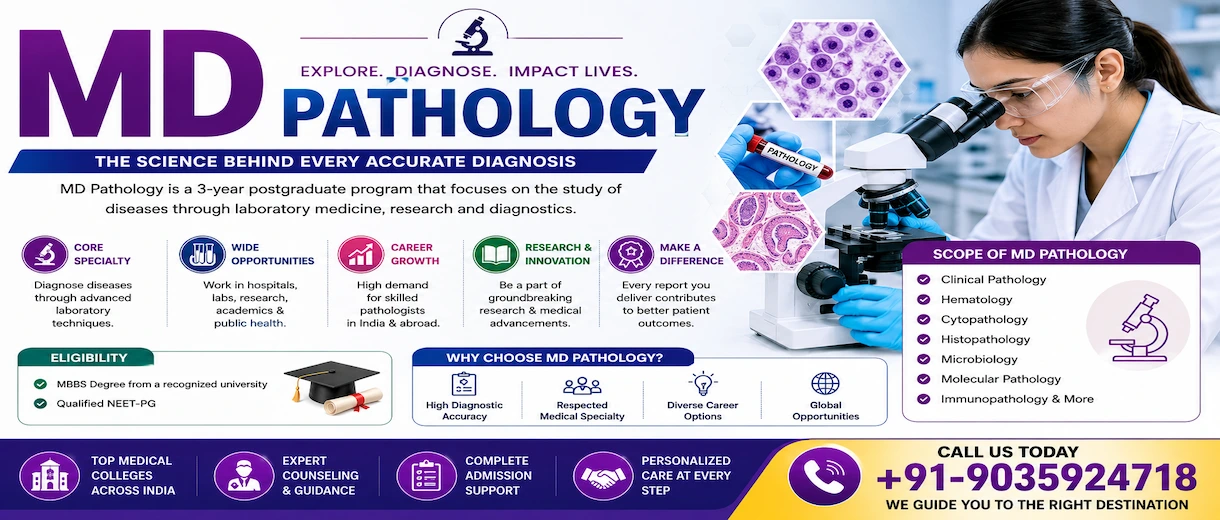
| In this article, you will find MD Pathology Admission Process and Course Information Details – State-wise seats matrix in Government/ Private institutions, Colleges Ranking, Tuition Fees 2026, NEET PG closing score cut off. |
About MD Pathology Course
MD Pathology is a three-year postgraduate medical program in the non-clinical branch of medicine. It trains doctors to study diseases, their origin, and their impact on the human body in depth. Pathology plays a vital role in medical diagnosis by examining tissues, fluids, and organs.
For MD Pathology admission, candidates must hold an MBBS degree with at least 50% marks from an NMC-approved university. They must also qualify for an entrance test like NEET PG or INI CET to secure a seat. Top institutions such as MAMC, MPGIMER Nashik, GMC Kozhikode, GMC Kottayam, LHMC, ESIC MC Joka, TMC Mumbai, GMC Goa, ESIC PGIMSR Bengaluru, and IMS BHU are offering admission for this program.
The course builds expertise in identifying diseases through advanced lab investigations and microscopic analysis. Leading colleges like MAMC, MPGIMER Nashik, GMC Kozhikode, GMC Kottayam, ESIC MC Joka, GMC Goa, ESIC PGIMSR Bengaluru, IMS BHU also provide excellent training in this field.
The demand for MD Pathology specialists is growing rapidly due to their critical role in modern healthcare systems. With hospitals, diagnostic centers, and research labs relying on precise disease detection, career prospects remain bright.
Students aspiring to pursue a career in MD Pathology should apply promptly, as applications are currently open at reputable institutions. For further details about admission, eligibility, or guidance, candidates can explore opportunities through our website.
MD Pathology Course 2026 Quick Summary
| Name of the course | Doctor of Medicine in Pathology |
|---|---|
| Generally Known as | MD Pathology |
| Course Level | Post Graduate |
| Duration | 3 years, full-time |
| Stream | Medicine |
| Examination Type | Semester System |
| Eligibility | MBBS degree recognized by the National Medical Commission (NMC) |
| Admission Process | Based on the results of the entrance examination (PG NEET) or personal interview in some cases |
| Number of Pathology Colleges | Govt. – 238 Pvt – 248 |
| Number of Pathology Seats | Govt – 1836 Pvt – 1507 |
| Entrance Exam | NEET PG, INI CET (AIIMS PG, PGIMER, JIPMER PG) |
| Average Course Tuition Fee | GOVT. Quota Fees – INR 1150/Year – INR 1960500/Year MNGT Quota Fees – INR 181910/Year –INR 4100000/Year NRI Quota Fees – INR 20000/Year – INR 5396300/Year |
| Average Starting Salary | INR 1 to 12 Lakhs |
| Top Recruiting Companies | Apollo Hospitals, National Institute of Health, Armed Forces Institute of Pathology, Food and Drug Administration, All India Institute of Medical Sciences, Dr. Lal Path Labs, Intelligence Bureau, Central Bureau of Investigation, Asian Institute of Medical Sciences |
What is MD Pathology?
Pathology is a branch of medicine focused on studying the causes and effects of various diseases. A trained specialist in this field is known as a Pathologist. Pathologists analyze body fluids and tissues to understand the cause and behavior of diseases, aiding in accurate diagnosis. When an individual or living organism is affected by a disease, it can cause both functional and structural changes within the body.
The study of these bodily changes is known as Pathology. This is a wide medical field. It can be divided into several specialized branches. These include Neuropathology, Hematopathology, Cytopathology, Renal Pathology, and Dermatopathology, among others. These are some of the most prominent subfields within Pathology.
MD Pathology Course Objectives
The MD Pathology course aims to build a strong understanding of disease mechanisms. It also seeks to improve diagnostic skills. The course promotes research and innovation. It encourages critical thinking and ensures ethical practice. It prepares students for roles in clinical and academic pathology. Here are the key course objectives:
- Comprehensive Knowledge: To provide an in-depth understanding of the fundamentals of pathology, including disease mechanisms, causes, and effects on the human body.
- Diagnostic Skills: To develop proficiency in laboratory techniques, histopathology, cytology, and clinical pathology for accurate disease diagnosis.
- Practical Application: To enable students to effectively apply pathological knowledge in real-world medical settings, particularly in diagnostic labs and hospitals.
- Research and Innovation: To encourage research and innovation in the field of pathology, promoting evidence-based practices and new diagnostic techniques.
- Critical Thinking: To foster analytical and critical thinking skills for interpreting laboratory results and correlating them with clinical findings.
- Collaboration and Communication: To improve communication and collaboration skills necessary for working with other healthcare professionals in a multidisciplinary environment.
- Lifelong Learning: To instill a commitment to continuous professional development, keeping up with advancements in pathology and medical research.
- Ethics and Professionalism: To ensure that students adhere to high standards of ethics and professionalism in their practice as pathologists.
These objectives are aimed at preparing MD Pathology graduates to excel in both clinical and academic settings.
MD Pathology Course Duration
The MD Pathology course typically spans 3 years, comprising both academic learning and extensive practical training. Here’s a breakdown of the duration:
- Total Duration: 3 years (full-time).
- Theoretical Studies: Comprehensive coursework covering various branches of pathology.
- Practical Training: Hands-on experience in clinical laboratories, including diagnostic techniques and procedures.
- Research Work: Involvement in research projects or dissertations focused on pathology-related topics.
- Examinations: Periodic assessments, practical exams, and final evaluations are conducted throughout the course.
This structure ensures a balanced combination of theoretical knowledge and practical skills necessary for a successful career in pathology.
MD Pathology Admission Eligibility Criteria
MD Pathology Admission Eligibility Criteria typically includes the following key points:
- Educational Qualification: Must have an MBBS degree from a recognized medical institution.
- Internship Completion: Completion of a 1-year mandatory rotating internship by the time of admission.
- Medical Registration: Registered with the Medical Council of India (MCI) or a State Medical Council (SMC).
- Entrance Exam: Must qualify for the NEET-PG entrance exam with the required cutoff score.
- Minimum Marks: Meet the minimum aggregate marks criteria in MBBS (often around 50% or above).
- Counseling: Participate in the counseling process based on NEET-PG ranking for seat allocation.
- Category Reservation: Eligibility may vary slightly depending on reservation criteria (SC/ST/OBC/General).
MD Pathology Admission Process
- Qualifying Exam: Candidates must appear for NEET PG/ AIIMS PG, PGIMER, JIPMER PG and score the required percentile to be eligible for counselling.
- Counselling: The counselling process for admission is conducted by the Medical Counselling Committee (MCC) for the All India Quota (AIQ) and by state authorities for state quota seats.
- Seats: Admissions are based on NEET PG rank, and the number of seats available in medical colleges under government, private, and deemed universities.
- Admission to MD in Pathology is based on the candidate’s performance in the national level entrance examination National Eligibility Cum Entrance Test (NEET) PG which is a single-window entrance examination to MD/MS/PG diploma courses in Medicine.
Entrance Exams
- NEET-PG: The National Board of Examinations (NBE) conducts NEET-PG annually for admission to various MD/MS courses, including Pathology.
- Some autonomous institutes like AIIMS, JIPMER, and PGIMER conduct separate entrance exams (INI CET) or counseling, though many colleges often accept NEET-PG scores.
Counselling Process for NEET PG MD Pathology Admission
- All India Quota (AIQ): 50% of the seats in government medical colleges are reserved under the All India Quota, and the counselling for these seats is conducted by the Medical Counselling Committee (MCC).
- State Quota: The remaining 50% of seats in government medical colleges, as well as seats in private and deemed universities, are filled through state-level counselling.
- Management Quota: Private medical colleges may also offer seats under the management quota, where admissions are based on NEET PG scores but with a different fee structure.
The NEET PG Counselling Process is an organized procedure for postgraduate medical admissions in India. Here’s a step-by-step guide:
1. Qualifying NEET PG Exam
- Candidates must first qualify for the NEET PG exam conducted by the National Board of Examinations (NBE). The exam is mandatory for admission into MD/MS/PG Diploma courses.
2. Registration for Counselling
- Qualified candidates need to register online for the counselling process.
- The registration is done through the official websites of either the Medical Counselling Committee (MCC) for All India Quota (AIQ) seats or respective state counselling authorities for state quota seats.
3. Payment of Counselling Fee
- After registration, candidates must pay a non-refundable registration fee and a refundable security deposit, based on the seat category (AIQ, Deemed Universities, etc.).
4. Choice Filling and Locking
- Candidates must fill in their choices of courses and colleges.
- They can select multiple colleges and courses in order of preference.
- Once satisfied, the choices must be locked before the deadline. After locking, changes cannot be made.
5. Seat Allotment
- Based on the candidate’s NEET PG rank, category, and choices, the seat allotment process is conducted.
- The result of the allotment is announced online, and candidates can check which seat they’ve been allotted.
6. Reporting to the Allotted College
- Candidates who are allotted a seat must report to the respective college within the given time frame with the required documents.
- At this stage, candidates can choose to either accept the seat or opt for upgradation to a better-preferred seat in subsequent rounds.
7. Document Verification
- At the allotted college, candidates undergo document verification.
8. Free Exit / Upgradation
- After Round 1, candidates can either:
- Exit without penalty if they do not wish to continue with the allotted seat, or
- Upgrade by participating in Round 2 for better options.
9. Round 2 and Mop-Up Round
- If seats remain vacant after Round 1, Round 2 and Mop-Up rounds are conducted.
- In these rounds, candidates may upgrade or apply for leftover seats. The same process of choice filling, locking, and seat allotment is followed.
10. Final Admission
- Once satisfied with the allotted seat, candidates complete all formalities by paying the fees and joining the course.
This process ensures that candidates are allotted seats based on merit and their preferred colleges and courses.
Documents Required for MD Pathology Admission
Here are the documents required for MD Pathology admission:
- MBBS Degree Certificate: Proof of completing the MBBS course from a recognized institution.
- MBBS Mark Sheets: Mark sheets of all professional MBBS examinations.
- Internship Completion Certificate: Certificate confirming the completion of a one-year compulsory rotating internship.
- NEET-PG Scorecard: Proof of qualifying the NEET-PG exam with the required cutoff.
- Medical Registration Certificate: Registration with the Medical Council of India (MCI) or State Medical Council (SMC).
- Transfer Certificate (TC): Issued by the previous institution after completion of MBBS.
- Migration Certificate: For students coming from other universities.
- Category Certificate (if applicable): SC/ST/OBC/EWS certificate if applying under a reserved category.
- Date of Birth Proof: Birth certificate or 10th-grade mark sheet for age verification.
- Passport-sized Photographs: Recent passport-sized photographs (usually 4-6 copies).
- Photo ID Proof: Aadhaar card, passport, or any government-issued ID.
- Domicile Certificate (if applicable): Proof of residence if required by the institution.
These documents are typically required during the admission and counseling process for MD Pathology.
MD Pathology Course Syllabus
The MD Pathology program is typically structured over three years, divided into six semesters. Below is a semester-wise breakdown of the course syllabus:
Key Subjects Covered:
- General Pathology: Study of disease mechanisms, cellular injury, inflammation, and neoplasia.
- Systemic Pathology: Pathology of various organ systems, including (Cardiovascular Respiratory, Gastrointestinal Renal Neurological Endocrine).
- Clinical Pathology: Laboratory techniques in hematology, biochemistry, and microbiology.
- Cytopathology: Techniques and interpretation of cytological specimens, including FNAC and Pap smears.
- Histopathology: Examination of tissue samples to diagnose diseases through microscopic analysis.
- Forensic Pathology: Basics of forensic medicine, including autopsy procedures and legal implications.
- Immunopathology: Study of immune system disorders and their pathological implications.
- Hematopathology: Focus on blood disorders, including leukemia, anemia, and coagulation disorders.
- Research Methodology: Principles of designing and conducting research, data analysis, and scientific writing.
- Practical Training: Hands-on experience in diagnostic laboratories and clinical settings, including autopsies.
Syllabus of Pathology as prescribed by various Universities and Colleges.
| Semester 1 | General Pathology and Basic Sciences |
| General Pathology | Introduction to pathology, cellular injury, inflammation, and repair. |
| Biochemistry | Basic biochemical processes relevant to pathology. |
| Histopathology | Basic histological techniques and tissue processing. |
| Microbiology | Introduction to infectious diseases and laboratory techniques. |
| Semester 2 | Systemic Pathology and Clinical Pathology |
| Systemic Pathology | Pathology of the cardiovascular, respiratory, and gastrointestinal systems. |
| Clinical Pathology | Basic techniques in hematology and clinical biochemistry. |
| Cytopathology | Fundamentals of cytology, including FNAC and Pap smears. |
| Immunology | Basic immunological principles related to disease. |
| Semester 3 | Advanced Pathology |
| Advanced General Pathology | In-depth study of neoplasia and genetic disorders. |
| Neuropathology | Pathology of the nervous system. |
| Renal Pathology | Study of kidney diseases and their pathological aspects. |
| Hematopathology | Disorders of blood and bone marrow. |
| Semester 4 | Clinical and Forensic Pathology |
| Forensic Pathology | Introduction to forensic medicine, autopsy techniques, and legal aspects. |
| Clinical Pathology | Advanced techniques in clinical biochemistry and laboratory management. |
| Dermatopathology | Study of skin diseases and histopathological findings. |
| Research Methodology | Principles of research design and biostatistics. |
| Semester 5 | Special Topics in Pathology |
| Pediatric Pathology | Pathological conditions specific to pediatric populations. |
| Endocrine Pathology | Study of diseases of the endocrine glands. |
| Gastrointestinal Pathology | Focus on diseases of the digestive system. |
| Research Project | Development and presentation of a research project. |
| Semester 6 | Practical Training and Thesis |
| Practical Training | Hands-on experience in laboratories and clinical settings, including autopsy practice. |
| Thesis Submission | Completion and submission of a research thesis based on independent research. |
| Case Discussions | Presentation and discussion of clinical cases and pathological findings. |
Assessment:
- Theory and practical examinations at the end of each semester.
- Continuous assessment through projects, presentations, and laboratory work.
This semester-wise structure ensures that MD Pathology students receive a comprehensive education, balancing theoretical knowledge with practical experience in various aspects of pathology.
MD Pathology Career Opportunities
In this section, we provide the career opportunities after MD Pathology course in India available to them in various fields; let’s look.
- Pathologist: Work in hospitals, diagnostic laboratories, or private practices, diagnosing diseases by examining tissues, blood, and other specimens.
- Clinical Pathologist: Specialize in laboratory medicine, focusing on the interpretation of laboratory tests and managing laboratory operations.
- Cytopathologist: Focus on the diagnosis of diseases through the examination of cellular material obtained from body fluids or tissues.
- Hematopathologist: Specialize in diagnosing blood disorders, including anemias, leukemias, and lymphomas, through blood and bone marrow analysis.
- Forensic Pathologist: Work in legal settings, performing autopsies to determine the cause of death and providing expert testimony in court.
- Research Scientist: Engage in medical research to advance knowledge in pathology and contribute to the development of new diagnostic techniques and treatments.
- Academic Positions: Teach in medical schools, training the next generation of medical professionals, and conducting research in pathology.
- Consultant Pathologist: Provide expert opinions on complex cases, advising hospitals and healthcare facilities on diagnostic issues.
- Laboratory Director: Manage and oversee the operations of clinical laboratories, ensuring quality control and compliance with regulations.
- Public Health Pathologist: Work with government agencies or public health organizations to monitor and address health issues at a population level.
These career paths offer diverse opportunities for professional growth, research, teaching, and leadership within the healthcare sector.
Super-Specialization after MD Pathology Course
After completing an MD in Pathology, graduates may pursue super-specialization in various subspecialties to enhance their expertise and career prospects. Here are some common areas of super-specialization:
| DM/DrNB | CLINICAL HAEMATOLOGY |
| DM | ONCO-PATHOLOGY |
| DM/DrNB | MEDICAL GENETICS |
- Hematopathology: Focuses on diseases of the blood and bone marrow, including leukemias, lymphomas, and anemias.
- Cytopathology: Involves the study and diagnosis of diseases through the examination of cells obtained from body fluids and tissues, commonly through procedures like fine-needle aspiration (FNA).
- Neuropathology: Concentrates on the pathology of the nervous system, including brain and spinal cord diseases, neurodegenerative disorders, and brain tumors.
- Dermatopathology: Specializes in the diagnosis of skin diseases through microscopic examination of skin biopsies.
- Gastrointestinal Pathology: Focuses on diseases affecting the gastrointestinal tract, including the esophagus, stomach, intestines, and liver.
- Pulmonary Pathology: Involves the study of diseases affecting the lungs, including interstitial lung disease, lung infections, and tumors.
- Forensic Pathology: Specializes in determining the cause of death through autopsy and the study of injury patterns in legal contexts.
- Transfusion Medicine: Focuses on blood banking, transfusion practices, and the management of blood product utilization.
- Molecular Pathology: Combines pathology with molecular biology techniques to diagnose diseases at the molecular level, particularly cancers and genetic disorders.
Benefits of Super-Specialization
- Enhanced Expertise: Deepens knowledge and skills in a specific area of pathology.
- Career Advancement: Opens up opportunities for advanced roles, academic positions, and leadership roles in healthcare settings.
- Increased Demand: Specialized pathologists are in high demand in hospitals, research institutions, and private laboratories.
Super-specialization in pathology allows MD graduates to refine their skills and contribute significantly to patient care and medical research, making it a valuable pathway for career development in the field.
MD Pathology Job Prospects and Salary
MD Pathology Job Prospects
Graduates with an MD in pathology have strong job prospects due to the essential role pathologists play in healthcare. Opportunities can be found in various settings, including:
- Hospitals: Working in both public and private hospitals as part of the pathology department, diagnosing diseases through lab tests and tissue analysis.
- Diagnostic Laboratories: Employed in standalone labs that conduct tests for various medical conditions, often specializing in specific areas like hematology or cytology.
- Academic Institutions: Teaching positions in medical colleges, training future doctors, and conducting research in pathology.
- Research Institutes: Engaging in research to advance the field of pathology, developing new diagnostic methods, and contributing to medical science.
- Forensic Laboratories: Working with law enforcement agencies to determine causes of death and provide expert testimony in legal cases.
- Public Health Organizations: Involvement in epidemiology and public health, addressing community health issues through disease surveillance and control.
- Consultancy: Providing expert opinions and consultations on complex diagnostic cases.
MD Pathology Salary
- Entry-Level Salary: Fresh MD Pathology graduates can expect salaries ranging from ₹8 to ₹12 lakhs per annum.
- Mid-Level Salary: With a few years of experience, pathologists may earn between ₹12 to ₹20 lakhs per annum.
- Senior-Level Salary: Experienced pathologists in specialized roles or leadership positions can earn ₹20 to ₹40 lakhs per annum or more, depending on their expertise and the nature of their employment.
Overall, MD Pathology offers excellent career prospects and competitive salaries, with opportunities for growth in both clinical practice and academic settings.
Quota-wise MD Pathology 2025 Closing Score Cut off
| Quota | Description | Opening NEET PG 2025 Score | Closing NEET PG 2025 Score |
|---|---|---|---|
| AIQ | All India Counselling | 76 | 565 |
| AMU | Aligarh Muslim University Counselling | 262 | 287 |
| DUQ | Delhi University – Internal Counselling | 156 | 515 |
| IPQ | Indraprastha University Counselling | 135 | 465 |
| MNQ | Deemed Universities Counselling | 167 | 578 |
| MQ | Management Counselling | 14 | 510 |
| NRI | Non Resident Indian (NRI) Counselling | 105 | 308 |
| OPMQ | Open Management Counselling | 12 | 506 |
| OPQ | Central Universities Counselling | 119 | 502 |
| SQ | State Counselling | 24 | 602 |
All India Category Wise MD Pathology Cut off
The NEET PG 2025 closing cutoff scores for Round-1 MCC Counselling are provided below for all reservation categories. The final column indicates the total number of MD Pathology seats allotted during the 2025 AIQ counselling.
| Category | 2025 Cut off Score | Allotted Seats |
|---|---|---|
| SC | 506 | 105 |
| OBC | 560 | 170 |
| GN-PH | 349 | 3 |
| EWS | 522 | 85 |
| OBC-PH | 246 | 1 |
| GN | 563 | 284 |
| ST | 480 | 60 |
Top 15 MD Pathology Colleges in India
Below is the list of top MD Pathology medical colleges in India, ranked according to candidates’ preferences during NEET PG 2025 All India Quota (AIQ) counselling.
| S. No. | Institute | City / District | Pathology Seats |
|---|---|---|---|
| 1 | Maulana Azad Medical College | New Delhi | 7 |
| 2 | MPGIMER Nashik | Nashik | 6 |
| 3 | Govt Medical College Kozhikkode | Kozhikode | 11 |
| 4 | Govt Medical College Kottayam | Kottayam | 8 |
| 5 | Lady Hardinge Medical College | New Delhi | 10 |
| 6 | ESIC Medical College Joka Kolkata | Kolkata | 4 |
| 7 | Tata Memorial Centre Mumbai | Mumbai | 12 |
| 8 | Goa Medical College Panaji | North Goa | 3 |
| 9 | ESIC and PGIMSR Bangalore | Bangalore Urban | 4 |
| 10 | Institute of Medical Sciences BHU | Varanasi | 9 |
| 11 | Nizam Institute of Medical Sciences | Hyderabad | 8 |
| 12 | Tirunelveli Govt Medical College | Tirunelveli | 7 |
| 13 | Govt Medical College Thiruvananthapuram | Thiruvananthapuram | 12 |
| 14 | Govt Medical College Chandigarh | Chandigarh | 6 |
| 15 | Govt Medical College Thrissur | Thrissur | 10 |
Statewise MD Pathology Seats
| SL. No. | State / UT | Total Colleges | Total Seats |
|---|---|---|---|
| 1 | Karnataka | 65 | 450 |
| 2 | Maharashtra | 59 | 420 |
| 3 | Uttar Pradesh | 56 | 369 |
| 4 | Gujarat | 29 | 285 |
| 5 | Tamil Nadu | 40 | 235 |
| 6 | Rajasthan | 23 | 212 |
| 7 | Madhya Pradesh | 24 | 194 |
| 8 | Telangana | 30 | 178 |
| 9 | Andhra Pradesh | 24 | 160 |
| 10 | Delhi | 10 | 111 |
| 11 | West Bengal | 19 | 107 |
| 12 | Bihar | 17 | 104 |
| 13 | Kerala | 24 | 100 |
| 14 | Uttarakhand | 7 | 94 |
| 15 | Haryana | 11 | 74 |
| 16 | Odisha | 10 | 66 |
| 17 | Punjab | 8 | 56 |
| 18 | Assam | 7 | 56 |
| 19 | Chhattisgarh | 8 | 54 |
| 20 | Jammu & Kashmir | 5 | 45 |
| 21 | Puducherry | 8 | 42 |
| 22 | Chandigarh | 2 | 25 |
| 23 | Jharkhand | 2 | 22 |
| 24 | Manipur | 2 | 16 |
| 25 | Himachal Pradesh | 3 | 14 |
| 26 | Tripura | 2 | 5 |
| 27 | Dadra Nagar Haveli | 1 | 4 |
| 28 | Meghalaya | 1 | 3 |
| 29 | Goa | 1 | 3 |
| Total | 511 | 4,184 |
Read More Articles
| MD TB & Chest | MS Orthopaedics | MD Radiology |
| MD Anaesthesiology | MD Psychiatry | MD Dermatology |
| MD General Medicine | MD/MS Obstetrics and Gynaecology | MD Pediatrics |
| MS ENT | MS General Surgery | MS Ophthalmology |
Conclusion
The demand for MD Pathology graduates is growing, driven by the increasing need for accurate disease diagnosis and the vital role pathologists play in patient care. With robust job prospects and competitive salaries, a career in pathology offers both professional satisfaction and financial stability.
MD Pathology 2026 – FAQs:
Q. What is MD Pathology?
Answer: MD Pathology (Doctor of Medicine in Pathology) is a 3-year postgraduate medical program focusing on the study of diseases through laboratory tests, microscopic analysis, and clinical pathology.
Q. What is the eligibility for MD Pathology in 2026?
Answer:
- Valid NEET PG 2026 qualification.
- MBBS degree from an NMC-recognized medical college.
- Completion of a 1-year compulsory internship.
Q. What is the admission process for MD Pathology?
Answer:
- Seat allotment based on NEET PG rank, category, and availability.
- Appear for NEET PG 2026.
- Participate in counseling (All India Quota / State Quota / Deemed / Private / NRI Quota).
Q. What is the expected NEET PG 2026 cut-off for MD Pathology?
Answer:
- Deemed Universities: 350–450+ marks.
(Exact cut-off varies every year based on difficulty & competition.) - Government Colleges: 550–600+ marks.
- Private Colleges: 400–500+ marks.
Q. What is the syllabus of MD Pathology?
Answer:
- Autopsy & Forensic Pathology
- General Pathology & Basic Sciences
- Hematology & Transfusion Medicine
- Histopathology & Cytopathology
- Clinical Pathology & Immunopathology
- Molecular & Experimental Pathology
Q. What is the course duration?
Answer: The duration of MD Pathology is 3 years (full-time residency program).
Q. What is the average fee for MD Pathology in India (2026)?
Answer:
- Deemed Universities: ₹18 – ₹35 Lakhs total.
- Government Colleges: ₹60,000 – ₹1,50,000 per year.
- Private Colleges: ₹12 – ₹25 Lakhs total.
Q. What is the stipend during MD Pathology?
Answer:
- Private/Deemed Colleges: ₹30,000 – ₹70,000 per month.
- Government Colleges: ₹40,000 – ₹90,000 per month (varies by state).
Q. What are the career opportunities after MD Pathology?
Answer:
- Private practice by setting up a pathology lab.
- Pathologist in hospitals, labs, and diagnostic centers.
- Teaching positions in medical colleges.
- Super-specialization (DM Hematopathology, Clinical Hematology, etc.).
Q. What is the salary after MD Pathology?
Answer:
- With experience / own lab: ₹15 – ₹25 LPA+.
- Freshers: ₹8 – ₹12 LPA.
Q. Is MD Pathology in demand?
Answer: Yes ✅. With increasing reliance on diagnostic labs, histopathology, and molecular medicine, the demand for skilled pathologists is consistently growing in India and abroad.