
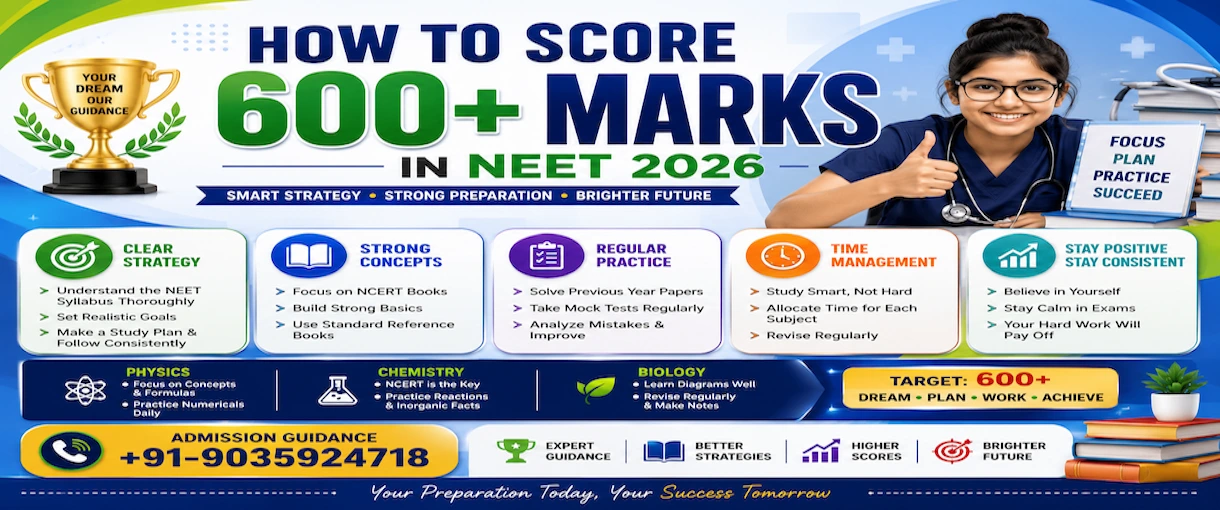
Scoring 600+ in NEET 2026 is an ambitious yet achievable goal with the right strategy, discipline, and consistent effort. It’s a score that can open doors to top government medical colleges and often places you in the 99.5 to 99.8 percentile. This guide provides a comprehensive, step-by-step plan to help you reach this target.
Understanding the Exam & Setting Your Target
Before you begin, it’s crucial to understand the exam’s structure and what a score of 600+ actually means.
- Exam Pattern: NEET 2026 will be a pen-and-paper test with 180 compulsory multiple-choice questions. You have 3 hours (180 minutes) to complete the paper.
- Marking Scheme: You get +4 marks for every correct answer and -1 mark for every incorrect one. Unanswered questions carry 0 marks.
- Subject-Wise Breakdown:
| Subject | No. of Questions | Total Marks |
|---|---|---|
| Physics | 45 | 180 |
| Chemistry | 45 | 180 |
| Biology (Botany + Zoology) | 90 | 360 |
| Total | 180 | 720 |
To score 600+ marks, you should aim for a minimum subject-wise breakdown:
| Subject | Target Score |
|---|---|
| Biology | 320 – 340 |
| Chemistry | 150 – 160 |
| Physics | 120 – 130 |
| TOTAL | 600+ |
The Step-by-Step Strategy
Here’s a proven framework to structure your preparation.
1. Master NCERT: Your Ultimate Foundation
NCERT is the single most important resource for NEET, with 70-80% of questions being directly or indirectly based on it. Your approach should be:
- Line-by-Line Reading: Read every line, understand every sentence, and don’t skip diagrams, tables, or footnotes.
- Multiple Revisions: Plan for at least 3 complete revisions of the NCERT syllabus, especially for Biology.
- Active Learning: Make concise notes, highlight key points, and create flashcards for formulas and reactions.
2. Create a Realistic & Consistent Timetable
Consistency is more important than sporadic long hours. A well-planned daily routine is non-negotiable. Here is a sample schedule to guide you:
| Time | Activity | Duration |
|---|---|---|
| 6:00 – 7:00 AM | Quick revision of formulas and NCERT Biology diagrams | 1 Hour |
| 7:00 – 9:00 AM | Physics: Concept building & problem-solving | 2 Hours |
| 9:00 – 10:00 AM | Chemistry: Theory (Inorganic/Organic) | 1 Hour |
| 10:00 – 10:30 AM | Break | 30 Min |
| 10:30 – 12:30 PM | Biology: Theory + MCQs | 2 Hours |
| 12:30 – 1:30 PM | Lunch & Rest | 1 Hour |
| 1:30 – 3:30 PM | Chemistry: Numericals & Practice | 2 Hours |
| 3:30 – 5:00 PM | Physics/Chemistry practice | 1.5 Hours |
| 5:00 – 6:00 PM | Break & Leisure | 1 Hour |
| 6:00 – 8:00 PM | Biology: PYQs & mock test analysis | 2 Hours |
| 8:00 – 9:00 PM | Revision & Notes | 1 Hour |
3. Subject-Wise Strategy for 600+
- Biology (Target: 320-340): This is your highest-scoring section.
- Focus: Human Physiology, Genetics & Evolution, Ecology, Plant Physiology, and Cell Biology.
- Method: Revise NCERT line by line and practice diagrams daily.
- Chemistry (Target: 150-160): A highly scoring subject with a balanced mix of theory and numericals.
- Inorganic: Stick to NCERT. Revise tables, reactions, and periodic properties.
- Organic: Focus on reaction mechanisms and named reactions.
- Physical: Practice numericals regularly.
- Key Chapters: Chemical Bonding, Thermodynamics, Hydrocarbons, Coordination Compounds.
- Physics (Target: 120-130): Often the most challenging, but a solid strategy can secure a good score.
- Focus: Mechanics, Modern Physics, Current Electricity, and Optics.
- Method: Build concepts first, then solve problems. Create a formula sheet for quick revision.
4. Practice & Assess: The Power of Mock Tests and PYQs
- Take Regular Mock Tests: Start taking full-length mock tests weekly and increase the frequency in the final months. In the last 60 days, aim for a minimum of 20 full mock tests.
- Analyze Your Performance: Post-test analysis is crucial. Review every mistake to understand your weak areas and work on them.
- Solve Previous Year Questions (PYQs): Solve at least the last 10 years’ question papers. This will familiarize you with the exam pattern and important topics.
5. Smart Revision & The 100-Day Plan
In the final stretch, a structured revision plan is essential. Here’s a proven 100-day framework:
| Phase | Days | Focus | Goal |
|---|---|---|---|
| Phase 1: Foundation Reset | Day 1-30 | Cover high-yield topics from scratch | Build a strong base |
| Phase 2: Intensive Revision | Day 31-60 | Complete NCERT revision, solve PYQs | Solidify concepts |
| Phase 3: Mock Test Marathon | Day 61-85 | Build exam temperament with daily mock tests | Improve speed and accuracy |
| Phase 4: Final Polish | Day 86-100 | Achieve peak performance, fine-tune weak areas | Final preparation |
Exam Day Strategy
Your performance on the day of the exam can be influenced by your last-minute actions.
- The Night Before:
- Spend a maximum of 60-90 minutes on light revision of Biology NCERT lines, Chemistry reactions, and Physics formulas.
- Do not start any new chapters or solve full-length tests.
- Sleep by 10 PM. Sleep deprivation can reduce recall by 30-40%.
- In the Exam Hall:
- Prioritize Easy Questions: Start with the questions you are most confident about. An easy question can earn you 4 marks in 20 seconds, while a hard one might take 4 minutes for the same reward.
- Focus on Accuracy: It is better to attempt fewer questions with high confidence than to guess blindly and lose marks to negative marking.
- Time Management: Keep the last 15 minutes for a quick review and to ensure all attempted questions are correctly marked.
Summary
Scoring 600+ in NEET 2026 requires a disciplined, multi-pronged approach. By mastering NCERT, following a consistent study schedule, practicing regularly with mock tests and PYQs, and executing a smart exam-day strategy, you can confidently achieve your target. Good luck with your preparation!
BEST of LUCK with your NEET Exam Preparation!