
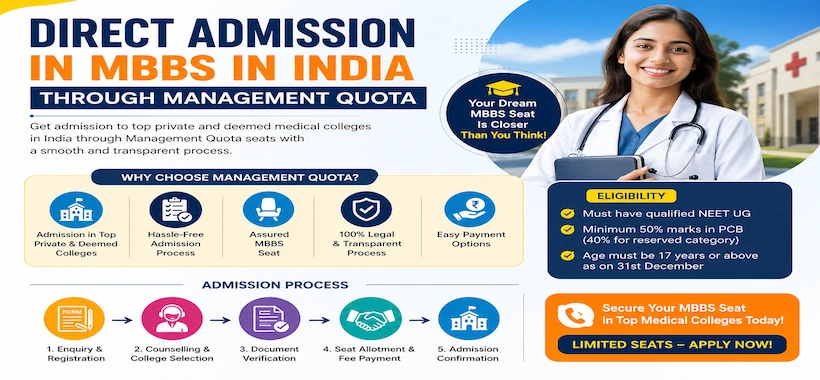
Direct Admission in MBBS in India: MBBS (Bachelor of Medicine and Bachelor of Surgery) is among the most sought-after medical courses in India, with over 22 lakh students appearing for NEET UG every year. Due to limited seats and high cutoffs, MBBS admissions are highly competitive, especially at top government colleges. Although direct admission to MBBS is usually not allowed, some students can enter through management quotas. Institutional quota seats may also be available.
While direct admission without NEET is not allowed, students with qualifying NEET scores can explore alternative routes, such as management-quota MBBS admission and NRI-quota MBBS seats in private medical colleges. These options provide opportunities for candidates who may not secure seats through regular counselling.
This updated MBBS admission guide 2026 covers eligibility, NEET requirements, management quota fees, NRI quota process, seat availability, and counselling steps. Stay updated with NEET UG 2026 news, cut-off trends, and expert guidance to improve your chances of securing an MBBS seat in India or abroad.
MBBS Direct Admission 2026 Quick Summary
| Particulars | Description |
|---|---|
| MBBS Course Duration | 5.5 Years (Including Internship) |
| Eligibility | 10+2 with 50% marks (40% for reserved categories) + NEET qualification |
| Admission Procedure | NEET-based counselling by MCC and State Authorities |
| Average Fees | Govt: ₹10,000 – ₹1,00,000/year Private: ₹7,00,000 – ₹25,00,000/year |
| Average Salary | ₹3 LPA – ₹8 LPA (Freshers) |
| Career Opportunities | Physician, Doctor, Endocrinologist, Pathologist, Neurologist, Cardiologist, Gynaecologist |
| Top Recruiters | Fortis Healthcare, Medanta, Global Hospitals, Dr. Lal PathLabs |
What is Direct Admission to MBBS in India?
MBBS direct admission through management quota and NRI/institutional quota offers an alternative route for students who may not secure top ranks in NEET UG. In private and deemed medical colleges, a limited number of seats are reserved under these quotas. However, NEET qualification is mandatory, and admission is typically based on Class 12 marks along with NEET score. Some colleges may also have additional selection criteria. This pathway is a practical option for students aiming for MBBS admission in India despite high competition and cut-offs.
Type of Direct Admission in MBBS in India
Students who want MBBS admission in India must qualify for NEET UG after completing 10+2. Then, they must join centralized counseling run by the Medical Counselling Committee. Candidates who do not get seats through regular counselling can look at other options. These include management quota MBBS admission and institutional/NRI quota seats. These seats are offered by private and deemed medical colleges.
- Management Quota: Seats in private medical colleges under management quota MBBS admission provide an alternative pathway for students who may not meet high NEET cut-offs but still fulfill eligibility criteria, making it easier to secure admission in top private institutions. While NEET qualification is mandatory for MBBS admission in India, the selection process through these quotas is more flexible, offering better chances with lower cutoff requirements and simplified counselling procedures.
- Institutional Quota: MBBS seats are managed directly by private medical colleges, allowing them to fill admissions based on their internal policies, eligibility norms, and preference criteria, such as regional candidates or institutional background. This pathway offers a more flexible option compared to general counselling, but the NEET qualification remains mandatory for MBBS admission in India, and the final selection is conducted by the respective college as per its admission guidelines.
- NRI Quota: MBBS Admission in India offers a premium pathway for eligible overseas candidates and NRI-sponsored students to secure seats in top private and deemed medical colleges. Qualification in NEET UG is mandatory, and admission is based on NEET score, eligibility, and documentation. NRI quota MBBS seats feature higher fee structures but provide easier access compared to general merit seats.
What are the advantages of direct admission to MBBS in India?
- Reserved Quota Seats: While NEET qualification remains mandatory, management and NRI/institutional quota MBBS seats provide opportunities for students with comparatively lower scores than general merit cut-offs.
- Higher MBBS Admission Chances: Management and institutional quota seats increase the probability of securing an MBBS seat in India, as selection is based on Class 12 marks along with NEET UG scores.
What are the disadvantages of direct admission to MBBS in India?
- Variation in Education Quality: Some colleges offering quota seats may not match top-tier standards, so students must carefully evaluate infrastructure, faculty, and clinical exposure before choosing.
- High MBBS Fees Under Quota: Direct MBBS admission through management or NRI/institutional quota involves significantly higher fees compared to regular NEET UG counselling, as colleges charge a premium for these seats.
- Limited College Options: Only selected private and deemed medical colleges in India offer quota-based admissions, which may restrict choice and preferred college selection.
How to get direct admission to MBBS in India?
- MBBS Eligibility Criteria in India: Candidates must complete 10+2 with Physics, Chemistry, Biology, and English from a recognized board.
- Minimum Marks Requirement: General category students must secure at least 50% marks in PCB subjects, while reserved categories have relaxation as per norms.
- Eligible Candidates: Indian citizens, NRIs, OCIs, PIOs, and foreign nationals can apply for MBBS admission in India.
- NEET UG Mandatory: Qualifying NEET UG is compulsory for all MBBS admissions, including management and NRI quota seats.
- No Direct Admission Without NEET: MBBS admission without NEET qualification is not permitted in India under any quota or category.
What is the process of direct admission to MBBS in India?
Direct MBBS admission process in India:
- Research MBBS Colleges: Explore top private and deemed medical colleges in India offering management/NRI quota MBBS admission. Check fees, rankings, infrastructure, and clinical exposure.
- Check Eligibility Criteria: Ensure you meet MBBS eligibility, including 10+2 PCB marks and qualifying NEET UG.
- Participate in Counselling: Register for NEET UG counselling (15% All India Quota & 85% State Quota) to explore available MBBS seats.
- Apply for Quota Seats: Submit applications directly to colleges for management quota or NRI quota MBBS seats with required documents.
- Pay MBBS Fees: Complete admission by paying the prescribed tuition fees, which are higher for direct admission routes.
- Confirm Admission: Finalize your MBBS seat after document verification and fee payment by the respective college.
What is the management quota admission process for MBBS in India?
- Qualify NEET UG Exam: Clear NEET UG to become eligible for management quota MBBS admission.
- Check NEET Results: Wait for NEET 2026 results declared by National Testing Agency (NTA).
- Register for Counselling: Apply on Medical Counselling Committee portal for deemed universities and respective state counselling authorities.
- State Counselling Registration: Enroll in your preferred state counselling for private medical college seats under management quota.
- Pay Security Deposit: Some states require a refundable security fee (approx. ₹1–2 lakh) during counselling registration.
- Document Verification: Upload and verify required documents like NEET scorecard, mark sheets, and ID proof.
- Choice Filling & Locking: Select preferred MBBS colleges and lock choices for seat allotment rounds.
- Seat Allotment & Mop-Up Rounds: Participate in counselling rounds; if no seat is allotted, attend mop-up and stray vacancy rounds for remaining seats.
What is the eligibility criteria for management quota MBBS admission in India?
Below are the eligibility criteria for management quota MBBS admission in India:
| Particulars | Description |
|---|---|
| Age Limit | Minimum age is 17 years for MBBS admission in India |
| Qualification | 10+2 in Science stream with Physics, Chemistry, Biology, and English |
| Qualifying Marks | Minimum 50% aggregate marks in PCB subjects (as per eligibility norms) |
What documents are required for management quota MBBS admission in India?
The following documents are required for management quota MBBS admission in India:
- Class 12 Documents: 12th marks card and 12th pass certificate (mandatory for MBBS admission in India)
- Class 10 Proof: 10th marks card for date of birth verification
- Transfer Certificate (TC): Issued by the last attended institution
- Conduct Certificate: Proof of good behavior from the previous school/college
- Migration Certificate: Required for students from other boards/universities
- NEET Scorecard: A valid NEET UG result is compulsory
- Category Certificate: Community/caste certificate (if applicable)
- Income Certificate: Required for scholarship or fee concession (if applicable)
- Identity Proof: Aadhaar card and Aadhaar number
- Photographs: Recent passport-size photographs for admission records
What is the NEET UG counselling process for management quota MBBS admission in India?
Candidates seeking MBBS admission in India must register for NEET UG counselling under the All India Quota (AIQ) and State Quota (SQ). The process, conducted by the Medical Counselling Committee, is held online in multiple rounds and also includes options for management quota MBBS admission in deemed and private medical colleges. The counselling involves key steps such as registration, choice filling, seat allotment, and reporting.
- Online Registration: Candidates must first register for NEET UG counselling on the official portal.
- Choice Filling & Locking (Round 1): Select preferred medical colleges and lock choices for the first round of seat allotment.
- Seat Allotment Result (Round 1): Seats are allotted based on NEET rank, preferences, and availability.
- Reporting to College: Candidates allotted a seat must report to the respective college for admission confirmation.
- Fresh Registration (Round 2): Students who didn’t get a seat or want an upgrade can register again for Round 2.
- New Choice Filling & Locking (Round 2): Re-select and lock college preferences for the second round.
- Seat Allotment Result (Round 2): The updated allotment list is released based on revised choices and vacancies.
- Final Reporting to College: Candidates must report to the allotted college in Round 2 to complete the admission process.
MBBS Top Deemed Private Medical Colleges in India
| Rank | College Name | City | State |
|---|---|---|---|
| 1 | Kasturba Medical College | Manipal | Karnataka |
| 2 | Kasturba Medical College | Mangaluru | Karnataka |
| 3 | Sri Ramachandra Medical College & RI | Chennai | Tamil Nadu |
| 4 | Amrita Institute of Medical Sciences | Kochi | Kerala |
| 5 | JSS Medical College | Mysuru | Karnataka |
| 6 | Kalinga Institute of Medical Sciences | Bhubaneswar | Odisha |
| 7 | KS Hegde Medical Academy | Mangaluru | Karnataka |
| 8 | Bharati Vidyapeeth Medical College | Pune | Maharashtra |
| 9 | Jawaharlal Nehru Medical College | Belagavi | Karnataka |
| 10 | Yenepoya Medical College | Mangaluru | Karnataka |
| 11 | SRM Medical College & Hospital | Chennai | Tamil Nadu |
| 12 | Saveetha Medical College | Chennai | Tamil Nadu |
| 13 | Chettinad Hospital & Research Institute | Kancheepuram | Tamil Nadu |
| 14 | Dr DY Patil Medical College | Pune | Maharashtra |
| 15 | Dr DY Patil Medical College | Navi Mumbai | Maharashtra |
| 16 | MGM Medical College | Navi Mumbai | Maharashtra |
| 17 | MGM Medical College | Aurangabad | Maharashtra |
| 18 | Krishna Institute of Medical Sciences | Karad | Maharashtra |
| 19 | JLN Medical College (Datta Meghe) | Wardha | Maharashtra |
| 20 | Datta Meghe Medical College | Nagpur | Maharashtra |
| 21 | Symbiosis Medical College for Women | Pune | Maharashtra |
| 22 | Rural Medical College & PIMS | Loni | Maharashtra |
| 23 | BLDE University Medical College | Vijayapura | Karnataka |
| 24 | Sri Siddhartha Medical College | Tumakuru | Karnataka |
| 25 | Sri Siddhartha Academy Medical College | Bengaluru | Karnataka |
| 26 | Raja Rajeswari Medical College | Bengaluru | Karnataka |
| 27 | Sri Devaraj Urs Medical College | Kolar | Karnataka |
| 28 | JGMM Medical College | Hubballi | Karnataka |
| 29 | GITAM Institute of Medical Sciences & Research | Visakhapatnam | Andhra Pradesh |
| 30 | IMS & SUM Hospital | Bhubaneswar | Odisha |
| 31 | MM Institute of Medical Sciences & Research | Mullana | Haryana |
| 32 | Santosh Medical College & Hospital | Ghaziabad | Uttar Pradesh |
| 33 | Aarupadai Veedu Medical College | Puducherry | Puducherry |
| 34 | Mahatma Gandhi Medical College | Puducherry | Puducherry |
| 35 | Sri Lakshmi Narayana Institute of Medical Sciences | Puducherry | Puducherry |
| 36 | Vinayaka Missions Medical College | Karaikal | Puducherry |
| 37 | ACS Medical College & Hospital | Chennai | Tamil Nadu |
| 38 | Meenakshi Medical College Hospital & RI | Kancheepuram | Tamil Nadu |
| 39 | Sree Balaji Medical College & Hospital | Chennai | Tamil Nadu |
| 40 | Shri Sathya Sai Medical College & RI | Chennai | Tamil Nadu |
| 41 | Bhaarath Medical College & Hospital | Chennai | Tamil Nadu |
| 42 | VMKV Medical College & Hospital | Salem | Tamil Nadu |
| 43 | Manipal TATA Medical College | Jamshedpur | Jharkhand |
| 44 | Dr DYP Education Society Medical College | Kolhapur | Maharashtra |
| 45 | BV Deemed University Medical College & Hospital | Sangli | Maharashtra |
FAQ’s
Q. Why is management quota MBBS admission helpful for students?
A. It offers an alternative route for candidates who may not secure top ranks in NEET UG but still qualify.
Q. How does direct admission reduce competition stress?
A. It allows students to bypass extremely high cut-offs in government colleges.
Q. Is admission faster through management or NRI quota?
A. Yes, the process is often quicker and more streamlined compared to regular counselling.
Q. Do students still need NEET qualification?
A. Yes, NEET qualification is mandatory even for management and NRI quota MBBS seats.
Q. Does it increase chances of getting an MBBS seat?
A. Yes, it improves admission chances in private and deemed medical colleges.
Q. Are there more college options available?
A. Yes, students can choose from a wider range of private institutions across India.