
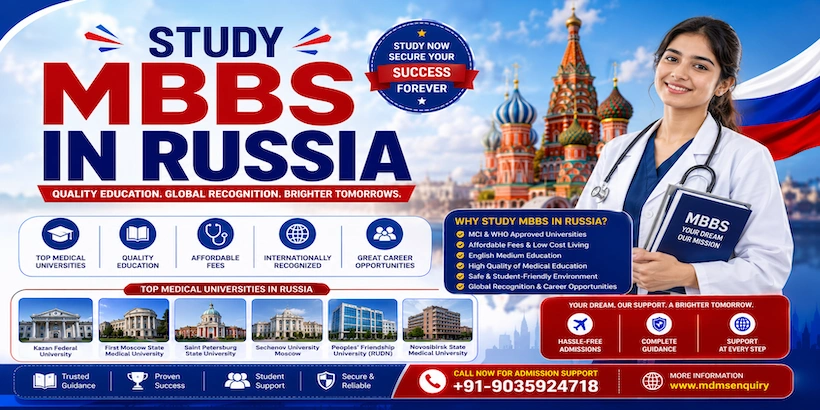
Study MBBS in Russia is a popular choice for Indian students seeking affordable, globally recognised medical education. Russia offers 50+ NMC-approved government medical universities, reasonable tuition fees, quality clinical training, and a simple admission process, making it an excellent alternative to costly private MBBS colleges in India.
Currently, over 15,000 Indian students are pursuing medicine in Russian universities. For the 2026-27 academic session, Russian universities have further modernized their infrastructure, introducing high-tech Simulation Centers and robotics in their curriculum.
MBBS in Russia 2026 Key Highlights
| Parameter | Details |
|---|---|
| Course Duration | 6 Years (5 years academic + 1 year internship) |
| Intake / Session Start | September (Main Intake), February (Limited Universities) |
| NMC-Approved Universities | 50+ |
| Medium of Instruction | English (with basic Russian for clinical practice) |
| NEET Requirement | Mandatory for Indian students |
| Minimum Marks in PCB (12th) | 50% (General) / 40% (SC/ST/OBC) |
| Minimum Age | 17 years as on December 31 of admission year |
| Annual Tuition Fees | ₹2.5 Lakh – ₹8 Lakh per year |
| Total Cost (6 Years) | ₹20 Lakh – ₹45 Lakh (all inclusive) |
| Hostel Fees | ₹50,000 – ₹1 Lakh per year |
| Cost of Living | ₹12,000 – ₹20,000 per month |
| Recognition | NMC, WHO (WDOMS), FAIMER, ECFMG, WFME |
| Entrance Exam | No separate entrance exam (NEET qualification required) |
| Visa Processing | Approximately 20 days |
| Indian Students | 15,000+ |
Why Study MBBS in Russia?
Advantages
1. Affordable Medical Education
- Russian medical universities offer MBBS at a fraction of the cost of private medical colleges in India, where fees often exceed ₹70 lakhs to ₹1 crore. The annual tuition fee typically ranges between ₹2.5 lakh and ₹5 lakh, with total course costs between ₹20-45 lakh. Russian MBBS programs are subsidised by the government, with annual fees starting from ₹3.5 lakh.
2. Globally Recognised Degrees
- Russian medical universities are NMC-compliant, listed in the World Directory of Medical Schools (WDOMS) , and recognised by major international organisations including FAIMER and ECFMG. This allows graduates to practice medicine globally after clearing local licensing requirements.
3. No Donation or Capitation Fees
- Russian universities do not charge any donation or capitation fee for admission. Admission is based on NEET score and academic records, with no hidden charges.
4. Simple Admission Process
- The admission process is straightforward and documentation-based. There is no complicated counseling process like in India.
5. English Medium of Instruction
- Most Russian universities offer MBBS programs in English for international students.
6. Excellent Practical Exposure
- Russian medical universities focus heavily on practical training. Students receive hands-on training in affiliated hospitals, with simulation-based training using advanced technology.
7. Indian Community & Support
- Active Indian Student Associations celebrate festivals like Diwali and Holi on campus. Pure Indian mess facilities are available in most government hostels, making the transition easier.
Disadvantages
1. Language Barrier
- While the first 3-4 years are taught in English, clinical rotations in years 4-6 require Russian proficiency. Students who do not learn Russian early often struggle during clinical years.
2. Harsh Climate
- Russian winters can be extremely cold, with temperatures dropping to -20°C or lower.
3. FMGE/NExT Licensing Exam Challenges
- Russia’s average FMGE pass rate is relatively low at 16.2%, though top universities perform significantly better. Students must prepare for FMGE/NExT alongside their regular curriculum.
4. Cultural Adjustment
- Adapting to a new country, culture, and food can be challenging for some students.
Top Medical Universities in Russia 2026
Russia has 116 NMC-approved medical universities out of 197 medical institutions. Here are some of the most prominent ones:
| University | Location | Total Fees (6 Years) | FMGE Rate | Key Highlights |
|---|---|---|---|---|
| I.M. Sechenov First Moscow State Medical University | Moscow | RUB 66,00,000 | 60% | Oldest & most prestigious; 260+ years of excellence |
| Pavlov First State Medical University of St. Petersburg | St. Petersburg | RUB 32,72,000 | 55% | Strong clinical exposure; historic city |
| Kazan Federal University | Kazan | RUB 32,40,000 | 24% | Affordable; large international community |
| People’s Friendship University of Russia (RUDN) | Moscow | USD 63,000 | 25% | Globally diverse; students from 150+ countries |
| Pirogov Russian National Research Medical University | Moscow | RUB 45,00,000 | 35% | Leading research-oriented university |
| Volgograd State Medical University | Volgograd | RUB 30,30,000 | 15% | Popular among Indian students |
| Kursk State Medical University | Kursk | USD 37,200 | 18% | Well-established; English-medium |
| Bashkir State Medical University | Ufa | RUB 24,30,000 | 25% | Most affordable option |
| Orenburg State Medical University | Orenburg | USD 36,000 | 43% | Affordable; good clinical training |
| Mari State University | Yoshkar-Ola | USD 39,000 | 35% | Affordable option |
Fee Structure 2026
Annual Tuition Fees (Select Universities)
| University | Annual Tuition (RUB) | Annual Tuition (INR)* |
|---|---|---|
| Ingush State Medical University | ₽1,97,000 | ₹2,48,220 |
| Amur State University | ₽2,53,352 | ₹3,19,223 |
| Chita State Medical University | ₽2,80,000 | ₹3,52,800 |
| Dagestan State Medical University | ₽2,80,000 | ₹3,52,800 |
| Kemerovo State Medical University | ₽2,95,000 | ₹3,71,700 |
| Astrakhan State Medical University | ₽3,00,000 | ₹3,78,000 |
| Chechen State Medical University | ₽3,00,000 | ₹3,78,000 |
| Altai State Medical University | ₽3,60,000 | ₹4,53,600 |
| Bashkir State Medical University | ₽3,99,120 | ₹5,02,891 |
| Kursk State Medical University | $6,200 | ₹5,89,000 |
| First Moscow State University | ₽13,00,000 | ₹16,38,000 |
Note: All INR values are approximate. Exchange rate used: 1 RUB = ₹1.259 (as of May 2026)
Eligibility Criteria 2026
| Parameter | Requirement |
|---|---|
| Academic Qualification | 10+2 with Physics, Chemistry, Biology, and English |
| Minimum Marks in PCB | 50% (General) / 40% (SC/ST/OBC) |
| NEET Qualification | Mandatory for Indian students |
| Minimum Age | 17 years as of December 31 of admission year |
| IELTS/TOEFL | Not Required |
Admission Process 2026-27
The admission process for MBBS in Russia is straightforward and documentation-based:
Step-by-Step Process
| Stage | Timeline | Description |
|---|---|---|
| 1. Research & Shortlist | November-December 2025 | Research universities, check NMC approval, fees |
| 2. Application | January-March 2026 | Submit online application with documents |
| 3. Offer Letter | March-April 2026 | Receive invitation letter from university |
| 4. Document Submission | April-May 2026 | Submit NEET score, 10th & 12th marksheets, passport |
| 5. Visa Application | May-July 2026 | Apply for student visa (processing: ~20 days) |
| 6. Travel | August-September 2026 | Travel to Russia for September intake |
Documents Required
- NEET Scorecard
- Class 10th Mark Sheet & Certificate
- Class 12th Mark Sheet & Certificate
- Valid Passport
- Passport-size Photographs
- Medical Fitness Certificate
Important Note
There is no separate entrance exam for MBBS admission in Russia. Admission is based on academic marks and NEET qualification.
FMGE / NExT Pass Rates
Critical Consideration
The FMGE (Foreign Medical Graduate Examination) pass rate is one of the most important factors to consider when choosing a university.
| Metric | Value |
|---|---|
| Russia’s Overall FMGE Pass Rate (2024) | ~29.5% |
| Average FMGE Pass Rate (2026 Data) | 16.2% |
| Top University Performance | 40-50% (e.g., Belgorod State University: 100%) |
| Bottom Performance | Some universities reported 0% pass rate in January 2026 |
FMGE Pass Rate by University
| University | FMGE Pass Rate |
|---|---|
| Belgorod State University | 100% |
| Petrozavodsk Medical Institute | 50% |
| Tambov State University | 34% |
| Peoples Friendship University (RUDN) | 25% |
| Kazan Federal University | 24% |
| Kursk State Medical University | 18% |
| Volgograd State Medical University | 15% |
| Samara State Medical University | 7% |
| Dagestan State Medical University | 6% |
Expert Advice
“Russia offers genuine value: real medical education at 1/5th the cost of Indian private colleges. But the 16.2% average FMGE pass rate tells you that many students don’t prepare adequately. If you go with a plan — learn Russian, start FMGE prep early, choose a top-ranked NMC university — your chances are significantly better than average.”
Recommendations for FMGE Success:
- Start Russian language classes from Day 1
- Join FMGE coaching (Marrow/PrepLadder) by Year 3
- Do not treat the first 3 years as a vacation
- Choose a university with a proven FMGE track record
NMC Recognition 2026
| Parameter | Details |
|---|---|
| Total NMC-Approved Universities in Russia | 116 |
| Total Medical Universities in Russia | 197 |
| Government Institutions | 161 out of 174 listed |
| Recognition Bodies | NMC, WHO (WDOMS), ECFMG, FAIMER |
Important: Only NMC-approved universities allow Indian students to appear for FMGE/NExT and practice in India. Always verify a university’s NMC status before applying.
Career Prospects After MBBS in Russia
| Pathway | Requirements |
|---|---|
| Practice in India | Clear FMGE or NExT (National Exit Test) |
| Practice in USA | Clear USMLE |
| Practice in UK | Clear PLAB |
| Postgraduate in India | Clear NEET-PG after FMGE/NExT |
| Postgraduate Abroad | Apply directly to universities in USA, UK, Australia, etc. |
2026 Key Updates
1. Russian Education Fair 2026
In May 2026, 18 Russian medical universities participated in an education fair for Indian students. MBBS fees in Russia were highlighted as as low as ₹3.5 lakhs to ₹5 lakh per annum.
2. NEET Mandatory
NEET qualification remains mandatory for Indian students seeking MBBS in Russia.
3. NMC-Approved Universities
116 NMC-approved universities are available in Russia for 2026.
4. Infrastructure Upgrades
Russian universities have introduced high-tech Simulation Centers and robotics in their curriculum for 2026.
5. Intake Window
The main intake for 2026 is September-October 2026.
Comparison: Russia vs India Private Medical Colleges
| Parameter | MBBS in Russia | Private Medical Colleges in India |
|---|---|---|
| Total Fees (6 Years) | ₹20-45 Lakhs | ₹70 Lakhs – ₹1 Crore+ |
| Donation/Capitation | ❌ None | ✅ Often required |
| Entrance Exam | NEET only | NEET + College-level exams |
| Medium of Instruction | English | English |
| Clinical Training | From Year 3-4 onwards | From Year 3 onwards |
| Recognition | NMC, WHO, ECFMG | NMC |
| FMGE/NExT Requirement | ✅ Required | ❌ Not required |
Frequently Asked Questions
Q: Is NEET mandatory for MBBS in Russia?
A: Yes, NEET qualification is mandatory for Indian students who wish to practice in India after completing MBBS.
Q: What is the total cost of MBBS in Russia?
A: The total cost for 6 years ranges from ₹20 lakhs to ₹45 lakhs, including tuition, hostel, and living expenses.
Q: Is MBBS in Russia recognized in India?
A: Yes, degrees from NMC-approved Russian universities are recognized in India. Students must clear FMGE/NExT to practice.
Q: What is the medium of instruction?
A: Most universities offer MBBS in English. However, clinical rotations in years 4-6 require Russian proficiency.
Q: How is the FMGE pass rate for Russian graduates?
A: Russia’s overall FMGE pass rate is 16.2%, though top universities perform much better (24-100%).
Q: Can I work in the USA or UK after MBBS in Russia?
A: Yes, graduates can appear for USMLE (USA) or PLAB (UK) to practice in those countries.
Q: Is there an age limit for MBBS in Russia?
A: The minimum age is 17 years as of December 31 of the admission year. There is no upper age limit.
Q: Do I need IELTS/TOEFL?
A: No, IELTS/TOEFL is not required for MBBS admission in Russia.
Disclaimer: This article is based on publicly available information as of July 2026. Admission policies, fees, and recognition status are subject to change. Readers are strongly advised to verify all information through official university websites and NMC notifications before making any admission decisions. The FMGE pass rate data varies by source and year; students should research individual university performance carefully.