
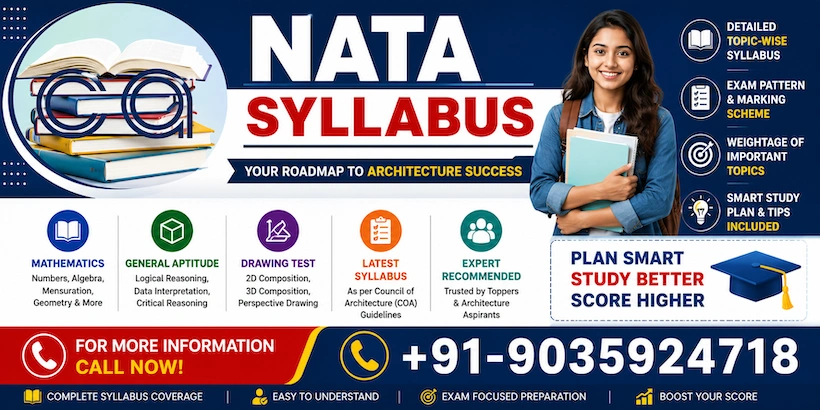
The NATA syllabus 2026 includes two main sections: Drawing and General Aptitude. The syllabus will be officially released by the Council of Architecture (CoA) and made available for candidates to access. Stay updated to ensure comprehensive preparation for the NATA exam by reviewing the detailed syllabus and focusing on the specified topics.
The NATA 2026 syllabus has been officially released by the Council of Architecture (CoA) on the NATA website. Candidates preparing for the NATA 2026 exam should carefully review the latest syllabus and exam pattern to understand the important topics and marking structure. The NATA question paper will be designed strictly according to the prescribed syllabus. NATA 2026 registration is expected to begin on March 9, 2026. The examination will be conducted every Friday and Saturday from April 4 to June 13, 2026. Aspirants aiming for admission to top B.Arch colleges should follow the updated NATA syllabus, practice regularly, and stay informed about all important exam dates and notifications.
NATA Syllabus 2026 Quick Details
The exam pattern of NATA 2026 gives detailed information about the exam’s duration, the number of questions asked, the medium of question paper and more. By checking the NATA 2026, the candidate will process the information and prepare well beforehand. Detailed information about NATA 2026 syllabus is listed below:
| NATA 2026 Syllabus Overview | Details |
|---|---|
| Conducting Authority | Council of Architecture (CoA) |
| Exam Name | National Aptitude Test in Architecture (NATA) 2026 |
| Exam Mode | Computer-Based Test (CBT) |
| Syllabus Focus | Architecture Aptitude, Drawing & Design Skills, Logical Reasoning, Mathematics, Visual Perception |
| Part A Topics | Mathematics, General Aptitude, Logical Reasoning, Visual Reasoning, Analytical Ability |
| Part B Topics | Drawing Composition, Sketching, 3D Visualization, Perspective Drawing, Creative Thinking |
| Mathematics Topics | Algebra, Trigonometry, Coordinate Geometry, Probability, Statistics, Calculus |
| Aptitude Topics | Observation Skills, Spatial Ability, Mental Ability, Critical Thinking, Pattern Recognition |
| Drawing & Design Topics | Architectural Awareness, Scale & Proportion, Geometric Composition, Creative Design |
| Important Skills Tested | Creativity, Visualization, Imagination, Aesthetic Sensitivity, Problem Solving |
| Registration Start Date | March 2026 |
| Exam Dates | Every Friday and Saturday from April to June 2026 |
| Official Website | nata.in |
NATA Syllabus 2026
National Aptitude Test in Architecture 2026 offers a syllabus in 3 phases, categorized broadly to include Mathematics, Drawing & General Aptitude.
| Aptitude Techniques | Explanation |
| Diagrammatic Reasoning | Testing the candidate’s ability of logical reasoning, using diagrams and scenarios |
| Numerical Reasoning | Testing the candidate’s Mathematical ability through simple problems |
| Verbal Reasoning | Assessing the ability to assess verbal logic |
| Inductive Reasoning | Testing the ability to see patterns and analyse given data |
| Situational Judgment | Assessing the problem-solving ability of the candidate |
| Logical Reasoning | Ability to recognize patterns, sequences or relationships between shapes and imagery |
| Abstract Reasoning | Assessing the candidate’s general knowledge, and ability to utilize knowledge in new situations |
NATA Syllabus 2026 for Mathematics
Candidates can review the NATA 2026 Mathematics syllabus based on the previous year’s notification for guidance. The syllabus highlights key mathematical topics important for architectural aptitude. Stay tuned for official updates on the NATA website to ensure your preparation aligns with the latest requirements.
| Units | Topics Covered |
| Algebra | Definitions of A. P. and G.P.; General term; Summation of first n-terms of series ∑n, ∑n²,∑n3 ;Arithmetic/Geometric series, A.M., G.M. and their relation; Infinite G.P. series and its sum |
| Logarithms | Definition; General properties; Change of base |
| Matrices | Concepts of m x n (m ≤ 3, n ≤ 3) real matrices, operations of addition, scalar multiplication of matrices. Transpose of a matrix. Determinant of a square matrix. Properties of determinants (statement only). Minor, cofactor and adjoint of a matrix. Nonsingular matrix. Inverse of a matrix. Finding area of a triangle. Solutions of system of linear equations. (Not more than 3 variables). |
| Trigonometry | : Trigonometric functions, addition and subtraction formulae, formulae involving multiple and submultiple angles, general solution of trigonometric equations. Properties of triangles, inverse trigonometric functions and their properties |
| Coordinate Geometry | Distance formula, section formula, area of a triangle, condition of collinearity of three points in a plane. Polar coordinates, transformation from Cartesian to polar coordinates and vice versa. Parallel transformation of axes, concept of locus, elementary locus problems. Slope of a line. Equation of lines in different forms, angle between two lines. Condition of perpendicularity and parallelism of two lines. Distance of a point from a line. Distance between two parallel lines. Lines through the point of intersection of two lines.Equation of a circle with a given center and radius. Condition that a general equation of second degree in x, y may represent a circle. Equation of a circle in terms of endpoints of a diameter. Equation of tangent, normal and chord. Parametric equation of a circle. Intersection of a line with a circle. Equation of common chord of two intersecting circles. |
| 3-dimensional coordinate geometry | Direction cosines and direction ratios, distance between two points and section formula, equation of a straight line, equation of a plane, distance of a point from a plane. |
| Theory of calculus | Functions, composition of two functions and inverse of a function, limit, continuity, derivative, chain rule, derivatives of implicit functions and functions defined parametrically. Integration as a reverse process of differentiation, an indefinite integral of standard functions. Integration by parts. Integration by substitution and partial fraction. Definite integral as a limit of a sum with equal subdivisions. Fundamental theorem of integral calculus and its applications. Properties of definite integrals. Formation of ordinary differential equations, solution of homogeneous differential equations, separation of variables method, linear first-order differential equations |
| Application of calculus | Tangents and normals, conditions of tangency. Determination of monotonicity, maxima and minima. Differential coefficient as a measure of rate. Motion in a straight line with constant acceleration. Geometric interpretation of definite integral as area, calculation of area bounded by elementary curves and Straight lines. Area of the region included between two elementary curves. |
| Permutation & Combination | Permutation of n different things taken r at a time (r ≤ n). Permutation of n things not all different. Permutation with repetitions (circular permutation excluded). Combinations of n different things taken r at a time (r ≤ n). Combination of n things not all different. Basic properties. Problems involving both permutations and combinations. |
| Statistics & Probability | Measure of dispersion, mean, variance and standard deviation, frequency distribution. Addition and multiplication rules of probability, conditional probability and Bayes’ Theorem, independence of events, repeated independent trails and Binomial distribution. |
NATA Syllabus 2026 for Chemistry
Candidates can check the NATA Chemistry syllabus 2026 from the given below.
| Subject | Syllabus |
| Chemistry | Some Basic Concepts of Chemistry; Structure of Atom; Classification of Elements and Periodicity in PropertiesChemical Bonding and Molecular; States of Matter: Gases and LiquidsChemical Thermodynamics; Equilibrium; Redox Reactions; Hydrogen; s- Block Elements p -Block ElementsOrganic Chemistry: Some basic Principles and Techniques; Hydrocarbons; Environmental Chemistry |
NATA Syllabus 2026 for Physics
Candidates can check the NATA Physics syllabus 2026 from the given below.
| Subject | Syllabus |
| Physics | Electrostatics- Electric charges and Fields; Electrostatic Potential and ClearanceCurrent Electricity; Magnetic Effects of Current and Magnetism; Moving Charges and magnetism; Magnetism and MatterElectromagnetic Induction and Alternating currents- Electromagnetic Induction; Alternating CurrentOptics- Ray optics and optical instruments, Wave Optics Dual nature of radiation and MatterAtoms and Nuclei- Atoms, NucleiElectronic devices- Semiconductor Electronics, Materials, Devices and Simple circuits. |
NATA Syllabus 2026 for General Aptitude
| Units | Topics Covered |
| General | Objects, texture related to architecture and the built environment. Interpretation of pictorial compositions, Visualizing three-dimensional objects from two-dimensional drawing. Visualizing different sides of 3D objects. Analytical reasoning, mental ability (visual, numerical and verbal), General awareness of national/ international architects and famous architectural creations |
| Mathematical Reasoning | Statements, logical operations like and, or, if and only if, implies, implied by. Understanding of tautology, converse, contradiction and contrapositive. |
| Sets & Relations | Idea of sets, subsets, power set, complement, union, intersection and difference of sets, Venn diagram, De Morgan’s Laws, Relation and its properties. Equivalence relation — definition and elementary examples. |
NATA Syllabus 2026 for Drawing Test
| Topic | Syllabus |
| Drawing | Understanding the important visual principles in a composition (2D OR 3D) such as balance, rhythm, direction, hierarchy, etc. Understanding geometry and the ability to visualize shape and solve geometrical puzzles to test spatial intelligence; Understanding color theory and the various terminologies to test color scheme awareness and knowledge; Visual system interpretation and perception to test graphical similarities and other properties; Ability to understand spatial relationship between objects, and to visualize images and scenarios; Tests for cognitive ability: perception, attention, recognition, memory etc.” |
NATA Contact Details
| Details | Contact |
| Head Office | Council Of Architecture India Habitat Centre, Core 6A, 1st Floor, Lodhi Road, New Delhi-110003 India |
| Contact No | 080-45549467 ( Timing will be – 10.00 AM to 7.00 PM ) |
| nata.helpdesk2026@gmail.com |
- NATA Notification
- NATA Admit Card
- NATA Eligibility Criteria
- NATA Cut-Off
- NATA Exam Pattern
- NATA Counseling
- NATA Syllabus
Frequently Asked Questions (FAQs)
Q: What is the objective of NATA 2026?
A. The objective of NATA 2026 is to evaluate candidates’ aptitude for architecture studies. It tests candidates’ abilities in subjects like mathematics, drawing, and general aptitude to assess their creativity and analytical skills.
Q: What is the medium of NATA 2026 paper?
A. The NATA 2026 paper will be conducted in English, and candidates will have to take the exam in the specified online or offline mode, depending on the guidelines issued by the conducting authority.
Q: Is NATA exam syllabus very tough?
A. The NATA exam syllabus is challenging but manageable with the right preparation. It includes topics like mathematics, drawing, and general aptitude, requiring a strong grasp of these areas. With consistent practice and understanding of the syllabus, candidates can perform well.
Q: What is the syllabus for NATA exam?
A. The NATA syllabus includes two sections: Mathematics and General Aptitude, focusing on topics like algebra, geometry, and trigonometry. It also covers Drawing, where candidates need to demonstrate creative skills, and Logical Reasoning, such as pattern recognition. Understanding these areas thoroughly is crucial for success in the exam.
Q: Who releases the NATA syllabus?
A. The National Aptitude Test in Architecture (NATA) syllabus is officially released by the Council of Architecture (CoA). They provide a detailed syllabus for the exam, covering topics such as mathematics, general aptitude, drawing, and reasoning skills. Candidates can find the updated syllabus on the official CoA website.
Q: Is the NATA 2026 syllabus released?
A. As of now, the NATA 2026 syllabus has not been officially released. However, the Council of Architecture (CoA) typically releases the syllabus for each year’s exam closer to the exam date. Keep an eye on the official CoA website or related announcements for the updated syllabus for NATA 2026.
| Disclaimer: The information shared here is collected from multiple reliable sources for educational and informational purposes. While we strive to provide accurate and updated details, some information may change over time. If you notice any incorrect data or discrepancies, please contact us at mbbsenquiry1[@]gmail.com so our team can review and update the information accordingly. Read More |