
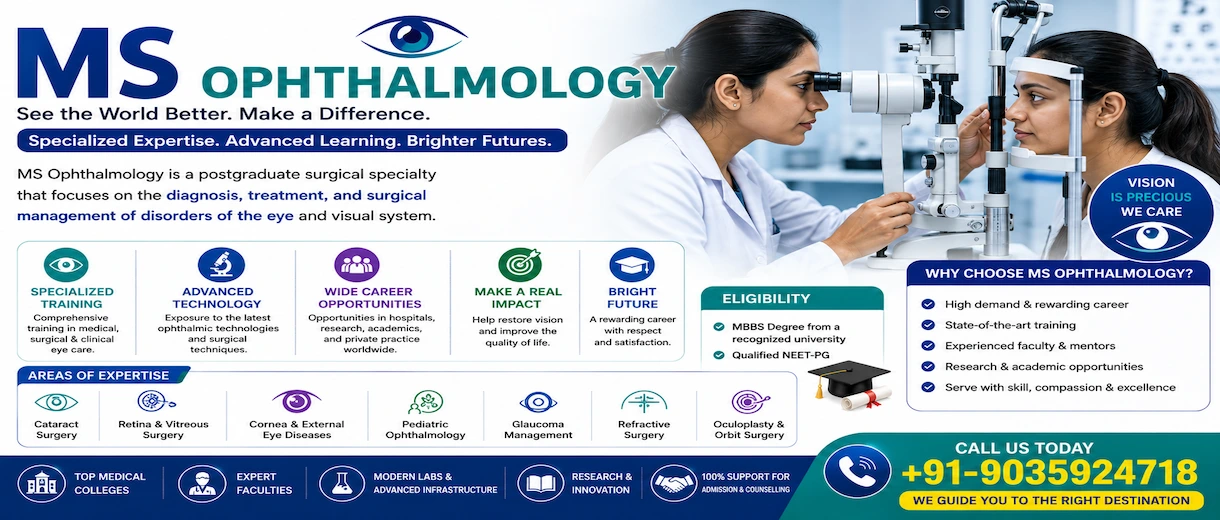
| In this article, you will find MS Ophthalmology Admission process and Course Information Details – State wise Seats matrix in Government/ Private institutions, Colleges Ranking, Tuition Fees, NEET PG closing score cut off. |
MS Ophthalmology is a postgraduate degree that focuses on eye care, vision disorders, and surgical treatments. The course equips doctors to handle procedures like cataract surgery, LASIK, corneal and retinal operations. It is a three-year program that blends theory, clinical practice, and research for comprehensive training.
For MS Ophthalmology admission, candidates must hold an MBBS degree with at least 50% marks from an NMC-recognized university and qualify for the relevant entrance exam. Leading medical institutions like GMC Chandigarh, VMMC & Safdarjung Hospital, PGIMER Delhi, Seth GSMC Mumbai, UCMS Delhi, IMS BHU, GMC Kozhikode, NRCH Delhi, HIMS Hassan, GMC Mumbai, GMC Thrissur, IGMC Shimla, KGMU Lucknow, PGIMS Rohtak are currently accepting applications for this program. If you aspire to pursue a career in Ophthalmology, now is the time to apply.
To get admission, applicants must clear the NEET PG exam conducted by the National Board of Education (NBE) or Autonomous INI CET Exam, conducted by the All India Institute of Medical Sciences, Delhi. The MS Ophthalmology course is a three-year postgraduate program offered in both public and private medical colleges. The Best MS Ophthalmology Medical Colleges in India’s are GMC Chandigarh, VMMC & Safdarjung Hospital, PGIMER Delhi, Seth GSMC Mumbai, UCMS Delhi, IMS BHU, GMC Kozhikode, NRCH Delhi, HIMS Hassan, GMC Mumbai, GMC Thrissur, IGMC Shimla, KGMU Lucknow, PGIMS Rohtak etc
The demand for MS Ophthalmology is high due to the aging population, increasing cases of joint disorders, fractures, and sports injuries. Rising trauma from accidents, lifestyle-related issues like back pain, and the growing need for joint replacement surgeries also contribute, ensuring a strong demand for orthopaedic specialists worldwide. This article provides information about admission, eligibility criteria, and career opportunities. Interested candidates can inquire or seek admission guidance through our website.
MS Ophthalmology Course 2026 Quick Summary
| Name of the course | Master of Surgery in Ophthalmology |
|---|---|
| Generally Known as | MS Ophthalmology |
| Course Level | Post Graduate |
| Duration | 3 years, full time |
| Stream | Medicine/Surgery |
| Examination Type | Semester/Yearly System |
| Eligibility | MBBS degree recognized by the National Medical Commission (NMC) |
| Admission Process | Based on the results of the entrance examination (NEET) or personal interview in some cases |
| Number of Ophthalmology Colleges | Govt. – 146 Prvt – 168 |
| Number of Ophthalmology Seats | Govt – 1044 Pvt – 888 |
| Entrance Exam | NEET PG, INI CET (AIIMS PG, PGIMER, JIPMER PG) |
| Average Course Tuition Fee | GOVT. Quota Fees – ₹ 1150/Year – ₹ 8500000/Year MNGT Quota Fees – ₹ 181910/Year – ₹ 7728000/Year NRI Quota Fees – $ 26317/Year -₹ 9660000/Year |
| Average Starting Salary | INR 3 to 12 Lakhs/Year |
| Top Recruiting Companies | Fortis Healthcare, MAX Healthcare, Care Hospitals, Indian Council of Medical Research, Apollo Hospitals, Kailash Hospital, Adecco India Private Limited, Jaypee Healthcare Limited, Meditrina Hospitals Private Limited, etc. |
Why Choose MS Ophthalmology?
Ophthalmology is a three-year postgraduate course. Candidates wanting to pursue MD/MS in Ophthalmology must complete their MBBS and appear for NEET PG as well. The ophthalmology course prepares candidates to study, diagnose, prevent, and treat diseases pertaining to the eye and the visual system as a whole.
- Micro-surgeries: Learn delicate procedures like cataract removal (phacoemulsification), glaucoma corrections, and corneal grafts.
- Laser technology: Gain hands-on practice with modern laser and diagnostic tools (like OCT).
- Immediate results: Eye surgeries often offer quick, life-changing vision restoration.
- Fewer emergencies: Unlike general surgery or emergency medicine, true life-threatening eye emergencies are rare.
- Better routine: Most practices run on scheduled outpatient clinics and planned elective operations.
- Controlled hours: Emergency night calls are less frequent compared to other surgical branches.
- Aging population: Older adults face higher rates of age-related vision issues like cataracts and macular degeneration.
- Screen fatigue: Heavy digital device use drives up daily vision complaints and dry eye cases.
- Job openings: Strong demand exists across private eye clinics, corporate hospitals, and government health sectors.
- Private practice: Easy to set up an independent eye clinic or optical store tie-in.
- Sub-specialties: Broad scope to fellowship further into retina, cornea, pediatric eye care, or oculoplastics.
- Technology-driven: A fast-evolving field with constant innovations in lens implants and laser vision correction.
MS Ophthalmology Course Objectives
The MS Ophthalmology course has well-defined objectives aimed at equipping students with the necessary knowledge and skills to diagnose, prevent and treat diseases pertaining to the eye and the visual system as a whole.. Here are the key course objectives:
- Develop Clinical Expertise: To provide advanced training in diagnosing and treating eye diseases, vision problems, and ocular injuries.
- Master Surgical Techniques: To equip students with the skills to perform various ophthalmic surgeries, including cataract removal, glaucoma treatment, and corneal transplants.
- Enhance Patient Care: To foster the ability to deliver comprehensive eye care, from routine checkups to the management of complex conditions.
- Promote Preventive Eye Care: To emphasize the importance of early detection, prevention, and management of vision-threatening conditions.
- Encourage Research: To inspire students to engage in research, innovation, and the advancement of treatment methodologies in ophthalmology.
- Cultivate Ethical Practice: To instill a strong sense of ethics, professionalism, and patient-centered care in ophthalmology.
- Prepare for Leadership: To train future leaders in ophthalmology, preparing them for roles in clinical practice, academia, and community health initiatives.
MS Ophthalmology Course Duration
MS Ophthalmology Course Duration typically follows these key points:
- Total Duration: The MS Ophthalmology course spans 3 years.
- Academic Training: Involves in-depth theoretical study of ophthalmology, covering various eye diseases, disorders, and treatments.
- Clinical Training: Includes hands-on patient care, diagnosis, and management of eye conditions in clinical settings.
- Surgical Training: Focuses on developing surgical skills for procedures such as cataract surgery, glaucoma treatment, and other eye surgeries.
- Examinations: Periodic assessments, practical exams, and final evaluations throughout the 3-year program.
The duration of the course is 2 years for those who have completed a recognized postgraduate diploma in the same specialty.
MS Ophthalmology Admission Eligibility Criteria
MS Ophthalmology Admission Eligibility Criteria typically includes the following key points:
- Educational Qualification: Must have an MBBS degree from a recognized medical institution.
- Internship Completion: Completion of a 1-year mandatory rotating internship by the time of admission.
- Medical Registration: Registered with the Medical Council of India (MCI) or a State Medical Council (SMC).
- Entrance Exam: Must qualify for the NEET-PG OR INI CET entrance exam with the required cutoff score.
- Minimum Marks: Meet the minimum aggregate marks criteria in MBBS (often around 50% or above).
- Counseling: Participate in the counseling process based on NEET-PG ranking OR INI CET ranking for seat allocation.
- Category Reservation: Eligibility may vary slightly depending on reservation criteria (SC/ST/OBC/General).
MS Ophthalmology Admission Process
- Qualifying Exam: Candidates must appear for NEET PG/ AIIMS PG, PGIMER, JIPMER PG and score the required percentile to be eligible for counselling.
- Counselling: The counselling process for admission is conducted by the Medical Counselling Committee (MCC) for the All India Quota (AIQ) and by state authorities for state quota seats.
- Seats: Admissions are based on NEET PG rank, and the number of seats available in medical colleges under government, private, and deemed universities.
- Admission to MS in Ophthalmology is based on the candidate’s performance in the national level entrance examination National Eligibility Cum Entrance Test (NEET) PG, and INI CET entrance examination for AIIMS PG, PGIMER, JIPMER PG to MD/MS/PG diploma courses.
Entrance Exams
- NEET-PG: The National Board of Examinations (NBE) conducts NEET-PG annually for admission to various MD/MS courses, including Ophthalmology.
- INI CET: Some autonomous institutes like AIIMS, JIPMER, and PGIMER conduct separate entrance exams (INI CET) or counseling.
Counselling Process
- All India Quota (AIQ): 50% of the seats in government medical colleges are reserved under the All India Quota, and the counselling for these seats is conducted by the Medical Counselling Committee (MCC).
- State Quota: The remaining 50% of seats in government medical colleges, as well as seats in private and deemed universities, are filled through state-level counselling.
- Management Quota: Private medical colleges may also offer seats under the management quota, where admissions are based on NEET PG scores but with a different fee structure.
The NEET PG Counselling Process is an organized procedure for postgraduate medical admissions in India. Here’s a step-by-step guide:
1. Qualifying NEET PG Exam
- Candidates must first qualify for the NEET PG exam conducted by the National Board of Examinations (NBE). The exam is mandatory for admission into MD/MS/PG Diploma courses.
2. Registration for Counselling
- Qualified candidates need to register online for the counselling process.
- Registration is done through the official websites of either the Medical Counselling Committee (MCC) for All India Quota (AIQ) seats or the respective state counselling authorities for state quota seats.
3. Payment of Counselling Fee
- After registration, candidates must pay a non-refundable registration fee and a refundable security deposit, based on the seat category (AIQ, Deemed Universities, etc.).
4. Choice Filling and Locking
- Candidates must fill in their choices of courses and colleges.
- They can select multiple colleges and courses in order of preference.
- Once satisfied, the choices must be locked before the deadline. After locking, changes cannot be made.
5. Seat Allotment
- Based on the candidate’s NEET PG rank, category, and choices, the seat allotment process is conducted.
- The result of the allotment is announced online, and candidates can check which seat they’ve been allotted.
6. Reporting to the Allotted College
- Candidates who are allotted a seat must report to the respective college within the given time frame with the required documents.
- At this stage, candidates can choose to either accept the seat or opt for upgradation to a better-preferred seat in subsequent rounds.
7. Document Verification
- At the allotted college, candidates undergo document verification.
8. Free Exit / Upgradation
- After Round 1, candidates can either:
- Exit without penalty if they do not wish to continue with the allotted seat, or
- Upgrade by participating in Round 2 for better options.
9. Round 2 and Mop-Up Round
- If seats remain vacant after Round 1, Round 2 and Mop-Up rounds are conducted.
- In these rounds, candidates may upgrade or apply for leftover seats. The same process of choice filling, locking, and seat allotment is followed.
10. Final Admission
- Once satisfied with the allotted seat, candidates complete all formalities by paying the fees and joining the course.
This process ensures that candidates are allotted seats based on merit and their preferred colleges and courses.
Documents Required for MS Ophthalmology Admission
Here are the documents required for MS Ophthalmology admission:
- MBBS Degree Certificate: Proof of completing the MBBS course from a recognized institution.
- MBBS Mark Sheets: Mark sheets of all professional MBBS examinations.
- Internship Completion Certificate: Certificate confirming the completion of a one-year compulsory rotating internship.
- NEET-PG Scorecard: Proof of qualifying the NEET-PG exam with the required cutoff.
- Medical Registration Certificate: Registration with the Medical Council of India (MCI) or State Medical Council (SMC).
- Transfer Certificate (TC): Issued by the previous institution after completion of MBBS.
- Migration Certificate: For students coming from other universities.
- Category Certificate (if applicable): SC/ST/OBC/EWS certificate if applying under a reserved category.
- Date of Birth Proof: Birth certificate or 10th-grade mark sheet for age verification.
- Passport-sized Photographs: Recent passport-sized photographs (usually 4-6 copies).
- Photo ID Proof: Aadhaar card, passport, or any government-issued ID.
- Domicile Certificate (if applicable): Proof of residence if required by the institution.
These documents are typically required during the admission and counseling process for MS Orthopaedics.
MS Ophthalmology Course Syllabus
Key Subjects Covered:
- Anatomy and Physiology
- Ophthalmic Optics
- Ocular Examination Techniques and Ocular Therapeutics
- Diseases of the Eye
- Diseases of the Adnexa
- Surgical Instruments in Ophthalmology
Syllabus of Ophthalmology as prescribed by various Universities and Colleges.
| Semester I | Semester II |
| Basic Science in Ophthalmology | Lens and Glaucoma |
| Trauma and Emergency Ophthalmology | Uvea and Vitreoretinal Diseases |
| Semester III | Semester IV |
| Disorders Of The Lids, Lacrimal Drainage Apparatus, Orbit and Oculoplastic | Debridement of Open Fractures |
| External Eye Disease, Sclera, Cornea | Internal Fixation of Minor Fractures with K-Wires |
| Optics and Refraction | Skull Tongs Application |
MS Ophthalmology Career Opportunities
In this section, we provided the career opportunities after MS Ophthalmology course in India; let’s look.
- Ophthalmologist in Hospitals: Work as a specialist in public or private hospitals, treating eye diseases and performing surgeries.
- Private Practice: Establish a private clinic offering comprehensive eye care services, including routine check-ups and surgeries.
- Eye Care Centers: Join specialized eye hospitals or vision centers focused on eye health and surgery.
- Academic Roles: Become a professor or lecturer in medical colleges, teaching and training future ophthalmologists.
- Research: Engage in clinical research to develop new treatments and technologies in ophthalmology.
- Consultancy: Provide specialized consultancy services to healthcare institutions, government bodies, or international organizations.
- International Opportunities: Explore global roles in countries facing shortages of skilled ophthalmologists.
- Public Health Programs: Work with NGOs or government programs focused on preventing blindness and promoting eye health.
Super-Specialization after MS Ophthalmology
After completing MS Ophthalmology, doctors can pursue further super-specialization in specific areas of eye care. Some prominent options include:
- Cornea and Refractive Surgery: Specializes in corneal disorders and refractive surgeries such as LASIK and corneal transplants.
- Glaucoma: Focuses on the diagnosis and treatment of glaucoma, including advanced surgical interventions.
- Retina and Vitreous Surgery: Deals with diseases of the retina and vitreous body, such as diabetic retinopathy and retinal detachment.
- Pediatric Ophthalmology: Specializes in eye disorders in children, including congenital conditions and developmental issues.
- Oculoplasty and Ocular Oncology: Focuses on reconstructive surgery of the eye and orbit, as well as the treatment of tumors affecting the eye.
- Neuro-Ophthalmology: Combines neurology and ophthalmology, addressing visual problems related to the nervous system.
- Uvea and Inflammatory Diseases: Specializes in uveitis and other inflammatory conditions affecting the eye.
These super-specializations allow ophthalmologists to develop advanced expertise in niche areas of eye care and surgery.
MS Ophthalmology Job Prospects and Salary
MS Ophthalmology Job Prospects
- Hospitals: Work as an ophthalmologist in public or private hospitals, providing comprehensive eye care and performing surgeries.
- Private Practice: Establish a private clinic specializing in eye examinations, treatments, and surgeries.
- Eye Care Centers: Join specialized eye hospitals or vision centers focusing on advanced eye care and surgical procedures.
- Academic Roles: Become a lecturer or professor in medical colleges, training future ophthalmologists.
- Research: Engage in clinical research in ophthalmology, contributing to advancements in treatments and technologies.
- Consultancy: Offer specialized consultancy services to healthcare organizations, NGOs, or government health programs.
- International Opportunities: Explore job prospects abroad in countries with a demand for skilled ophthalmologists.
MS Ophthalmology Salary
- India:
- Entry-level: ₹8 to ₹15 lakhs per annum in hospitals.
- Experienced Ophthalmologists: ₹20 to ₹50 lakhs per annum, especially in private practice or specialized clinics.
- Abroad:
- Entry-level: $100,000 to $300,000+ per annum, depending on the country and healthcare setting.
The field offers attractive salaries and diverse opportunities for career growth, both in India and internationally. specialization, and reputation, ophthalmologists can see a significant increase in both job opportunities and salary growth. A branch of medicine and surgery, with excellent career prospects in both the public and private sectors.
MS Ophthalmology Cutoff 2025: Government, Private & Deemed Medical Colleges
Compare the MS Ophthalmology cutoff for Government Medical Colleges (AIQ 50% vs State Quota 50%), Private Medical Colleges (Open State & Non-Domicile Quota), and Deemed Universities (Management Quota) to choose the best college based on your NEET PG rank and score.
| State | AIQ (Govt) | State Quota (Govt) | Closing Rank 2025 (Private College – Open State Non-Domicile) |
|---|---|---|---|
| Andhra Pradesh | 24,375 | 32,694 | 1,28,948 |
| Assam | 25,265 | 33,511 | — |
| Bihar | 19,913 | 16,812 | 1,17,638 |
| Chhattisgarh | 21,809 | 36,424 | 57,973 |
| Gujarat | 15,822 | 14,031 | — |
| Himachal Pradesh | 9,297 | 8,399 | 1,02,587 |
| Haryana | 8,836 | — | 1,23,556 |
| Karnataka | 25,333 | 27,066 | 76,670 |
| Kerala | 17,310 | 20,070 | — |
| Madhya Pradesh | 21,232 | 28,943 | — |
| Maharashtra | 21,353 | 58,613 | — |
| Odisha | 12,539 | 11,666 | — |
| Pondicherry | — | 22,780 | 1,51,021 |
| Punjab | 13,030 | 23,230 | 23,804 |
| Rajasthan | 14,807 | — | 2,05,188 |
| Tamil Nadu | 24,658 | 27,726 | 1,61,759 |
| Telangana | 21,434 | 24,659 | 1,26,722 |
| Uttar Pradesh | 19,396 | 26,477 | 1,42,366 |
| Uttarakhand | 22,299 | 40,711 | 99,139 |
| West Bengal | 21,282 | 24,135 | 1,27,998 |
Deemed University MS Ophthalmology Cutoff Management Quota
| Institute | CR 2025 |
|---|---|
| Kasturba Medical College, Manipal | 33,859 |
| Kasturba Medical College, Mangalore | 34,954 |
| Amrita School of Medicine, Kochi | 38,489 |
| SRMC & RI, Chennai | 47,523 |
| Symbiosis Medical College for Women, Pune | 49,131 |
| JSS Medical College, Mysore | 51,382 |
| Kalinga Institute of Medical Sciences, Bhubaneswar | 51,916 |
| BVDU Pune | 54,960 |
| JN Medical College, Belgaum | 55,493 |
| Shri BM Patil Medical College, Vijayapura | 58,604 |
| DY Patil Medical College, Kolhapur | 59,376 |
| IMS & SUM, Bhubaneswar | 59,440 |
| Amrita School of Medicine, Faridabad | 59,547 |
| K.S. Hegde Medical College, Mangalore | 60,110 |
| Rural Medical College, LONI | 65,717 |
| Hamdard Institute, Delhi | 67,133 |
| BVDU Sangli | 69,978 |
| GITAM Institute of Medical Sciences, Vizag | 70,481 |
| SBKS Medical College, Vadodara | 71,313 |
| MGM Medical College, Aurangabad | 72,096 |
| SRM Medical College, Kancheepuram | 78,710 |
| Chettinad Hospital & Research Institute, Kanchipuram | 82,648 |
| MGM Medical College, Navi Mumbai | 83,082 |
| Krishna Institute of Medical Sciences, Karad | 89,477 |
| Rajeshwari Medical College, Bangalore | 92,265 |
| Saveetha Medical College, Kanchipuram | 92,814 |
| Malla Reddy Institute of Medical Sciences, Hyderabad | 94,716 |
| Vinayaka Missions Medical College, Salem | 94,951 |
| MM Institute of Medical Sciences, Mullana Ambala | 95,114 |
| ACS Medical College, Chennai | 95,593 |
| Yenepoya Medical College, Mangalore | 95,732 |
| Malla Reddy Medical College (Women), Hyderabad | 95,899 |
| Santosh Medical College, Ghaziabad | 98,449 |
| SDU Medical College, Kolar | 1,01,865 |
| Sree Balaji Medical College, Chennai | 1,06,135 |
| Vinayaka Missions Medical College, Karaikal | 1,07,515 |
| MGMC & RI, Pondicherry | 1,07,536 |
| DY Patil Medical College, Navi Mumbai | 1,07,653 |
| Aarupadai Veedu Medical College, Pondicherry | 1,09,262 |
| DY Patil Medical College, Pimpri Pune | 1,10,424 |
| Datta Meghe Medical College, Nagpur | 1,11,597 |
| JN Medical College, Meghe Wardha | 1,15,316 |
| Sri Lalithambigai Medical College, Chennai | 1,16,684 |
| Meenakshi Medical College, Enathur | 1,18,948 |
| Vels Medical College, Tiruvallur | 1,19,004 |
| Shri Satya Sai Medical College, Kancheepuram | 1,24,515 |
| Bhaarat Medical College, Chennai | 1,29,543 |
| SLIMS, Pondicherry | 1,44,389 |
| Sri Siddhartha Institute of Medical Sciences, T. Begur | 1,46,603 |
| Siddhartha Medical College, Tumkur | 1,51,622 |
Quota Wise MS Ophthalmology 2025 Closing Score Cut off
| Quota | Description | Opening NEET PG 2025 Score | Closing NEET PG 2025 Score |
|---|---|---|---|
| AIQ | All India Counselling | 99 | 671 |
| AMU | Aligarh Muslim University Counselling | 438 | 575 |
| BHQ | Banaras Hindu University PG Counselling | 417 | 546 |
| DUQ | Delhi University – Internal Counselling | 485 | 580 |
| IPQ | Indraprastha University Counselling | 400 | 577 |
| MNQ | Deemed Universities Counselling | 205 | 483 |
| MQ | Management Counselling | 15 | 554 |
| NRI | Non Resident Indian (NRI) Counselling | 50 | 434 |
| OPMQ | Open Management Counselling | 90 | 565 |
| OPQ | Central Universities Counselling | 186 | 538 |
| SQ | State Counselling | 71 | 618 |
All India Category Wise MS Ophthalmology Cut off
The NEET PG 2025 closing cutoff scores for Round-1 MCC Counselling are provided below for all reservation categories. The final column indicates the total number of MS Ophthalmology seats allotted during the 2025 AIQ counselling.
| Category | 2025 Cut off Score | Allotted Seats |
|---|---|---|
| GN | 628 | 191 |
| EWS | 618 | 45 |
| ST | 536 | 43 |
| OBC | 598 | 140 |
| GN-PH | 344 | 2 |
| SC | 557 | 75 |
Top Ranked MS Ophthalmology Colleges in India
| S. No. | Institute | City / State | Type | MS Ophthalmology Intake | Fees |
|---|---|---|---|---|---|
| 1 | Maulana Azad Medical College | New Delhi, Delhi | Govt-State | 17 | ₹51,300 (Total) |
| 2 | Govt Medical College Chandigarh | Chandigarh | Govt-State | 5 | ₹1.05 Lakhs (Total) |
| 3 | VMMC And Safdarjung Hospital | South Delhi, Delhi | Govt-State | 7 | ₹1.53 Lakhs (Total) |
| 4 | PGIMER Delhi | New Delhi, Delhi | Govt-State | — | ₹19.50 Lakhs (Total) |
| 5 | Seth GS Medical College | Mumbai, Maharashtra | Govt-State | 5 | ₹1.63 Lakhs (Total) |
| 6 | University College of Medical Sciences | North East Delhi, Delhi | Govt-State | 5 | ₹1.63 Lakhs (Total) |
| 7 | Institute of Medical Sciences BHU | Varanasi, Uttar Pradesh | Govt-Deemed | 7 | ₹48,000 (Total) |
| 8 | Govt Medical College Kozhikkode | Kozhikode, Kerala | Govt-State | — | ₹2.08 Lakhs (Total) |
| 9 | Northern Railway Central Hospital Delhi | Central Delhi, Delhi | Govt-DNB | 4 | ₹2.25 Lakhs (Total) |
| 10 | Hassan Institute of Medical Sciences | Hassan, Karnataka | Govt-State | 3 | ₹3.42 Lakhs (Total) |
| 11 | Grant Medical College Mumbai | Mumbai, Maharashtra | Govt-State | 18 | ₹4.68 Lakhs (Total) |
| 12 | Govt Medical College Thrissur | Thrissur, Kerala | Govt-State | 7 | ₹1.74 Lakhs (Total) |
| 13 | Indira Gandhi Medical College Shimla | Shimla, Himachal Pradesh | Govt-State | 4 | ₹72,000 (Total) |
| 14 | King George Medical University | Lucknow, Uttar Pradesh | Govt-State | — | ₹1.61 – ₹1.64 Lakhs (Total) |
| 15 | Pt BD Sharma PGIMS | Rohtak, Haryana | Govt-State | 10 | ₹4.50 Lakhs (Total) |
Statewise MS Ophthalmology Seats
| SL. No. | State | Total Colleges | Total Seats |
|---|---|---|---|
| 1 | Maharashtra | 60 | 296 |
| 2 | Karnataka | 59 | 339 |
| 3 | Tamil Nadu | 49 | 246 |
| 4 | Uttar Pradesh | 49 | 245 |
| 5 | Andhra Pradesh | 30 | 167 |
| 6 | Telangana | 28 | 159 |
| 7 | Gujarat | 22 | 150 |
| 8 | Delhi | 9 | 164 |
| 9 | Rajasthan | 18 | 124 |
| 10 | Madhya Pradesh | 20 | 117 |
| 11 | West Bengal | 21 | 101 |
| 12 | Kerala | 24 | 91 |
| 13 | Bihar | 16 | 71 |
| 14 | Uttarakhand | 8 | 62 |
| 15 | Odisha | 9 | 55 |
| 16 | Haryana | 12 | 46 |
| 17 | Puducherry | 9 | 46 |
| 18 | Chhattisgarh | 11 | 41 |
| 19 | Punjab | 9 | 34 |
| 20 | Jammu & Kashmir | 4 | 32 |
| 21 | Assam | 5 | 30 |
| 22 | Chandigarh | 2 | 18 |
| 23 | Jharkhand | 2 | 11 |
| 24 | Himachal Pradesh | 3 | 10 |
| 25 | Manipur | 2 | 9 |
| 26 | Tripura | 2 | 5 |
| 27 | Goa | 1 | 5 |
| 28 | Dadra Nagar Haveli | 1 | 3 |
| 29 | Meghalaya | 1 | 2 |
| 30 | Andaman & Nicobar | 1 | 1 |
| Total | 516 | 2,777 |
Conclusion
In conclusion, MS Ophthalmology is a vital and rewarding postgraduate program that equips medical graduates with the skills and knowledge necessary to specialize in eye care. With a focus on diagnosing, treating, and managing various eye disorders, this program opens doors to a range of career opportunities in hospitals, private practice, research, and academia. The demand for skilled ophthalmologists is consistently high, and the potential for professional growth and financial rewards is significant. As advancements in technology and treatments continue to evolve, the field of ophthalmology remains an exciting and impactful area of medicine, dedicated to improving vision and enhancing the quality of life for patients.
Read More Articles
| MD TB & Chest | MS Orthopaedics | MD Radiology |
| MD Anaesthesiology | MD Psychiatry | MD Dermatology |
| MD General Medicine | MD/MS Obstetrics Gynaecology | MD Pediatrics |
| MS ENT | MS General Surgery |
MS Ophthalmology Admission 2026 – FAQs
Q. What is MS Ophthalmology?
A. MS Ophthalmology is a 3-year postgraduate medical course focused on the diagnosis, treatment, and surgical management of eye disorders, vision care, and ocular diseases.
Q. What is the eligibility criteria for admission?
A. Applicants must have an MBBS degree with at least 50% marks from an NMC-recognized university and must have completed a one-year internship.
Q. Which entrance exams are required?
A. Admission is through NEET PG (National Eligibility cum Entrance Test for Postgraduate) conducted by NBE, or INI-CET conducted by AIIMS for central institutes.
Q. What is the admission process for MS Ophthalmology?
A.
- Qualify NEET PG/INI-CET.
- Participate in counseling rounds (All India MCC or State-level).
- Select college preferences.
- Seats are allotted based on rank, merit, and availability.
Q. What are the career opportunities after MS Ophthalmology?
A. Graduates can work as Ophthalmologists in hospitals, eye care centers, or start private practice. They can also pursue fellowships in Retina, Cornea, Glaucoma, Pediatric Ophthalmology, or Oculoplasty for super-specialization.